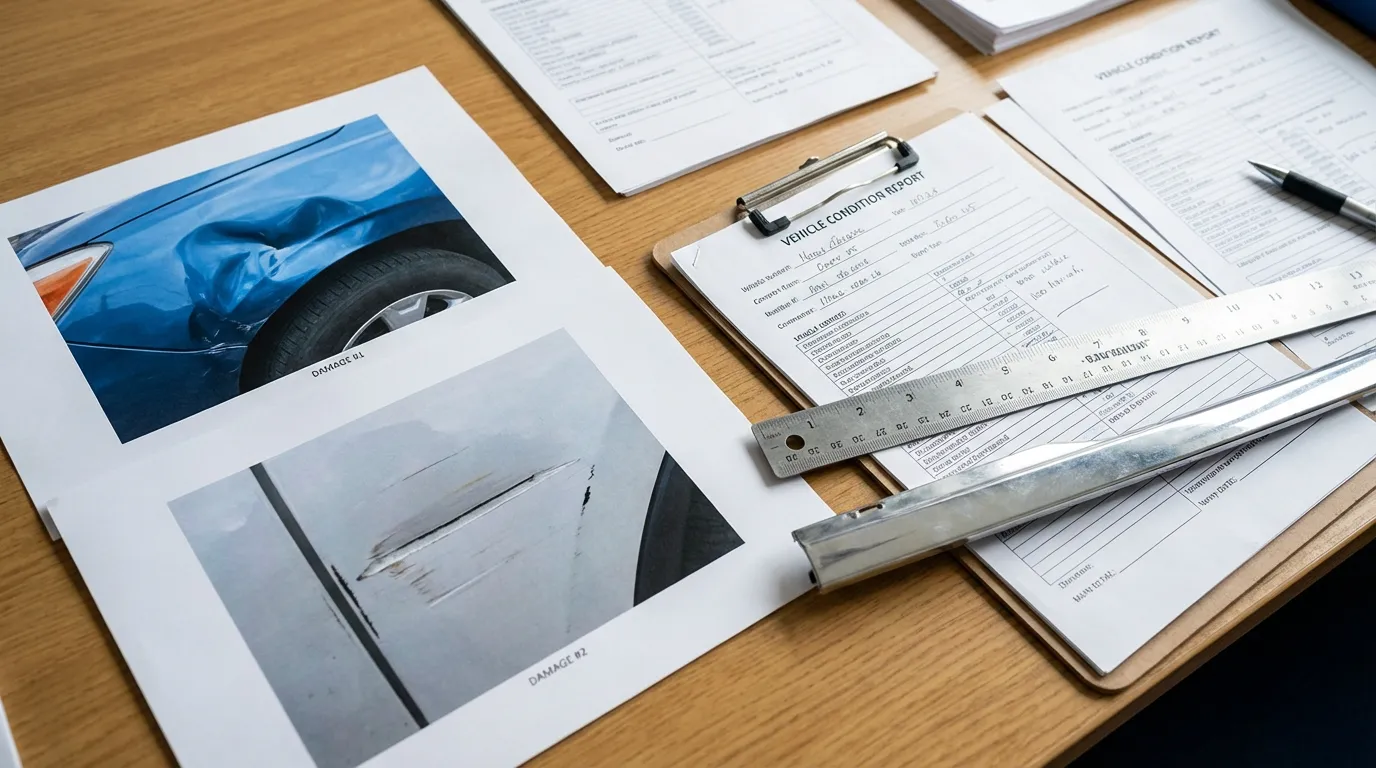
Why Evidence Quality Determines Arbitration Outcomes
Incomplete arbitration evidence — not weak claims — is the most common reason valid cases get denied at B2B vehicle auctions. Platforms enforce strict filing windows and separate evidence submission cutoffs. A legitimate claim for undisclosed frame damage or a hidden transmission fault fails if the supporting documentation arrives one day late or lacks the required detail.
This checklist covers 29 items across five categories: before purchase documentation, delivery inspection, defect evidence, communication records, and timeline tracking. Each checkbox saves to your browser, and the page is print-friendly for use at the inspection bay or office. For the full policy framework and filing procedures, see the Arbitration Claims Guide.
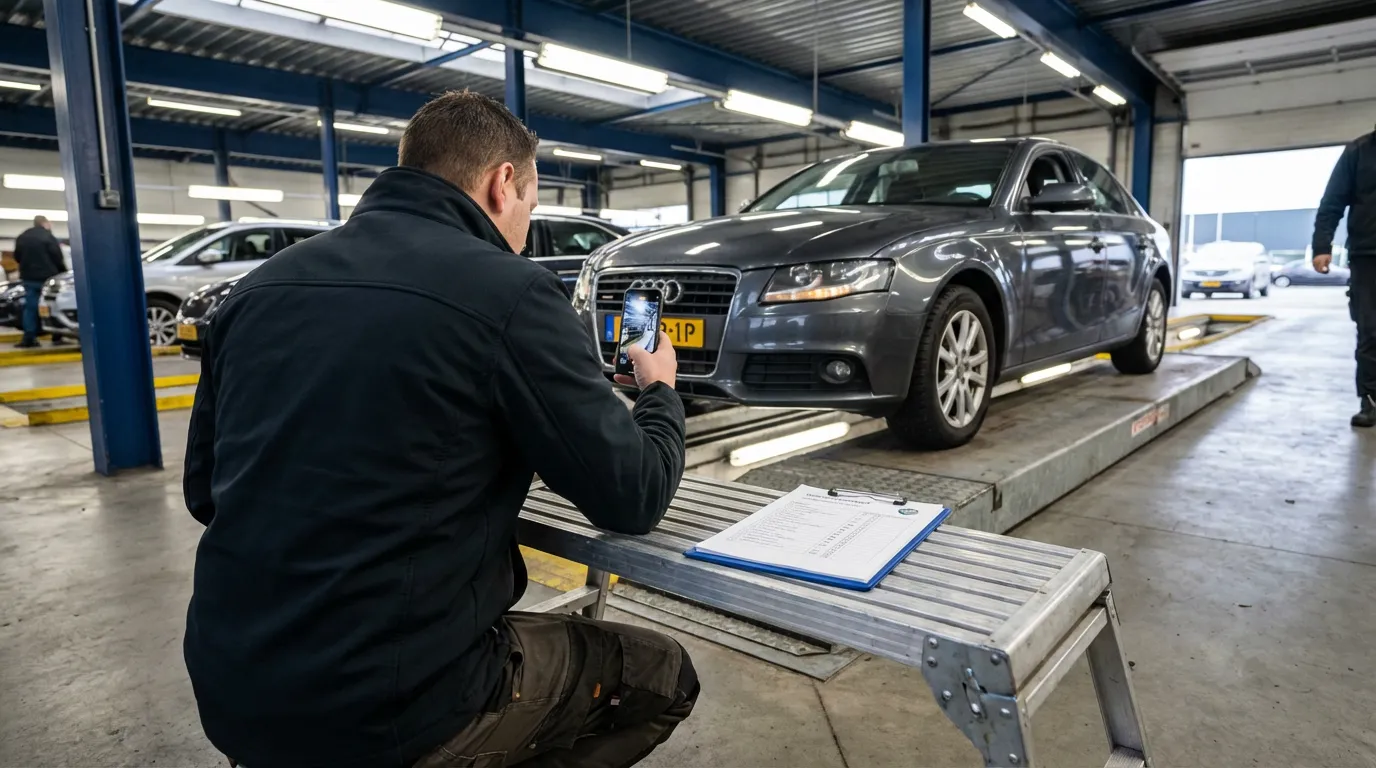 Evidence quality — not defect severity — determines arbitration outcomes at B2B vehicle auctions.
Platform Deadline Comparison
Deadlines are the single most critical constraint in any arbitration claim. Every major platform enforces a filing window measured in calendar or business days from purchase or delivery — and a separate, shorter evidence deadline within that window. Missing either deadline voids the claim regardless of defect severity.
| Platform | Filing Window | Evidence Deadline | Mileage Limit | Wholesale Labor Rate |
|---|---|---|---|---|
| Manheim | 10 calendar days (digital) | 5 cal. days per milestone | 200 miles | $95/hr ($115 CA) |
| ADESA / OPENLANE | 10 calendar days | 2 business days | 100 miles | NAAA standard |
| ACV Auctions | 10 calendar days | 2 calendar days | 150 miles | $90/hr (ICE); $100/hr (EV) |
| BCA (UK) | 48 hours or 500 miles | With initial claim | 500 miles | Platform-assessed |
Before Purchase
Start building your evidence package before you place a bid. The original listing, condition report, and condition grade form the baseline against which you prove a defect was undisclosed. Once the auction closes, sellers can modify listing details on some platforms. Manheim does not accept CarFax or AutoCheck reports as arbitration evidence — only its own condition reports and third-party inspections qualify.
Before Purchase — Baseline Documentation
0 of 6 completedUpon Delivery
The delivery moment opens the evidence clock. Most filing windows and mileage limits begin when the vehicle arrives at your location or when you take possession at the auction facility. Do not drive, move, or unload the vehicle before completing the initial inspection. Every mile added reduces the mileage budget available for your claim.
Upon Delivery — Immediate Inspection
0 of 6 completedEvidence of Issue
Build evidence that makes the arbitrator’s decision straightforward. The standard for a successful claim is proving that a material defect existed at the time of sale and was not disclosed in the listing or condition report. Photograph every defect from at least five angles. Obtain a third-party inspection from an ASE-certified facility within 24 hours of discovery. Do not repair the vehicle before the platform validates your claim — unauthorized repairs void arbitration rights on most platforms.
Evidence of Issue — Defect Documentation
0 of 7 completed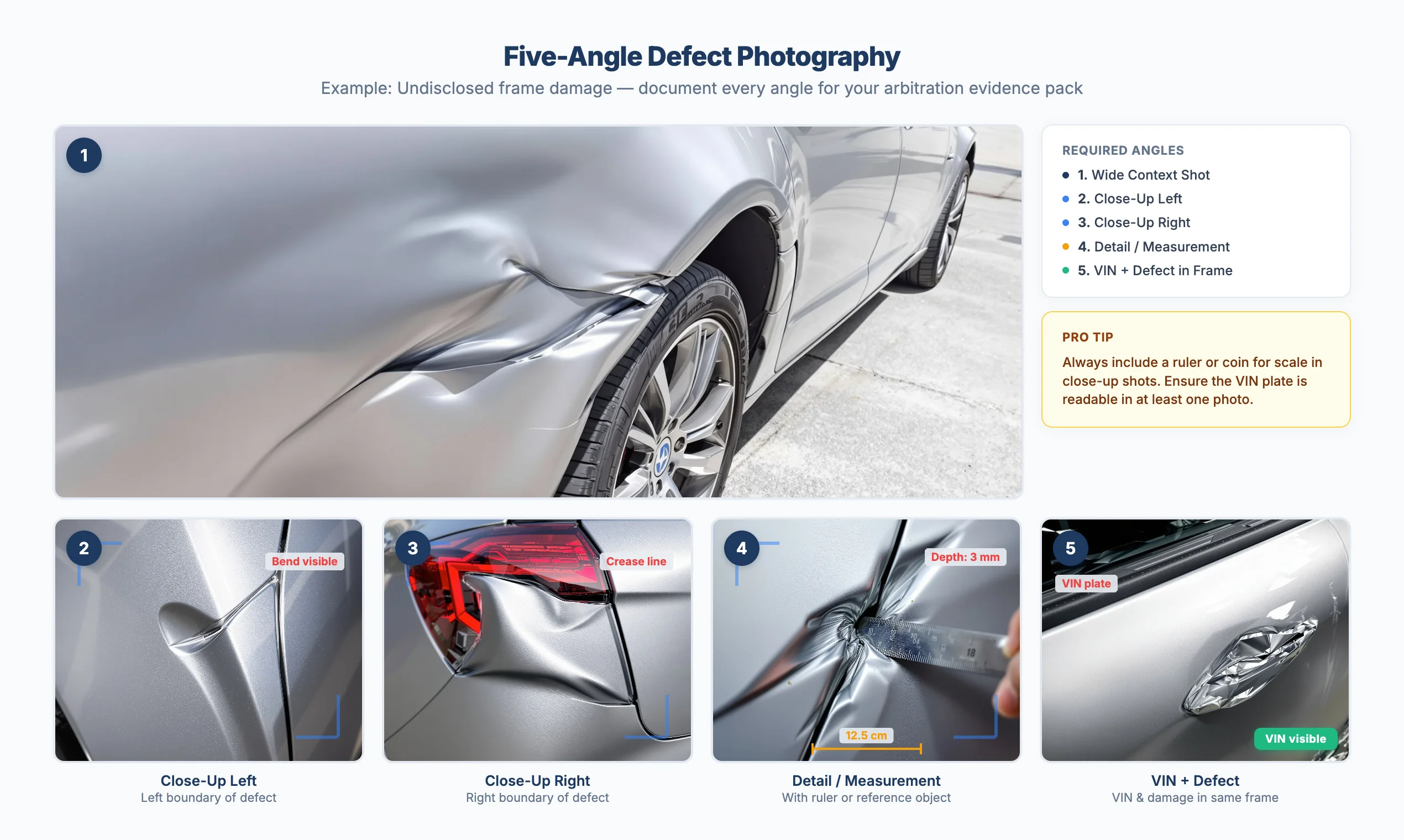 Photograph every defect from at least five angles — one wide shot for context and close-ups for detail, with the VIN plate visible in at least one frame.
Communication Records
Communication records establish that you followed the platform’s required process and timeline. Arbitrators review whether the buyer notified the platform promptly, used official channels, and provided specific defect descriptions. Vague complaints weaken claims. Precise, timestamped communications through the platform’s designated portal strengthen them.
Communication Records
0 of 5 completedTimeline Documentation
Arbitration is a compliance exercise. Platforms evaluate whether you met every procedural deadline before they assess the merits of your defect claim. A timeline gap — even one day — gives the platform grounds to deny an otherwise valid case. Track every date and timestamp from purchase through resolution with zero tolerance for missed deadlines.
Timeline Documentation
0 of 5 completedStrengthening Your Claim
Inspect within the first hour
Do not unload, drive, or move the vehicle. Photograph the odometer and VIN immediately at the delivery point. Every mile you add reduces your mileage budget and weakens your position.
Get the third-party inspection within 24 hours
Use an ASE-certified or manufacturer-certified facility. Proactive inspection reports carry the most weight with arbitrators — they demonstrate due diligence and provide objective, credentialed documentation of the defect.
File the claim before the deadline
Use the platform's official arbitration portal. Be specific in your defect description: 'Engine knocks' is weak. 'Rod knock at idle, not disclosed in condition report, third-party repair estimate $2,400' is strong.
Upload all evidence before the evidence deadline
Submit photos, video, condition report copy, third-party inspection report, repair estimate, and delivery receipt. Upload everything in a single batch if possible — supplemental uploads after the deadline may not be accepted.
Save your confirmation and reference number
Screenshot the claim confirmation page with its timestamp. Record the claim reference number in your timeline log. This is your proof of timely filing if the platform disputes your submission date.
Frequently Asked Questions
What evidence do platforms accept for arbitration claims?
Accepted evidence includes timestamped photos, video with audio, the original condition report, third-party inspection reports from certified facilities, itemized repair estimates, and communication records. Manheim does not accept CarFax or AutoCheck reports — only platform-issued condition reports and independent inspections qualify. Include the VIN plate in at least one photo frame per defect to confirm vehicle identity.
Can I still file a claim if I drove the vehicle before discovering the defect?
Yes, but mileage limits apply. ADESA enforces a 100-mile limit from delivery. ACV Auctions allows 150 miles. Manheim permits 200 miles. BCA (UK) allows 500 miles. If you exceed the mileage limit before filing, the platform can deny the claim regardless of defect severity. Log your odometer reading at delivery and again at the time of discovery.
What if the defect involves a wear item like brakes or tyres?
Wear items — brakes, tyres, wiper blades, and similar consumables — are excluded from NAAA arbitration. The $800 disclosure threshold applies only to non-wear mechanical defects. If the condition report states “brakes fair” and you find the pads are at 1mm, that is a wear-item issue and not arbitrable under standard NAAA policy. Structural damage, undisclosed salvage vehicle history, and odometer discrepancies remain arbitrable regardless of dollar amount.
How long does arbitration resolution typically take?
ACV Auctions resolves most claims within three to seven business days. Manheim and ADESA typically take five to 10 business days. BCA targets five business days for standard claims. The most common outcome is a price adjustment — a partial refund based on the documented repair cost — rather than a full vehicle return. Complex structural or title-brand cases may take longer if the platform requests additional evidence or an independent re-inspection.
Next Steps
This checklist gives you a repeatable process for assembling arbitration evidence before, during, and after every wholesale vehicle purchase. Apply it consistently — a single well-documented claim recovers thousands, while a poorly documented one recovers nothing.
For deeper guidance on arbitration strategy and related workflows, explore these resources:
- Arbitration Claims in Vehicle Auctions — full policy framework covering NAAA standards, platform-specific rules, and resolution outcomes
- How to File an Arbitration Claim — platform-specific filing procedures with step-by-step instructions
- Arbitration Claim Email Template — ready-to-use notification template with platform-compliant language
- Condition Report Verification Checklist — 35-item verification checklist to catch discrepancies before you bid