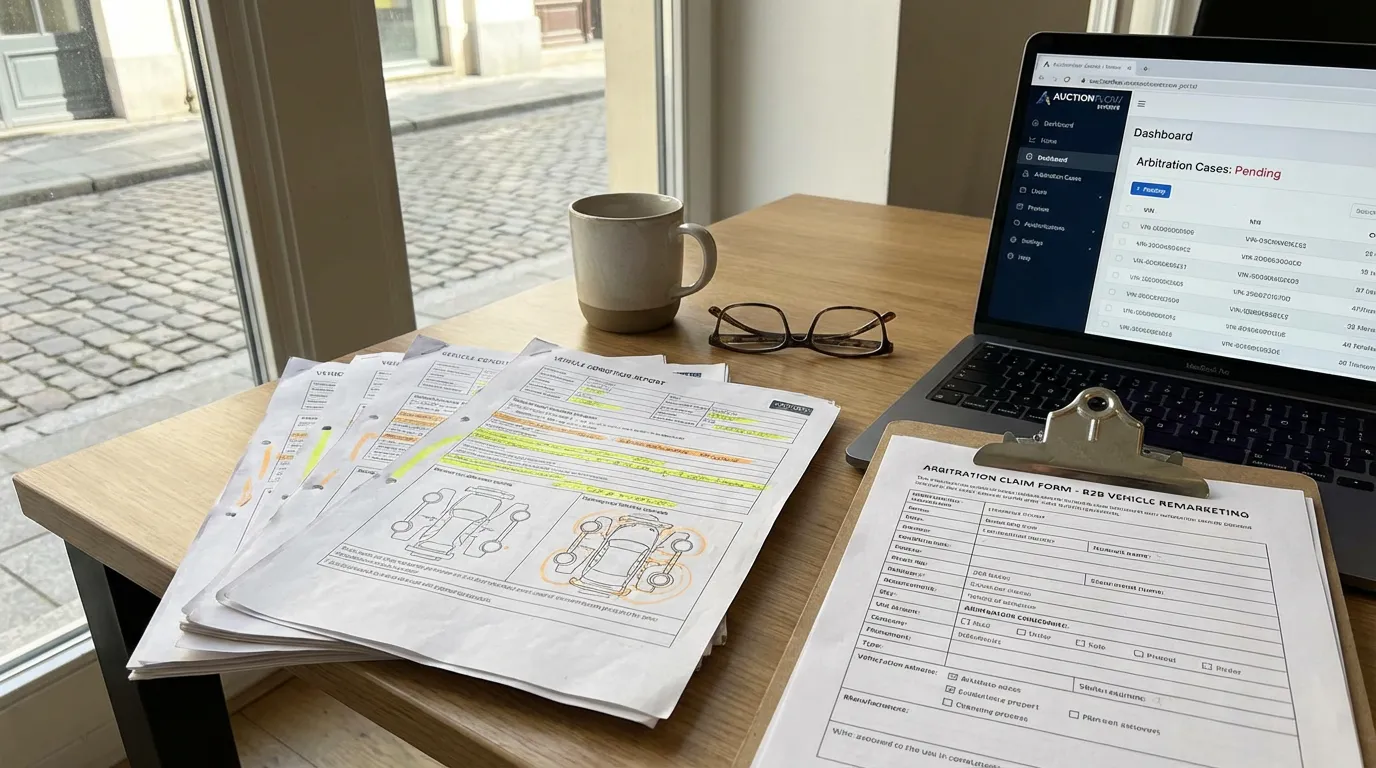
Why Arbitration Matters in B2B Auctions
A dealer wins a vehicle online, arranges transport, and discovers undisclosed frame damage three days later. The condition report said nothing about structural issues. Without arbitration, that dealer absorbs the full loss. With it, there is a structured path to resolution — no courtroom, no lawyer, and typically a decision within two weeks.
Approximately 3–5% of all B2B auction transactions result in arbitration claims. With NAAA members selling 7.6 million vehicles in 2024 at $105 billion in gross sales, that translates to hundreds of thousands of disputes annually. This guide walks through the full arbitration lifecycle for dealers, fleet operators, and remarketing professionals — from understanding eligibility and filing claims to gathering evidence and navigating platform-specific policies across Manheim, ADESA, ACV Auctions, BCA, and CarOnSale.
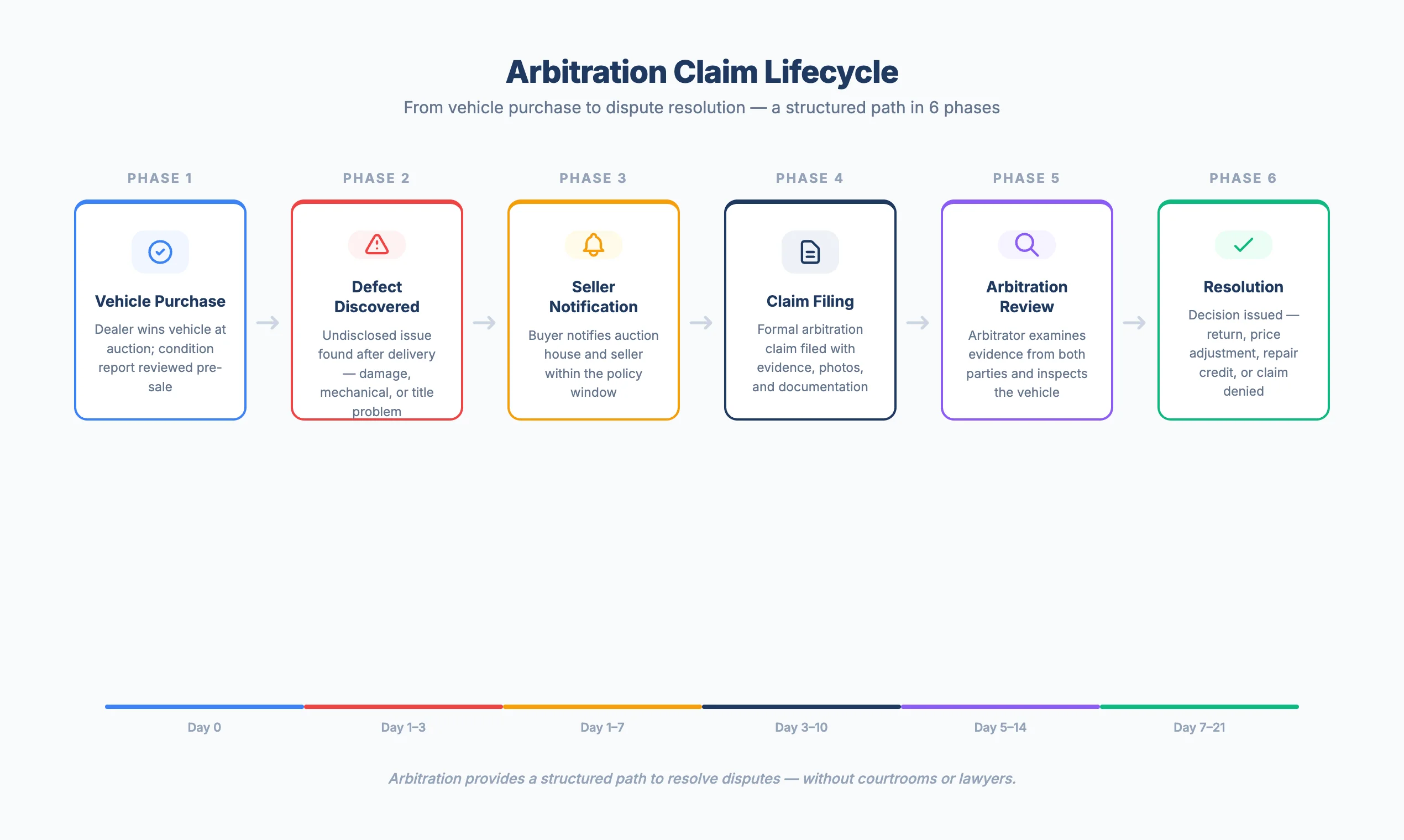 Arbitration provides a structured path to resolve disputes — without courtrooms or lawyers.
What Is Arbitration in Vehicle Auctions?
Arbitration in vehicle auctions is a binding dispute resolution process administered by the auction platform itself. When a buyer discovers a defect that was not disclosed in the condition report or seller announcements, they file a claim with the platform. A neutral arbitrator — employed by or contracted through the auction house — reviews the evidence and issues a final decision. The process is designed to be faster, cheaper, and more practical than litigation.
In North America, the National Auto Auction Association (NAAA) publishes the industry-standard arbitration policy, updated most recently on June 1, 2025. Most major platforms — Manheim, ADESA, and hundreds of independent NAAA-member auctions — adopt this policy as their baseline, with platform-specific addenda. European platforms operate without a centralized equivalent, meaning each platform defines its own claims framework.
The Sale Light System and Eligibility
The sale light designation on every vehicle determines the scope of arbitration rights. Not every vehicle carries the same protections:
- Green Light — Full arbitration rights under NAAA policy. Seller guarantees the vehicle is free of known defects above the $800 repair threshold.
- Yellow Light — Limited arbitration. Seller has announced specific conditions; only undisclosed defects are arbitrable.
- Red Light (As-Is) — Arbitration restricted to odometer discrepancies, salvage/flood history, frame damage, and title issues.
- Red-Yellow Light — No arbitration rights whatsoever. Buyer accepts all risk.
- Blue Light — Title not present at time of sale. Title-related arbitration rights preserved.
Common Grounds for Arbitration Claims
Arbitration claims fall into well-defined categories. Frame damage and title issues are the most frequent, accounting for roughly 20% and 15% of all claims respectively. Understanding these categories helps buyers know what qualifies — and sellers know what to disclose. For a detailed breakdown of each claim category — including success rates, evidence requirements, and filing windows — see Common Arbitration Claim Grounds.
| Claim Category | Approx. Frequency | Typical Filing Window | Eligible Sale Lights |
|---|---|---|---|
| Structural / frame damage | ~20% of claims | 10 calendar days (digital) | Green, Yellow, Red |
| Title issues (branded, salvage, undisclosed lien) | ~15% of claims | 10–30 calendar days | All lights including Red |
| Odometer discrepancy / rollback | ~12% of claims | 10 calendar days | All lights including Red |
| Undisclosed mechanical defects (>$800 repair) | ~12% of claims | 10 calendar days | Green, Yellow |
| Missing components (catalytic converter, keys) | ~10% of claims | 10 calendar days | Green, Yellow |
| VIN mismatch / cloned VIN | Rare but serious | 10 calendar days | All lights including Red |
| Cosmetic damage exceeding condition grade | ~8% of claims | Varies by platform | Green only |
The NAAA policy sets a $800 disclosure threshold for mechanical defects. Sellers must announce any single defect costing $800 or more to repair or replace. Failure to disclose triggers arbitration eligibility on Green and Yellow Light vehicles. Paintwork involving three or more adjacent panels (excluding bumpers) also requires disclosure.
Platform-Specific Arbitration Policies
While the NAAA policy provides a baseline in North America, each platform adds its own filing windows, fee structures, and process variations. European platforms operate under entirely different frameworks. The comparison below covers the five platforms most relevant to cross-border B2B buyers and sellers.
| Policy Detail | Manheim | ADESA / OPENLANE | ACV Auctions | BCA (UK) | CarOnSale (EU) |
|---|---|---|---|---|---|
| Filing Window (Digital) | 10 calendar days | 10 calendar days | 10 calendar days | 48 hours / 500 miles | Non-binding; varies |
| Evidence Deadline | 5 calendar days per milestone | 2 business days | 2 calendar days | With initial claim | With initial claim |
| Invalid Claim Fee | Not specified | $195 (buyer pays) | Not specified | Not specified | EUR 99 vendor penalty (seller pays if valid) |
| Policy Standard | NAAA + Manheim addenda | NAAA + ADESA addenda | NAAA-aligned + ACV policies | BCA Assured program | Platform-specific, non-binding |
| Mechanical Threshold | $800 (NAAA) | $800 (NAAA) | $800 (NAAA) | Material defect standard | No fixed threshold |
| Extended Protection | Ready+2 (transport delay) | Standard NAAA | Purchase Protection +10/+20 | Assured 40-point inspection | Mediation-based |
| Resolution Timeline | ~5–10 business days | ~5–10 business days | ~3–7 business days | ~5 business days | ~7–14 business days |
Manheim provides a 10 calendar day filing window for all digital transactions (Simulcast and OVE/Timed). Buyers using Ready Logistics transport who exceed the 10-day window receive two additional calendar days from the delivery date. ADESA/OPENLANE follows the same 10-day standard but charges $195 for invalid claims — a fee that discourages speculative filings. Compare fee structures including arbitration penalties with the Auction Fee Comparator. Title disputes at ADESA carry an extended 30-day window.
ACV Auctions offers the most flexible buyer protection. The standard 10-day window can be extended by purchasing Protection +10 or +20 at the time of sale. ACV’s GO GREEN program shifts arbitration costs from sellers to the platform when ACV performed the condition report. However, ACV caps payouts on vehicles $5,000 or under at 25% of the sale price and excludes catalytic converter claims on vehicles over 125,000 miles.
BCA in the UK operates a dramatically tighter window — 48 hours from vehicle collection or delivery, or 500 miles driven, whichever comes first. BCA Assured vehicles undergo a 40-point independent inspection, and claims are verified by BCA-dispatched inspectors. CarOnSale in Germany does not offer formal arbitration at all. Instead, it provides a non-binding complaints tool and charges vendors EUR 99 per validated complaint.
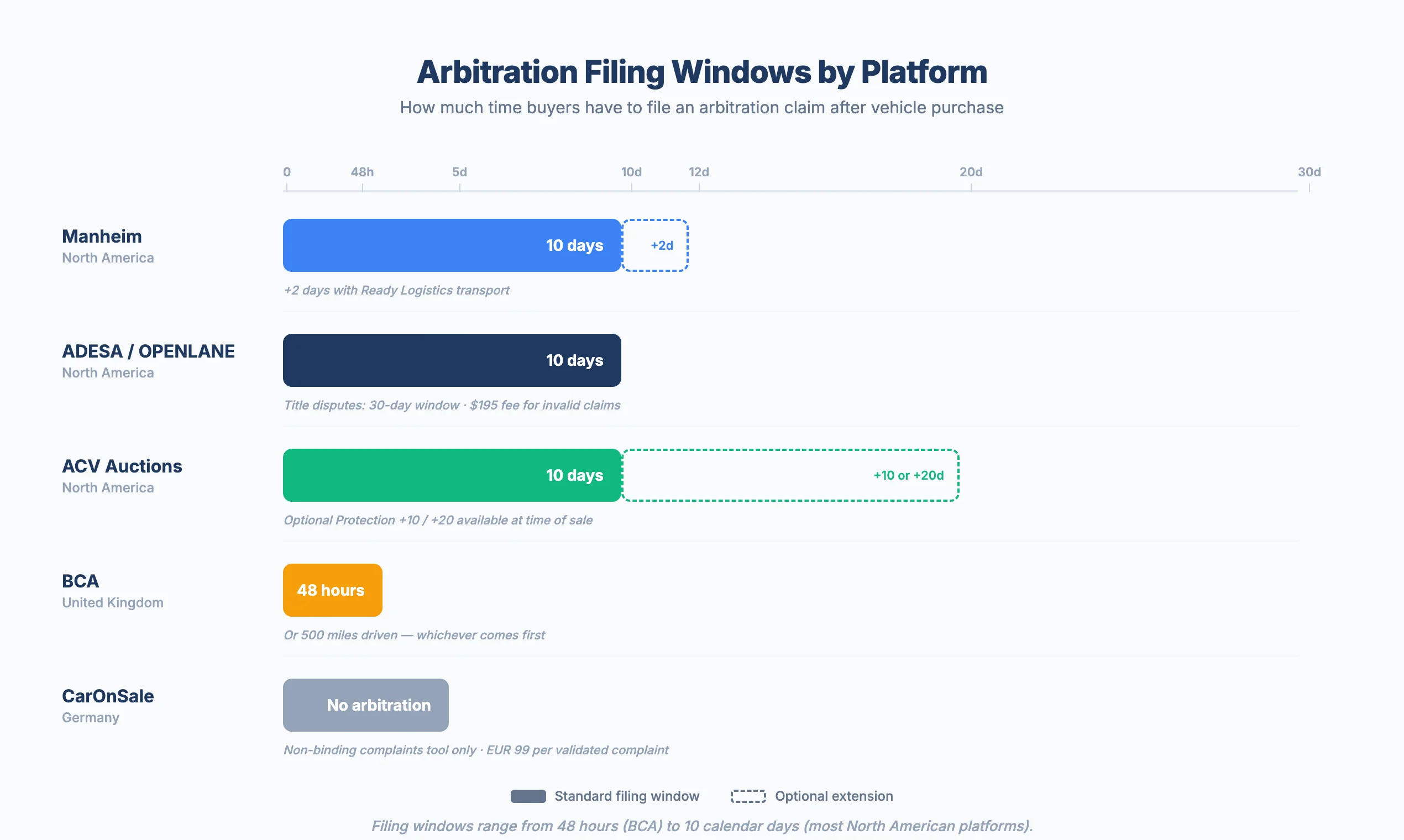 Filing windows range from 48 hours (BCA) to 10 calendar days (most North American platforms).
The Arbitration Process Step-by-Step
While each platform has nuances, the arbitration workflow follows a consistent five-step pattern. Understanding the process before you need it is critical — once a defect is discovered, the clock is already ticking.
Discover the defect
Inspect the vehicle immediately upon delivery or pickup. Compare the actual condition against the condition report. Document any discrepancy with dated photos, video, and written notes before moving or repairing the vehicle.
File the claim within the platform window
Open an arbitration case through the platform's official dispute channel — online portal, app, or phone. Include the vehicle stock number, sale date, claim category, and a brief description. Do not wait. The filing window starts from the sale date, not the discovery date.
Submit supporting evidence
Upload all required documentation within the evidence deadline (2–5 days depending on platform). This includes timestamped photos, third-party inspection reports, condition report screenshots, and any communication with the seller.
Platform reviews and arbitrates
The platform's arbitration team reviews the claim, the seller's response, and all evidence. They may request a third-party inspection at a designated facility. Both parties may be asked for additional documentation.
Resolution issued
The arbitrator issues a binding decision: full return and refund, price adjustment (most common), seller-funded repair, or claim denial. Approximately 90% of claims resolve within two weeks. Some platforms allow a one-time appeal within 48 hours of the decision.
Full sale cancellation is not the default outcome. ACV Auctions states that “payment for parts and labor expenses, at wholesale rates, associated with any arbitration claim” is the likely resolution rather than cancellation. Partial credits, diminished value adjustments, and seller-funded repairs at wholesale labor rates ($90/hour for gas engines, $100/hour for EVs at ACV) are the most common resolutions. For a detailed walkthrough of the filing mechanics — platform-specific portals, deadline comparisons, communication templates, and common mistakes — see How to File an Arbitration Claim.
Evidence Requirements and Best Practices
Evidence quality is the single biggest factor in arbitration outcomes. Weak claims with blurry photos get denied. Strong claims with timestamped, systematic documentation resolve quickly. Every major platform accepts photos, video, third-party inspection reports, condition report comparisons, and communication records.
Photographic evidence should include wide shots for context and close-ups for detail — minimum five angles per defect, with the VIN plate visible in at least one frame. Video walkarounds of 60 seconds or longer are particularly valuable for mechanical issues (engine knock, transmission slip) that photos cannot capture. Third-party inspection reports from ASE-certified or platform-approved facilities carry the most weight with arbitrators.
Arbitration Evidence Pack — Buyer Checklist
0 of 8 completedFor a comprehensive, step-by-step approach to assembling your evidence package, follow the Arbitration Evidence Pack Checklist. When you are ready to file, use the Arbitration Claim Email Template as a starting point for your initial claim submission.
Tips for Successful Arbitration Claims
Beyond following the process, experienced dealers use specific strategies to maximize their arbitration success rate. These six practices separate claims that get resolved from claims that get denied.
- Inspect within 24 hours of delivery. Do not wait until the filing window is nearly closed. The sooner you inspect, the more time you have to gather evidence and file.
- Document before you drive. If picking up in person, photograph and video the vehicle at the auction lot before loading. Record mileage at pickup — it is critical evidence, as ACV Auctions disqualifies claims if the odometer increases more than 150 miles from the listed reading.
- Know your platform’s exact deadlines. Bookmark or print the arbitration policy page for every platform you buy from. Calendar the filing and evidence deadlines for each purchase.
- Use the platform’s official channels. Filing by phone call or email outside the system may not create a valid claim. Always use the designated portal or app. Manheim recommends initiating claims online “to ensure the details of your claim are fully captured.”
- Get a third-party inspection early. Do not wait for the platform to request one. Proactive third-party reports carry significant weight with arbitrators and accelerate the review process.
- Be specific in your claim description. “Engine knocks” is weak. “Rod knock audible at idle, not disclosed in condition report, repair estimate $2,400 from ASE-certified shop” is strong. Attach the repair estimate.
Before bidding on any vehicle, use the Break-Even / Max Bid Calculator to factor potential arbitration costs — inspection fees, return transport, and holding time — into your maximum bid.
Preventing Arbitration Issues — Seller Perspective
Arbitration claims cost sellers money: return shipping, lost sale value, platform penalties (ADESA charges $195 per claim; CarOnSale charges vendors EUR 99 per validated complaint), and reputational damage. These costs compound on top of standard auction fees. Platforms track seller arbitration rates — ACV may remove high-claim-rate sellers from its GO GREEN protection program. Prevention through accurate disclosure is cheaper than resolution.
The NAAA $800 disclosure threshold means even moderate defects require announcement. Sellers who invest in professional condition reports before listing consistently face fewer claims. The 2025 NAAA policy update also allows auctions to repair or remediate an arbitrable defect in lieu of unwinding the sale — giving sellers an alternative to full buy-backs.
Seller Pre-Sale Disclosure Checklist
0 of 8 completedBefore listing, verify condition reports against the vehicle with the Condition Report Verification Checklist to catch discrepancies that could trigger buyer claims.
Frequently Asked Questions
Can I file an arbitration claim on an As-Is vehicle?
Yes, but only for specific issues. Even Red Light (As-Is) vehicles are eligible for arbitration claims involving title problems (branded, salvage, or undisclosed liens), odometer discrepancies, frame damage, and VIN issues. Mechanical and cosmetic defects are generally excluded on As-Is sales. Only Red-Yellow Light vehicles are sold with zero arbitration rights.
What happens if I miss the filing deadline?
Your claim will almost certainly be denied. Platforms enforce filing windows strictly — there is no grace period. On BCA in the UK, the 48-hour window is especially tight. Set calendar reminders for every vehicle you purchase and inspect immediately upon delivery.
Will I always get a full refund if my claim is approved?
No. Full return and refund is one possible outcome, but price adjustments and partial credits are more common. The arbitrator may order the seller to pay for specific repairs at wholesale labor rates. The resolution depends on the severity of the undisclosed defect and the platform’s policy framework.
Can I repair the vehicle and then file a claim?
No. Repairing or altering the vehicle before the arbitration process completes will almost always result in a denied claim. Platforms require the vehicle to remain in the condition it was in at delivery so that inspections can verify the defect. ACV Auctions explicitly states that pre-repair costs are not covered.
Do arbitration outcomes affect my seller rating?
On most platforms, yes. Repeated successful claims against a seller can lower their reputation score, affect their fee structure, and in extreme cases lead to suspension. ACV tracks arbitration history and may remove sellers from its GO GREEN program if their claim rate exceeds the platform average.
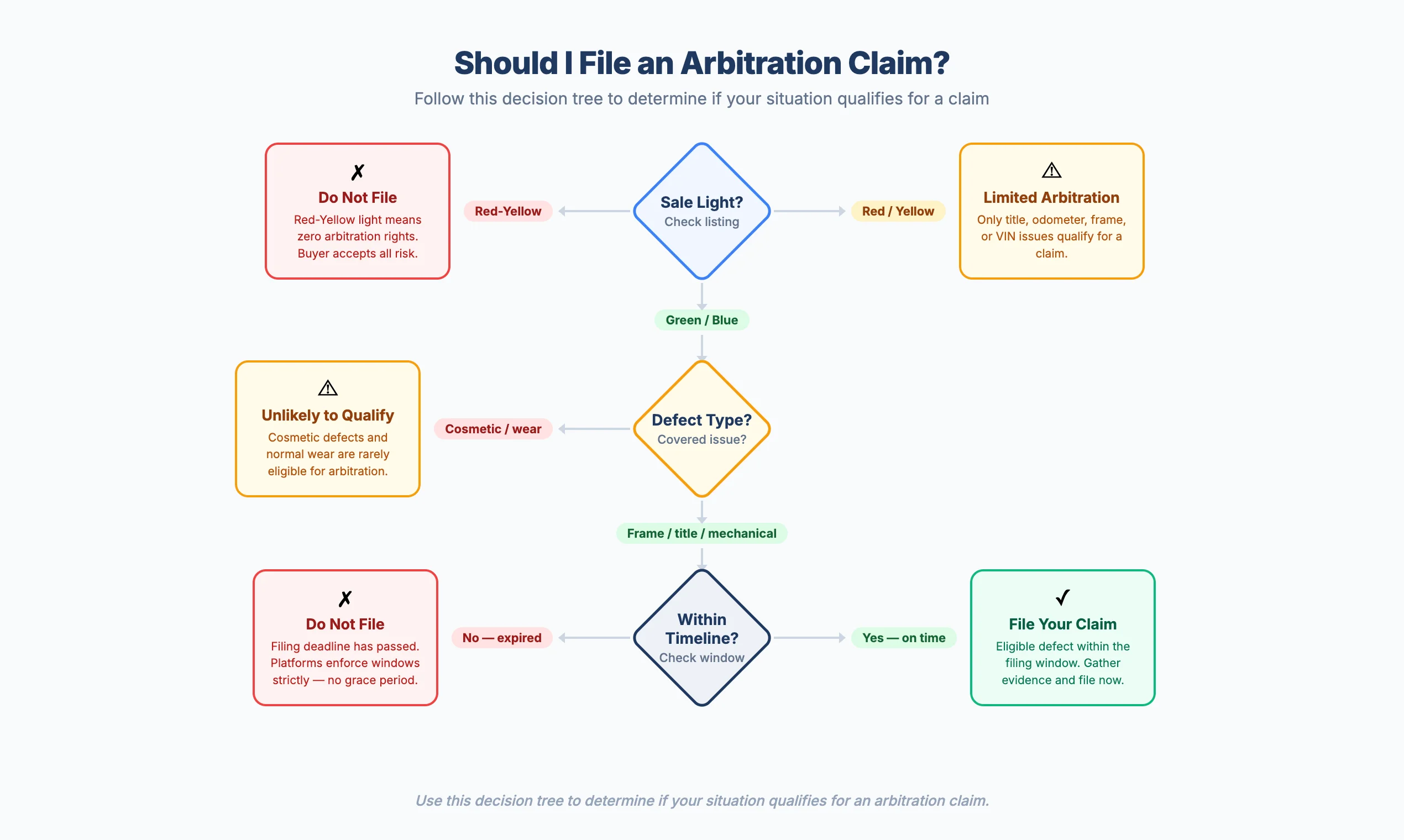 Use this decision tree to determine if your situation qualifies for an arbitration claim.