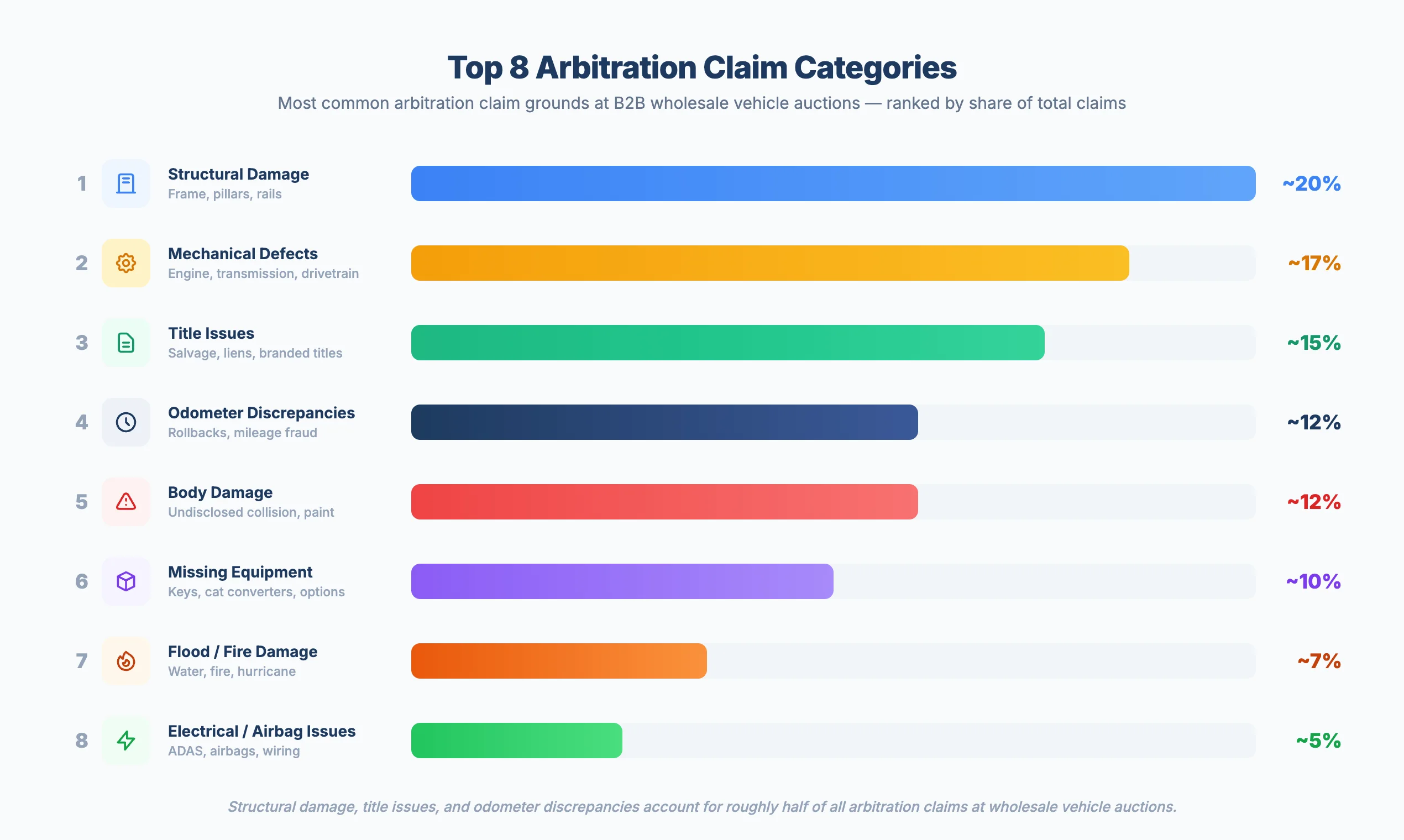
 Structural damage, title issues, and odometer discrepancies account for roughly half of all arbitration claims at wholesale vehicle auctions.
Approximately 3–5% of B2B vehicle auction transactions result in arbitration claims. Frame and structural damage accounts for roughly 20% of those claims, title issues for 15%, and odometer discrepancies for 12%. Not all arbitration claim grounds carry equal weight — flood and fire damage claims succeed at the highest rate, while cosmetic complaints rarely survive the process.
Knowing which grounds carry strong success rates — and which ones platforms routinely deny — helps dealers decide whether to pursue a claim or absorb the loss. This article covers eight claim categories with their evidence requirements, filing windows, and realistic success rates. For the full overview of how arbitration works and the sale light system, see the Arbitration Claims guide. For the step-by-step filing process, see How to File an Arbitration Claim.
Undisclosed Frame and Structural Damage
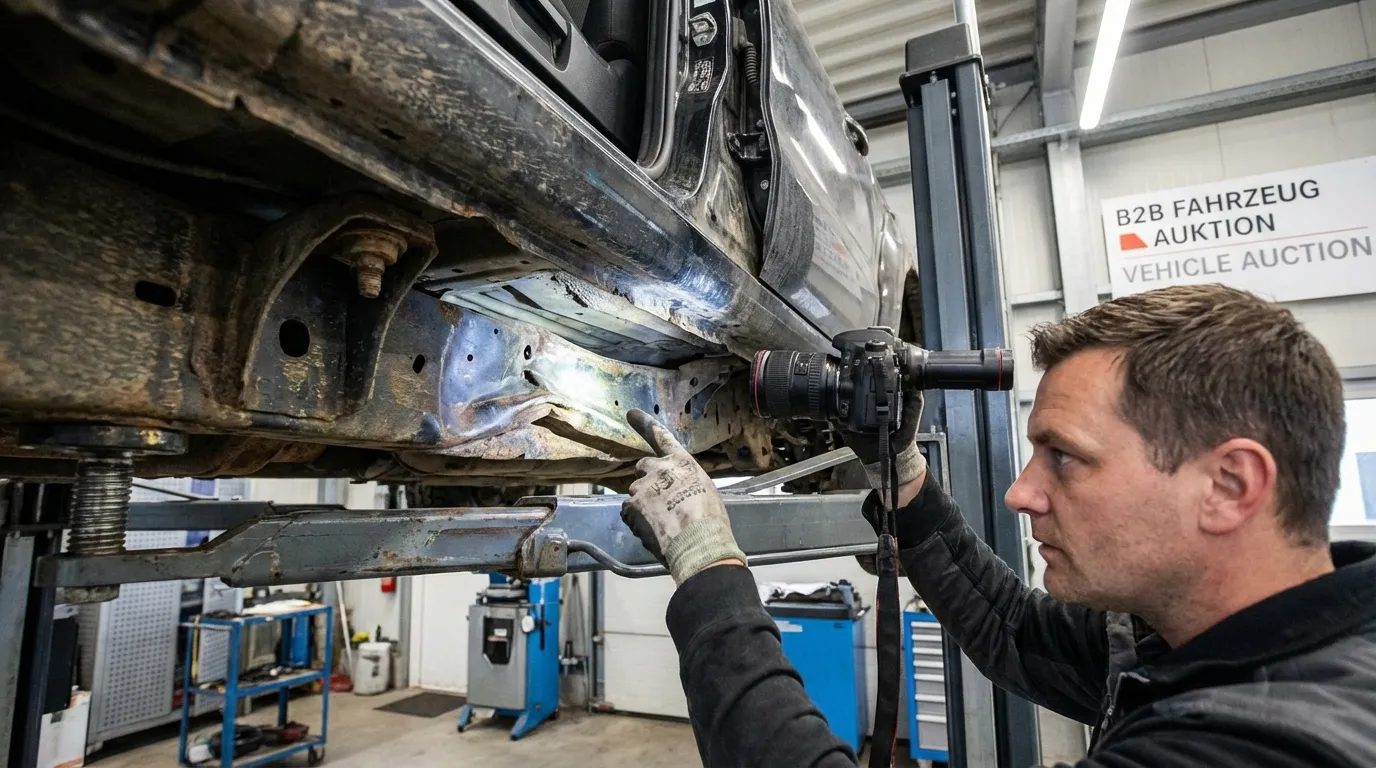
Frame and structural damage is the single most frequent arbitration claim category, representing approximately 20% of all claims filed. The NAAA Arbitration Policy defines 15 structural components: frame rails, strut towers, A/B/C/D pillars, rocker panels, floor panels, trunk panels, firewall, radiator core support, crossmembers, apron assemblies, upper rails, spring pods, and torque boxes.
Measurement tolerance is +/-8mm from the vehicle manufacturer’s published specification at designated control points. Any deviation beyond this threshold constitutes structural damage requiring disclosure in the condition report.
Detection relies on three methods:
- Computerized frame measurement systems (Car-O-Liner, Chief Genesis) that compare against factory specifications
- Paint thickness gauges — factory finishes typically measure 100–150 microns, while repainted panels read 200+ microns
- Visual inspection of weld points, panel gaps, and seam sealer consistency
The five most cited structural components in arbitration claims are:
- Frame rails (front and rear)
- Strut towers
- A-pillars
- Rocker panels
- Radiator core support
Structural damage is arbitrable under Green, Yellow, and Red light vehicles — it is one of the few claim categories that applies regardless of sale designation.
Odometer Discrepancy
NHTSA estimates that more than 450,000 vehicles are sold annually in the United States with false odometer readings. Odometer fraud is arbitrable under all sale light designations — Green, Yellow, and Red — and even applies to vehicles sold for $3,000 or less at Manheim.
The NMVTIS database cross-references recorded mileage at every title transfer, creating a chain of custody for odometer readings. Modern detection goes further: ECU and module interrogation reveals stored mileage across multiple electronic control modules, making digital rollbacks detectable even when the instrument cluster has been replaced.
Platform thresholds differ. ACV Auctions disqualifies arbitration claims if the actual odometer exceeds the listing by more than 150 miles. Manheim uses a 200-mile threshold. Exceeding either limit voids the claim regardless of whether the discrepancy was pre-existing.
Odometer claims benefit from extended filing windows on most platforms — significantly longer than the standard seven to 10 calendar days for condition-based claims.
Title Issues
Title-related claims account for approximately 15% of all arbitration filings. They encompass several distinct categories:
- Undisclosed salvage or rebuilt title status
- Branded titles (flood, lemon law, theft recovery)
- Outstanding liens not cleared before sale
- Title jumping (intermediate sellers who never register in their name)
An estimated 800,000 vehicles on U.S. roads carry washed titles — approximately one in every 325 used vehicles, according to IHS Markit data. Title washing occurs when a vehicle is re-registered in a state that does not recognize the original brand, effectively erasing the salvage or flood designation.
Title claims carry an extended filing window of 30 calendar days under the NAAA policy, compared to seven to 10 days for standard condition claims. This reflects the reality that title problems often surface during registration or financing, not during initial vehicle inspection.
Under the NAAA title warranty, sellers warrant each title as marketable and lien-free for four years from the sale date. Liability reduces by 2% per month over that period. ACV Auctions updated its policy in June 2025 — titles now need only be negotiable in the seller’s state, rather than the buyer’s.
Major Mechanical Defects
The NAAA Arbitration Policy sets an $800 threshold for mechanical arbitration: any single defect costing $800 or more to repair at wholesale pricing must be disclosed by the seller. This threshold applies only to Green and Yellow light vehicles — Red light (as-is) vehicles are excluded from mechanical arbitration entirely.
Platform thresholds vary. Manheim Digital Buyer Protection uses a $400 single-defect and $800 cumulative threshold. Some independent auctions set their own limits at $400–$500 per defect. The most common mechanical claims involve engine internal failure, transmission slipping or failure, and drivetrain or transfer case damage.
ACV Auctions inspects vehicles at “lot driving, not road speeds.” Defects that manifest only at highway speeds — such as torque converter shudder above 60 mph — may not be arbitrable if the inspection could not reasonably detect them. ADESA charges $195 for invalid inspection claims and limits buyers to one inspection per claim. Compare full fee structures including arbitration penalties with the Auction Fee Comparator.
Success rates for mechanical claims are moderate. These claims require expert diagnosis and can be disputed as post-sale wear, normal degradation, or the result of buyer misuse after delivery.
Flood and Fire Damage
Undisclosed flood or fire history carries the highest success rate of any claim category when proven. Every major platform treats undisclosed water or fire damage as material misrepresentation, regardless of sale light designation. The filing window is also the longest: up to 120 days under NAAA Appendix I for Green and Yellow light vehicles.
The scale of the problem is significant. The 2024 hurricane season damaged an estimated 347,000 vehicles — Hurricane Milton accounted for roughly 120,000 and Hurricane Helene for approximately 138,000. In 2017, Hurricanes Harvey and Irma damaged a combined 637,000+ vehicles. NICB warns that thousands of these vehicles enter wholesale channels with washed titles in the months following each disaster.
Detection relies on physical indicators: musty odors in the cabin, corroded electrical connectors, silt deposits in hidden crevices (under seats, inside door panels), waterline staining on interior surfaces, and accelerated rust on underbody components. The free NICB VINCheck tool — which covers approximately 88% of the personal auto insurance market — flags vehicles with flood, theft, or salvage records.
Missing Equipment and Other Grounds
Missing equipment claims cover listed features that are not present on the vehicle at delivery. This includes catalytic converter theft, missing keys, and advertised options (navigation systems, premium audio) that do not match the actual vehicle. Catalytic converter claims dropped 74% in the first half of 2024 compared to the same period in 2023. ACV caps catalytic converter claim eligibility at 125,000 miles.
The 2025 NAAA policy update introduced two notable changes. Biohazard contamination now requires explicit disclosure by sellers. ADAS (advanced driver-assistance system) components integrated with damaged visible parts — such as a camera embedded in a cracked windshield — are no longer separately arbitrable.
| Claim Ground | Key Detail |
|---|---|
| Missing Equipment | Must be listed on condition report; catalytic converter claims capped at 125K miles (ACV) |
| Excessive Body Damage | Beyond what condition report disclosed; cosmetic-only claims rarely succeed on non-Green vehicles |
| Paint/Panel Mismatch | Indicates undisclosed collision repair; paint depth readings above 200 microns as evidence |
| Airbag Deployment | Non-functional or deployed airbags not disclosed; safety-critical claim, moderate–high success |
Success Rates by Claim Category
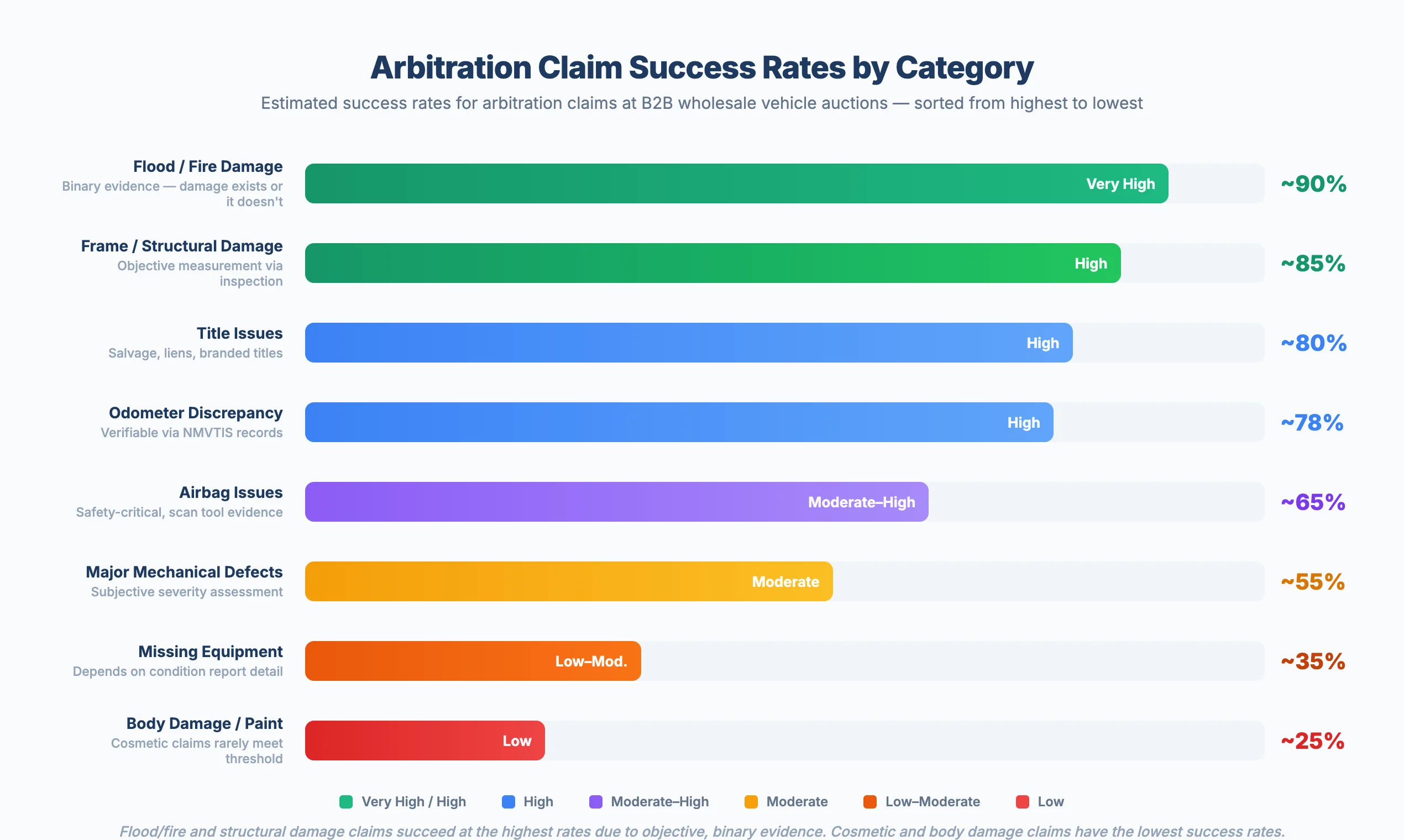 Flood/fire and structural damage claims succeed at the highest rates due to objective, binary evidence. Cosmetic and body damage claims have the lowest success rates.
| Claim Category | Share of Claims | Success Rate | Typical Resolution | Filing Window |
|---|---|---|---|---|
| Frame / structural damage | ~20% | High | Full return or price adjustment | 7–10 cal. days |
| Odometer discrepancy | ~10–15% | High | Full return | 30+ days |
| Title issues | ~15% | High | Full return | 30 days (NAAA) |
| Major mechanical defects | ~15–20% | Moderate | Repair credit or price adjustment | 7–10 cal. days |
| Flood / fire damage | ~5–10% | Very high | Full return | Up to 120 days |
| Missing equipment | ~10% | Low–moderate | Price adjustment | 7–10 cal. days |
| Body damage / paint | ~10–15% | Low | Price adjustment or denial | 7–10 cal. days |
| Airbag issues | ~5% | Moderate–high | Price adjustment or return | 7–10 cal. days |
Success rates are approximations based on industry patterns, not guarantees. Flood/fire and structural damage claims succeed most often because the evidence is objective and binary — the damage either exists or it does not, and the condition report either disclosed it or failed to. Mechanical and cosmetic claims carry lower success rates because they involve subjective assessments of severity, pre-existing wear, and whether the defect falls within the platform’s arbitration threshold.
How to Strengthen Your Case
Evidence quality determines the outcome of any arbitration claim. A valid defect paired with incomplete documentation results in denial just as often as a weak claim with strong photos. For the full step-by-step filing process, including platform-specific portals and deadline management, see How to File an Arbitration Claim.
Arbitration Evidence Gathering Checklist
0 of 10 completedNot all claim grounds are equal. Structural damage, odometer fraud, title issues, and flood/fire history carry the highest success rates and the strongest legal protections across platforms. Cosmetic and minor mechanical claims rarely justify the time investment unless the defect clearly exceeds the platform’s disclosure threshold. Focus arbitration efforts on categories with objective, measurable evidence — and build documentation habits into your standard receiving workflow. For a broader understanding of arbitration eligibility and the sale light system, return to the Arbitration Claims guide. To factor arbitration risk into your bidding strategy, use the Break-Even / Max Bid Calculator.
Frequently Asked Questions
What are the most common arbitration claim grounds at vehicle auctions?
The most frequent categories are undisclosed frame and structural damage (approximately 20% of all claims), title issues (approximately 15%), and odometer discrepancies (approximately 12%). Major mechanical defects exceeding the NAAA $800 threshold and flood/fire damage are also common. Flood and fire claims carry the highest success rate because undisclosed water or fire history constitutes material misrepresentation on every major platform.
What is the $800 threshold for mechanical arbitration claims?
Under the NAAA Arbitration Policy, any single mechanical defect costing $800 or more to repair at wholesale pricing must be disclosed by the seller. If the seller fails to disclose, the buyer can file an arbitration claim on Green and Yellow light vehicles. Red light (as-is) vehicles are excluded from mechanical arbitration. Some independent auctions and platform-specific programs set lower thresholds — Manheim Digital Buyer Protection uses $400 for a single defect and $800 cumulative.
How long do I have to file an arbitration claim for title issues?
Title claims carry a 30-calendar-day filing window under the NAAA policy — significantly longer than the seven to 10 day standard window for condition claims. This extended window reflects that title problems often surface during registration or financing, not during initial inspection. ADESA requires buyers to allow 30 calendar days for title delivery before filing a late-title claim.
Do arbitration claims apply to vehicles sold as-is?
Partially. Red light (as-is) vehicles are excluded from mechanical and cosmetic arbitration. However, even as-is vehicles retain arbitration rights for undisclosed structural/frame damage, odometer fraud, flood/fire history, and title issues on most platforms. Only Red-Yellow light vehicles — a separate designation — have zero arbitration rights under the NAAA policy.
What percentage of auction transactions result in arbitration claims?
Approximately 3–5% of B2B vehicle auction transactions result in arbitration claims. Of those, roughly 90% resolve within two weeks. The most common outcome is a price adjustment or repair credit at wholesale labor rates, not a full vehicle return. The 2025 NAAA policy update grants auctions the right to repair defects in lieu of unwinding the sale.