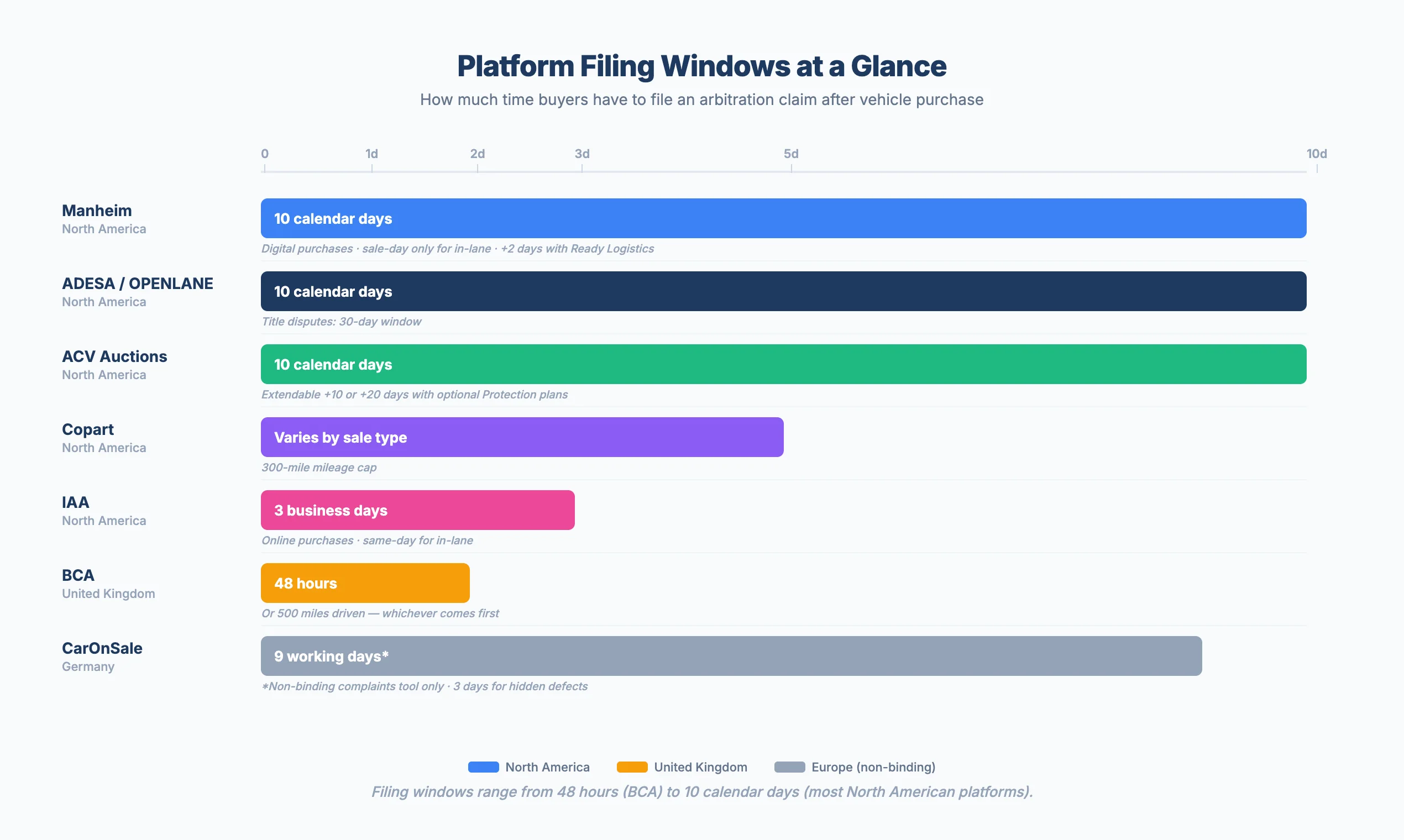
 Filing windows range from 48 hours (BCA) to 10 calendar days (most North American platforms).
A dealer wins a vehicle through an online auction, arranges transport, and three days later discovers undisclosed frame damage along the left front rail. The condition report stated “no structural damage.” The clock is already ticking — depending on the platform, this dealer has between 48 hours and 10 calendar days to file a claim, and as few as two days after that to upload every piece of evidence.
This article walks through the exact mechanics of filing an arbitration claim, platform by platform, with deadline comparisons, a ready-to-use notification template, and the seven mistakes that get valid claims denied. For the broader overview of how arbitration works, eligibility rules, and the sale light system, see the parent arbitration claims guide.
Know Your Deadline Before You Bid
Filing windows vary significantly across platforms — and the evidence deadline is always shorter than the filing deadline. Missing either one results in automatic denial, regardless of how strong the claim is. The table below compares deadlines across seven major B2B auction platforms.
| Platform | Filing Window | Evidence Deadline | Mileage Cap | Filing Channel |
|---|---|---|---|---|
| Manheim | 10 cal. days (digital); sale-day (in-lane) | 5 cal. days per milestone | Ready+2 for transport | Manheim.com buyer portal |
| ADESA/OPENLANE | 10 cal. days; 30 days (title) | 2 business days | 100 miles | ADESA Clear online system |
| ACV Auctions | 10 cal. days (extendable +10/+20) | 2 cal. days | 150 miles | MyACV portal |
| BCA (UK) | 24 hrs (grading); 48 hrs / 500 mi (general) | With initial claim | 500 miles | Phone (0330 102 8461) or email |
| CarOnSale (EU) | 9 working days; 3 days (hidden defects) | With initial claim | Not specified | Non-binding complaints tool |
| Copart | Varies by sale type | With initial claim | 300 miles | Platform portal |
| IAA | Same-day (in-lane); 3 bus. days (online) | With initial claim | Not specified | Platform portal |
Manheim provides the longest evidence window at five calendar days per milestone, while ACV Auctions and ADESA give just two days (calendar and business, respectively). BCA in the UK operates the tightest overall window — 48 hours from collection or 500 miles driven, whichever comes first, with all evidence required at the time of filing.
Step-by-Step Arbitration Claim Filing Process
The filing process follows six steps across all major platforms. Most failures happen at steps two and five — documentation and evidence upload. Prepare for these steps before you even bid.
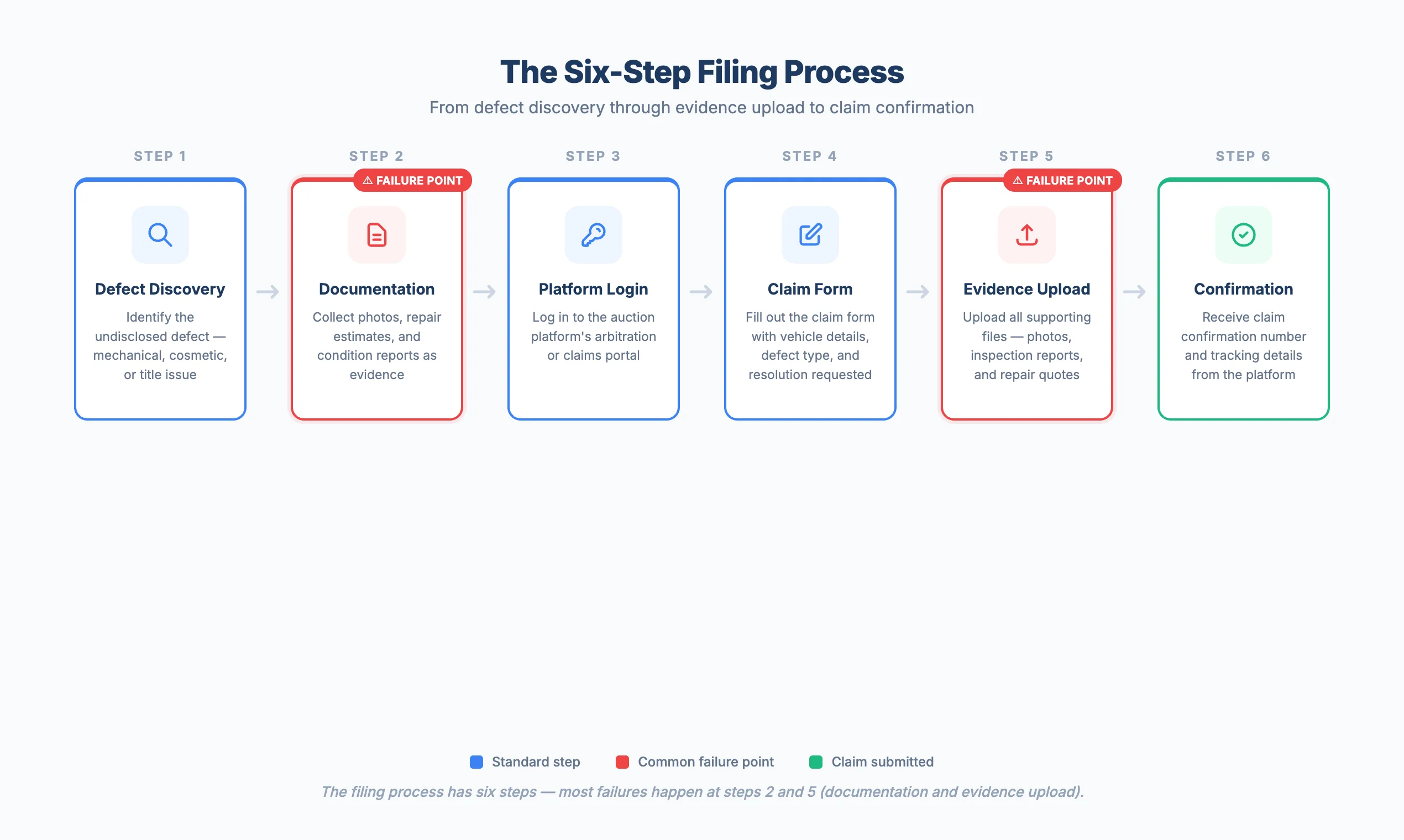 The filing process has six steps — most failures happen at steps 2 and 5 (documentation and evidence upload).
Stop and preserve the vehicle
Do not drive, repair, or move the vehicle beyond the delivery point. Record the odometer reading immediately. Any alteration to the vehicle's condition after receipt can invalidate your claim.
Document the defect within 60 minutes
Take a minimum of five timestamped photos from different angles with the VIN plate visible in at least one frame. Record a 60-second video walkaround. Screenshot the original condition report from the platform listing.
Log into the platform's official claims portal
Open Manheim.com, ADESA Clear, MyACV, or BCA's claims line. Do not file by email unless the platform specifically requires it — filing through the wrong channel is a common reason for denial.
Complete the claim form with precision
Enter the stock number, sale date, claim category, and a specific defect description. Vague descriptions like 'engine problem' weaken claims. State the defect location, severity, and how it contradicts the condition report.
Upload all evidence before the evidence deadline
Attach photos, video, condition report screenshots, third-party inspection report, and transport receipt showing mileage at delivery. On ACV, this deadline is two calendar days from filing. On ADESA, two business days.
Confirm submission and save your reference number
Screenshot the confirmation page. Note the case number, submission timestamp, and any follow-up deadlines the platform provides. This confirmation is your proof of timely filing.
After filing, the platform’s arbitration team reviews your claim alongside the seller’s response and all submitted evidence. Approximately 90% of claims resolve within two weeks. The 2025 NAAA policy update also allows platforms to offer repair-in-lieu-of-return as a resolution option, giving sellers an alternative to full buy-backs.
Arbitration Claim Notification Template
Some platforms accept or require email-based claim submissions alongside portal filings. Use the template below to structure your initial notification, or generate a customized version with the Claims Template Builder. Pre-filling your dealer details and standard evidence list saves critical time when a defect surfaces.
Subject: Arbitration Claim — [Stock #] — [Claim Category]
To: [Platform Arbitration Team / claimsenquiry@bca.com]
I am filing an arbitration claim for the following vehicle:
Stock Number: [Stock #] VIN: [Full VIN] Sale Date: [Date of purchase] Platform: [Platform name] Sale Light: [Green / Yellow / Red]
Claim Category: [e.g., Undisclosed structural damage]
Description of Defect: [Specific description — location, severity, and how it contradicts the condition report. Example: “Frame damage to the left front rail, visible at the subframe mount. Condition report dated [date] states ‘No structural damage.’ Third-party inspection by [Shop Name] (ASE-certified) estimates repair at $[amount].”]
Evidence Attached:
- timestamped photos (VIN plate visible)
- 60-second video walkaround
- Original condition report screenshot
- Third-party inspection report
- Transport receipt (mileage at delivery: [X] miles)
Requested Resolution: [Full return / Price adjustment / Seller-funded repair]
Buyer Account: [Account name / dealer number] Contact: [Phone] | [Email]
For a standalone downloadable version, see the Arbitration Claim Email Template.
Seven Mistakes That Kill Arbitration Claims
Most denied arbitration claims fail on process, not merit. The defect was real, the evidence existed, but the dealer missed a procedural requirement. These seven mistakes account for the majority of denied claims across all platforms.
- Missing the filing deadline. Filing windows range from same-day (IAA in-lane) to 10 calendar days (most North American digital platforms). There is no grace period.
- Missing the evidence deadline. This is separate from the filing deadline and always shorter. ACV requires all evidence within two calendar days of filing. ADESA requires it within two business days.
- Driving beyond the mileage cap. ADESA disqualifies claims if the odometer exceeds 100 miles from the listed reading. ACV caps at 150 miles. Copart caps at 300 miles. BCA caps at 500 miles. Exceeding the limit voids your claim regardless of the defect.
- Repairing before resolution. Altering the vehicle in any way — even a minor repair — before the arbitration process completes results in automatic denial on every platform.
- Filing through the wrong channel. A phone call to the seller is not a claim. An email to your sales rep is not a claim. Use the platform’s designated portal, app, or claims line.
- Vague claim descriptions. “Car has issues” gets denied. “Frame damage to left front rail, not disclosed in condition report dated [date], repair estimate $3,200 from ASE-certified facility” gets resolved.
- Filing multiple separate claims per transaction. ACV Auctions explicitly limits buyers to one claim per transaction. Consolidate all defects into a single, comprehensive filing.
What Happens After You File
Once you submit a claim, the platform assigns an arbitrator who reviews the evidence from both buyer and seller. The arbitrator may request a third-party inspection at a designated facility. Both parties can submit additional documentation during the review period.
Resolution timelines vary by platform — ACV Auctions typically resolves claims within three to seven business days, while CarOnSale mediation takes seven to 14 business days. Across the industry, approximately 90% of claims resolve within two weeks. The four possible outcomes are:
- Full return/refund — The sale is unwound. The buyer returns the vehicle and receives a full refund of the hammer price and buyer fees.
- Price adjustment/partial credit — The most common outcome. The arbitrator reduces the sale price to reflect the undisclosed defect’s impact on value.
- Seller-funded repair at wholesale rates — The seller pays for repairs at wholesale labor rates ($90/hour for gas engines, $100/hour for EVs at ACV; up to $135/hour at some Manheim locations).
- Claim denial — The claim is rejected due to insufficient evidence, missed deadlines, or the defect not meeting arbitration criteria.
Platform Quick-Reference Checklist
Use this checklist for every vehicle you purchase at auction. Print it, post it in your reconditioning bay, and run through it within the first hour of receiving any vehicle. Every item exists because skipping it has cost dealers valid claims.
Arbitration Filing Quick-Reference Checklist
0 of 10 completedFiling an arbitration claim correctly is a compliance exercise — the outcome depends as much on following the process as on the strength of the underlying defect. Dealers who build these steps into their standard receiving workflow protect themselves on every transaction, not just the ones that go wrong. Before bidding, run through the Auction Readiness Checklist. For a broader understanding of arbitration eligibility, the sale light system, and seller-side prevention strategies, return to the Arbitration Claims guide. To factor arbitration risk into your bidding strategy, use the Break-Even / Max Bid Calculator.