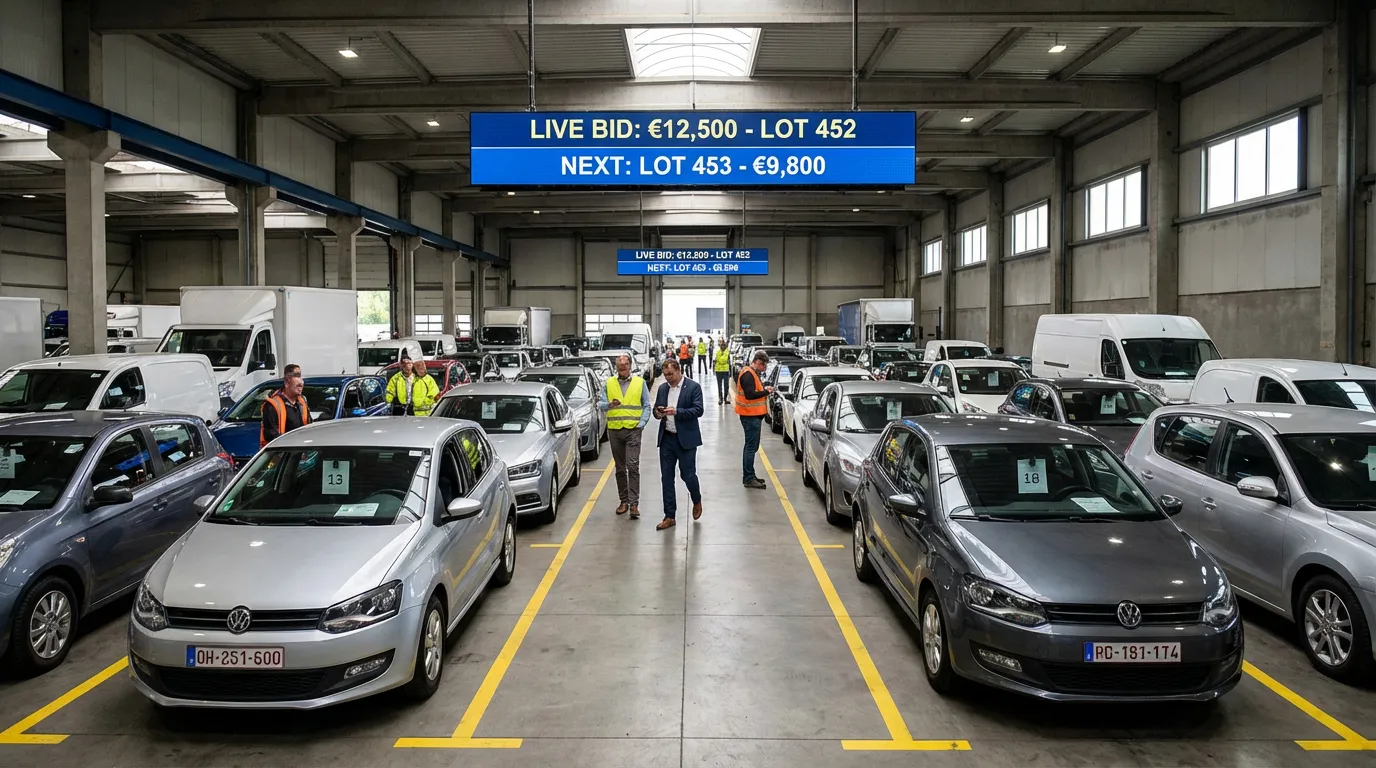
The Gap Between Hammer Price and Total Cost
NAAA members sold 7.6 million vehicles in 2024, generating over $105 billion in gross sales at an average wholesale price of $13,921. Those headline numbers capture the hammer price — the winning bid — but they omit the fees that both buyers and sellers pay on every transaction.
Auction fees typically add 5–20% on top of the hammer price. For buyers, that means the vehicle you won at $13,921 may cost $14,600–$16,700 once you account for buyer premiums, documentation fees, transport, and storage. For sellers, commissions and no-sale fees erode net proceeds. Understanding these costs separates a profitable trade from a loss.
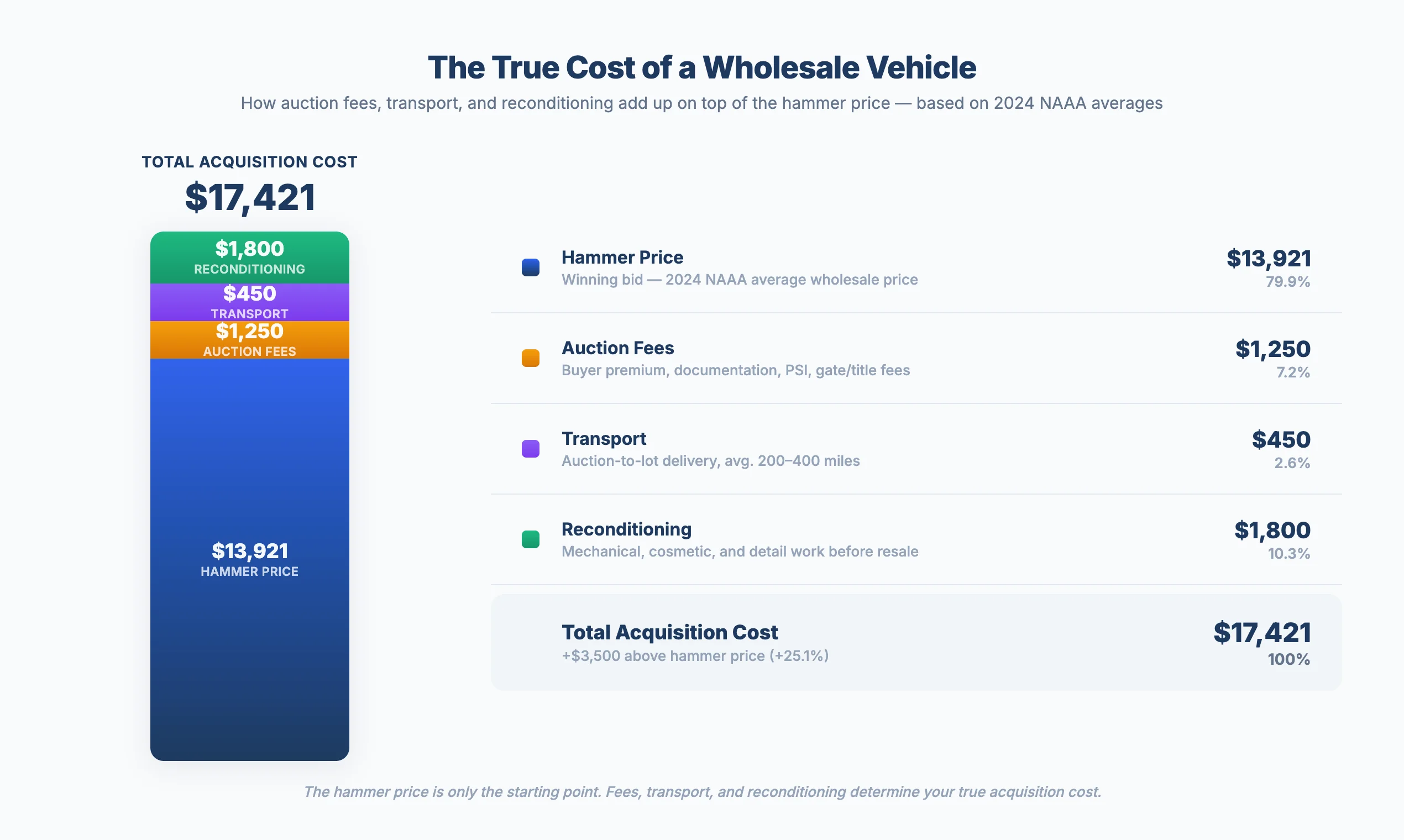 The hammer price is only the starting point. Fees, transport, and reconditioning determine your true acquisition cost.
Buyer-Side Auction Fees
Every platform structures buyer fees differently, but six fee categories appear across most B2B auctions. Some are flat-rate, others are percentage-based, and a few are avoidable with the right process.
| Fee Type | Typical Range | When Charged | Negotiable? |
|---|---|---|---|
| Buyer Premium / Buyer Fee | 1–14% of hammer price (or flat $100–$500+) | On winning bid | Yes, via account tier |
| Online/Platform Fee | $50–$200 flat per transaction | Per purchase | Rarely |
| Payment Processing Fee | 1–3% (credit card) or $0 (wire/ACH) | On payment | No |
| Title/Documentation Fee | $25–$75 per vehicle | Per purchase | No |
| Gate/Release Fee | $25–$100 | At vehicle pickup | No |
| Late Pickup / Storage Fee | $5–$45/day after grace period | Daily after grace | No |
The buyer fee — often called the buyer premium — represents the single largest add-on cost. At US platforms, this fee is typically a flat dollar amount tiered by hammer price, ranging from $100 to over $500 per vehicle. European platforms more commonly charge a percentage of the hammer price, with BCA UK applying up to 14% for standard-tier accounts on vehicles above GBP 5,000.
Payment method also affects total cost. Paying by credit card adds 1–3% in processing fees, while wire transfer or ACH payments incur no additional charge. Dealers who process high volumes save thousands annually by switching payment methods. Use the Auction Fee Comparator to model these differences across platforms.
For a detailed breakdown of all buyer-side fees — including the four buyer premium models, a nine-platform comparison, and strategies to reduce costs by 20–50% — see the Buyer Fees Deep Dive.
Seller-Side Auction Fees
Sellers face a separate fee structure that directly impacts net proceeds. Unlike buyer fees, many seller fees are negotiable — especially for fleet operators and remarketing companies that bring consistent volume to a platform.
| Fee Type | Typical Range | When Charged | Notes |
|---|---|---|---|
| Seller Commission | 0.5–3% of hammer price | On sale | Primary platform revenue from sellers |
| Listing Fee | $0–$50 per vehicle | On listing | Some platforms waive entirely |
| No-Sale Fee | $25–$100 per vehicle | When reserve not met | Charged even if vehicle does not sell |
| Condition Report / Inspection Fee | $50–$150 per vehicle | On inspection | Optional but strongly recommended |
| Post-Sale Inspection (PSI) Fee | ~$150 per vehicle | When buyer requests PSI | Paid by buyer but impacts seller if claim upheld |
| Contract/Subscription Fee | Varies (monthly/annual) | Recurring | For dedicated seller accounts |
The seller fee most often overlooked is the no-sale fee. Platforms charge $25–$100 every time a vehicle fails to meet its reserve — regardless of whether the vehicle eventually sells. At BCA UK, seller commission starts at GBP 56.50 on the first GBP 1,000, then 2.8% on the amount above. A listing fee of $0–$50 may seem minor on a single vehicle, but it compounds quickly across a fleet of hundreds.
A condition report or inspection fee ($50–$150 per vehicle) is technically optional on most platforms. Vehicles with professional condition reports consistently achieve higher sell-through rates and fewer post-sale disputes, making the fee a worthwhile investment for most sellers.
For a detailed breakdown of all seller-side commissions — including the five commission models, a six-platform comparison, and strategies to negotiate lower rates — see the Seller Commissions Deep Dive.
How Major Auction Platforms Stack Up
Fee models vary significantly across platforms and regions. The table below compares six major B2B auction platforms on their buyer and seller fee structures, estimated total cost per vehicle, and distinguishing features.
| Platform | Region | Buyer Fee Model | Seller Fee Model | Est. Total Cost/Vehicle | Notable Features |
|---|---|---|---|---|---|
| Manheim (US) | North America | Tiered flat-fee premiums (~$500 est.) | Negotiated by contract | ~$500–$700+ | Largest US wholesale platform; fees not publicly listed |
| ADESA / OPENLANE (US) | North America | Tiered buyer premiums | Negotiated | ~$400–$600 est. | Merged digital-first experience |
| ACV Auctions | North America | ~$360/vehicle total | Included in total | ~$360 | Transparent digital-native fee model |
| BCA | Europe (UK/DE) | Up to 14% standard; Gold/Platinum <50% | GBP 56.50 + 2.8% above GBP 1,000 | Highly variable | Five UK account tiers; Germany ~2.62% (min EUR 350) |
| CarOnSale | Europe (DE) | Tiered flat fees EUR 99–959 | From EUR 119/vehicle | EUR 218–1,078 | Fully digital; transparent published schedule |
| OPENLANE Europe | Europe | Variable + country-specific | Variable | Varies by country | Cross-border with country-specific surcharges |
ACV Auctions operates on a transparent, all-in pricing model at approximately $360 per vehicle (based on a 2.0% base take-rate with a $350 cap, plus a $50 seller fee). This contrasts with legacy platforms like Manheim, where tiered premiums and negotiated seller contracts push total costs above $700 per vehicle. Manheim also charges a $50 simulcast fee for remote bidding access.
In Europe, fee structures diverge further. BCA UK operates five buyer account tiers — Advantage (one to three purchases per year), Club (four to 14), Club+ (15–99), Premier (100–399), and Premier+ (400+). Standard-tier buyers pay up to 14% on vehicles above GBP 5,000, while Gold and Platinum members pay less than 50% of the standard rate. CarOnSale publishes a fixed fee schedule ranging from EUR 99 for vehicles under EUR 700 to EUR 959 for vehicles between EUR 22,500 and EUR 50,000.
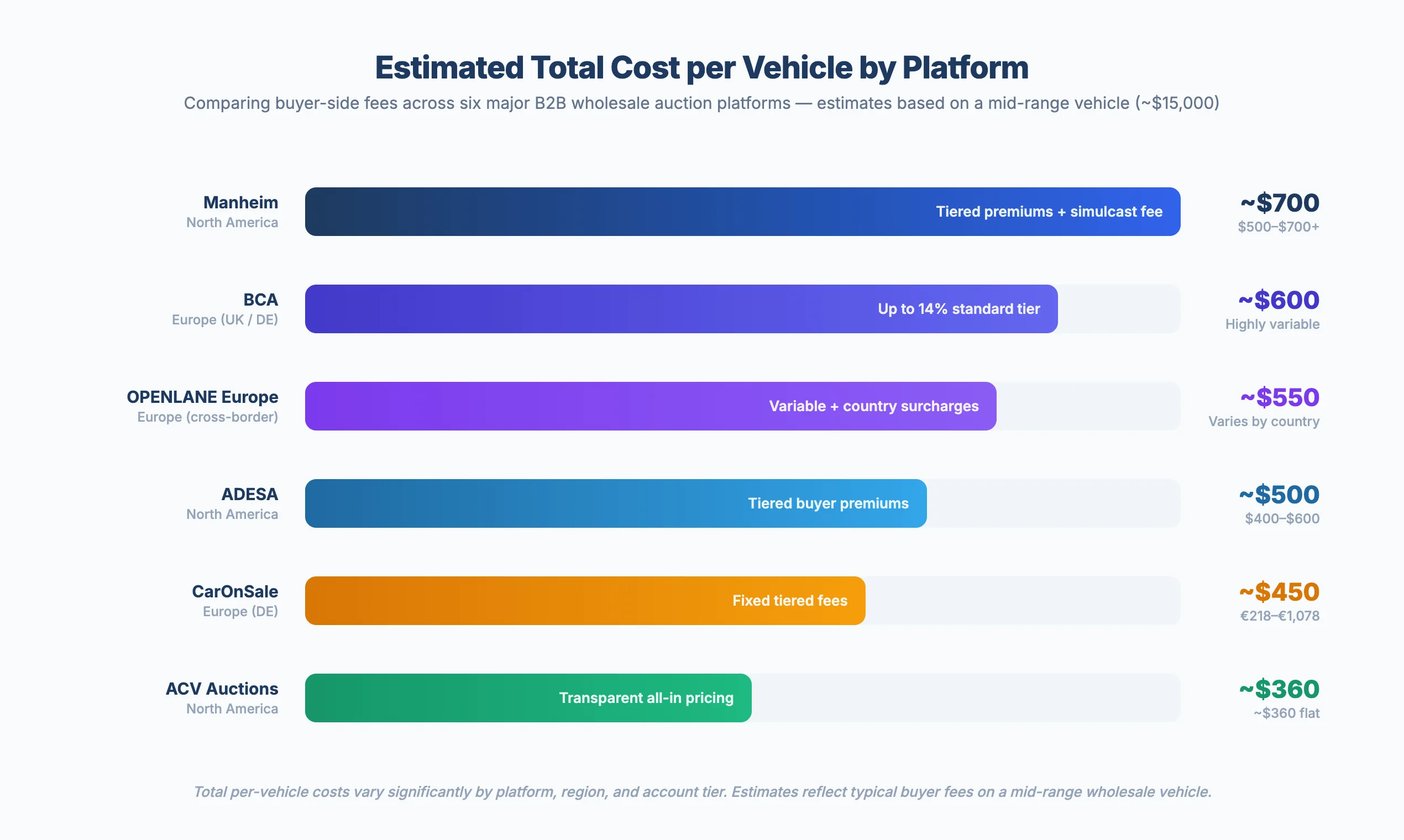 Total per-vehicle costs vary significantly by platform, region, and account tier.
Hidden Auction Fees and Unexpected Costs
Published fee schedules capture the obvious charges, but several costs remain invisible until they appear on an invoice. These hidden costs can turn an otherwise profitable acquisition into a loss.
Common hidden costs include:
- Late payment penalties — $150 or more per overdue invoice, applied after a short grace period
- Storage fees — $5–$45/day after the free pickup window (ADESA charges up to $45/day after seven calendar days; Manheim UK charges GBP 10–20+VAT/day after three free days)
- Arbitration fees — charged when a post-sale dispute is filed, regardless of outcome
- Currency conversion — 1.5–3% markup on cross-border transactions, often hidden in the exchange rate
- Reconditioning surprises — undisclosed mechanical issues discovered after purchase
- Transport surcharges — fuel surcharges, oversized vehicle fees, or remote-location premiums
- Title processing delays — holding costs accumulate while waiting for title transfer
To illustrate how these costs compound, consider a $15,000 vehicle purchased across three different platforms:
| Cost Component | Manheim (US) | ACV Auctions | BCA (UK, Standard Tier) |
|---|---|---|---|
| Hammer Price | $15,000 | $15,000 | GBP 12,000 |
| Buyer Premium | ~$500 | ~$300 | ~GBP 1,680 (14%) |
| Documentation/Title | ~$50 | Included | ~GBP 22 (V5 handling) |
| Simulcast/Online Fee | $50 | Included | Included |
| Storage (5 days late) | ~$100 | ~$50 | ~GBP 60 |
| Total Acquisition Cost | ~$15,700 | ~$15,350 | ~GBP 13,762 |
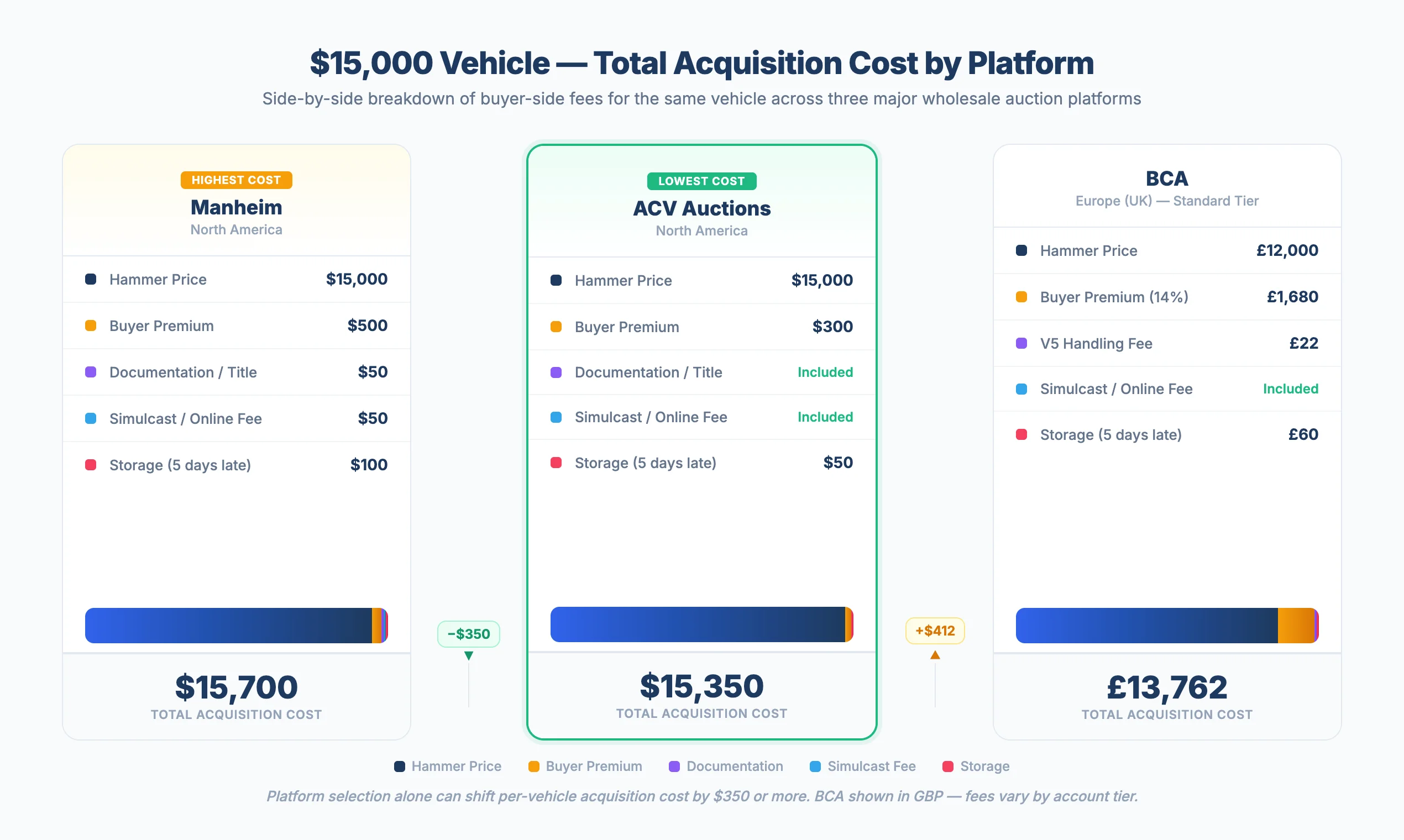 Platform selection alone can shift per-vehicle acquisition cost by $350 or more.
The difference between the lowest and highest total cost in this example exceeds $350 on a single vehicle. Across 100 vehicles per month, platform selection alone can shift annual costs by $35,000 or more. Use the Landed Cost Calculator to model these differences for your specific vehicle mix.
How to Calculate Your True All-In Cost
Calculating the true cost of a vehicle acquired at auction requires working through seven distinct cost layers. Skipping any step risks underestimating your acquisition cost and compressing margins.
Start with the hammer price
Record the winning bid amount. This is your base acquisition cost before any fees.
Add the buyer premium
Apply the platform's buyer fee — either a flat amount or percentage of the hammer price. Check your account tier, as volume buyers often qualify for reduced rates.
Add documentation and processing fees
Include title/documentation fees ($25–$75), gate/release fees ($25–$100), and any payment processing charges (1–3% for credit card payments).
Estimate transport costs
Calculate the cost to move the vehicle from the auction site to your location. Factor in distance, vehicle type, and carrier availability. Open transport runs $300–$800 for domestic moves.
Budget for reconditioning
Estimate repair and preparation costs based on the condition report. Common reconditioning runs $500–$2,000 for retail-ready preparation.
Account for holding costs
Calculate daily costs for storage, insurance, and floor plan interest from the day you win the bid until the vehicle sells. Even three to five days of delay adds measurable cost.
Compare to your target retail or wholesale price
Subtract total acquisition cost from your expected selling price. If the margin falls below your minimum threshold, adjust your maximum bid accordingly.
Auction Fee Negotiation Strategies
Auction fees are more negotiable than most dealers assume. Platforms compete for high-volume buyers and sellers, and account managers have discretion to adjust rates for accounts that bring consistent business.
Six strategies that reduce fees:
- Consolidate volume on fewer platforms — Concentrating purchases on one or two platforms qualifies you for higher account tiers. BCA’s Premier+ tier (400+ purchases/year) pays less than 50% of standard buyer fees.
- Negotiate annual contracts — Request a fixed fee schedule in writing, locked for 12 months. Annual commitments give account managers justification to offer reduced rates.
- Leverage competing offers — Share fee schedules from rival platforms. If ACV charges $360 total and Manheim charges $500+, use that gap as negotiation leverage.
- Bundle services — Platforms offer better rates when you use their transport, reconditioning, and floor plan services. Bundling gives them more revenue per vehicle, funding fee concessions on the auction side.
- Pay by wire or ACH — Eliminate 1–3% credit card processing fees immediately. On 100 vehicles at $14,000 average, switching from credit card to ACH saves $14,000–$42,000 annually.
- Review invoices monthly — Audit every line item. Storage fees, late pickup charges, and incorrect tier assignments appear frequently. Catching errors within 30 days makes disputes simpler to resolve.
Fee Negotiation Preparation Checklist
0 of 7 completedRegional Fee Differences
Fee structures differ substantially between North American and European platforms, and cross-border transactions introduce additional cost layers. Understanding these regional patterns helps dealers and remarketing teams budget accurately when sourcing or selling across borders.
| Factor | United States | Europe | Cross-Border |
|---|---|---|---|
| Fee Transparency | Low — most fees negotiated privately | Mixed — some platforms publish full schedules | Low — surcharges vary by country pair |
| VAT / Sales Tax | Sales tax varies by state; often exempt for dealers | VAT 19–25% applies; reverse-charge for intra-EU B2B | VAT rules depend on origin/destination; compliance costs apply |
| Buyer Premium Range | Flat $100–$500+ tiered by hammer price | 1–14% of hammer price (varies by tier) | Platform fee + export documentation + currency conversion |
| Currency Risk | None (USD) | Varies (GBP, EUR) | 1.5–3% conversion markup common |
| Regulatory Fees | State title/registration fees | Country-specific registration and compliance | Export documentation (EUR 85–110), customs clearance |
US platforms predominantly use flat-fee buyer premiums tiered by hammer price, keeping costs predictable regardless of vehicle value. European platforms lean toward percentage-based fees, meaning premium vehicles carry proportionally higher transaction costs. BCA Germany charges approximately 2.62% of the net price with a minimum of EUR 350 — a structure that penalizes high-value vehicle purchases more than the US flat-fee model.
Cross-border transactions compound these costs further. OPENLANE Europe charges EUR 110 for export documentation and EUR 85 for pickup coordination, on top of standard auction fees. Currency conversion adds 1.5–3%, and VAT compliance varies by country pair. Dealers buying across borders should model the full landed cost — including transport, duties, and reserve price strategy adjustments — before bidding.
Frequently Asked Questions
Are auction fees negotiable?
Yes. Buyer premiums, seller commissions, and ancillary fees are negotiable at most platforms, especially for accounts with consistent volume. High-volume dealers (100+ vehicles/month) regularly achieve 20–40% reductions. Even smaller operations negotiate successfully by consolidating volume, committing to annual contracts, or leveraging competing platform offers.
What is a typical buyer premium?
In the US, buyer premiums at major platforms range from $100 to $500+ per vehicle, structured as flat fees tiered by hammer price. In Europe, buyer premiums are more commonly percentage-based, ranging from 1% to 14% of the hammer price depending on platform and account tier. ACV Auctions charges approximately $360 total per transaction, among the lowest in the US market.
Do sellers pay auction fees?
Sellers pay commissions (0.5–3% of hammer price), listing fees ($0–$50), and no-sale fees ($25–$100) when a vehicle fails to meet its reserve. Optional condition report fees ($50–$150) and recurring subscription fees also apply on some platforms. Seller fees are generally more negotiable than buyer fees, particularly for fleet operators and remarketing companies.
How do I calculate my total acquisition cost?
Add the hammer price, buyer premium, documentation fees, transport, reconditioning estimate, and holding costs (storage, insurance, floor plan interest). Compare the total to your target selling price to determine margin. The all-in cost typically runs 5–20% above the hammer price, depending on platform, vehicle condition, and distance from the auction site.
Are fees different in Europe compared to the US?
Significantly. US platforms favor flat-fee buyer premiums ($100–$500+), while European platforms lean toward percentage-based fees (1–14%). European transactions also involve VAT (19–25%), which US sales tax structures do not replicate. Cross-border European purchases add export documentation fees (EUR 85–110) and currency conversion costs (1.5–3%).
Conclusion
Auction fees are a controllable cost — but only if you measure them. The gap between hammer price and total landed cost ranges from 5% on a well-optimized platform to 20% or more when hidden fees, storage charges, and poor payment choices compound. Selecting the right platform, negotiating your account tier, and auditing every invoice are the three actions with the highest impact on your bottom line.
Start by benchmarking your current per-vehicle cost across every platform you use. Compare those numbers with the Auction Fee Comparator, model your net proceeds with the Net Proceeds Calculator, and calculate your full acquisition cost with the Landed Cost Calculator. The data in this guide provides the framework — the tools turn it into actionable decisions for your specific operation.