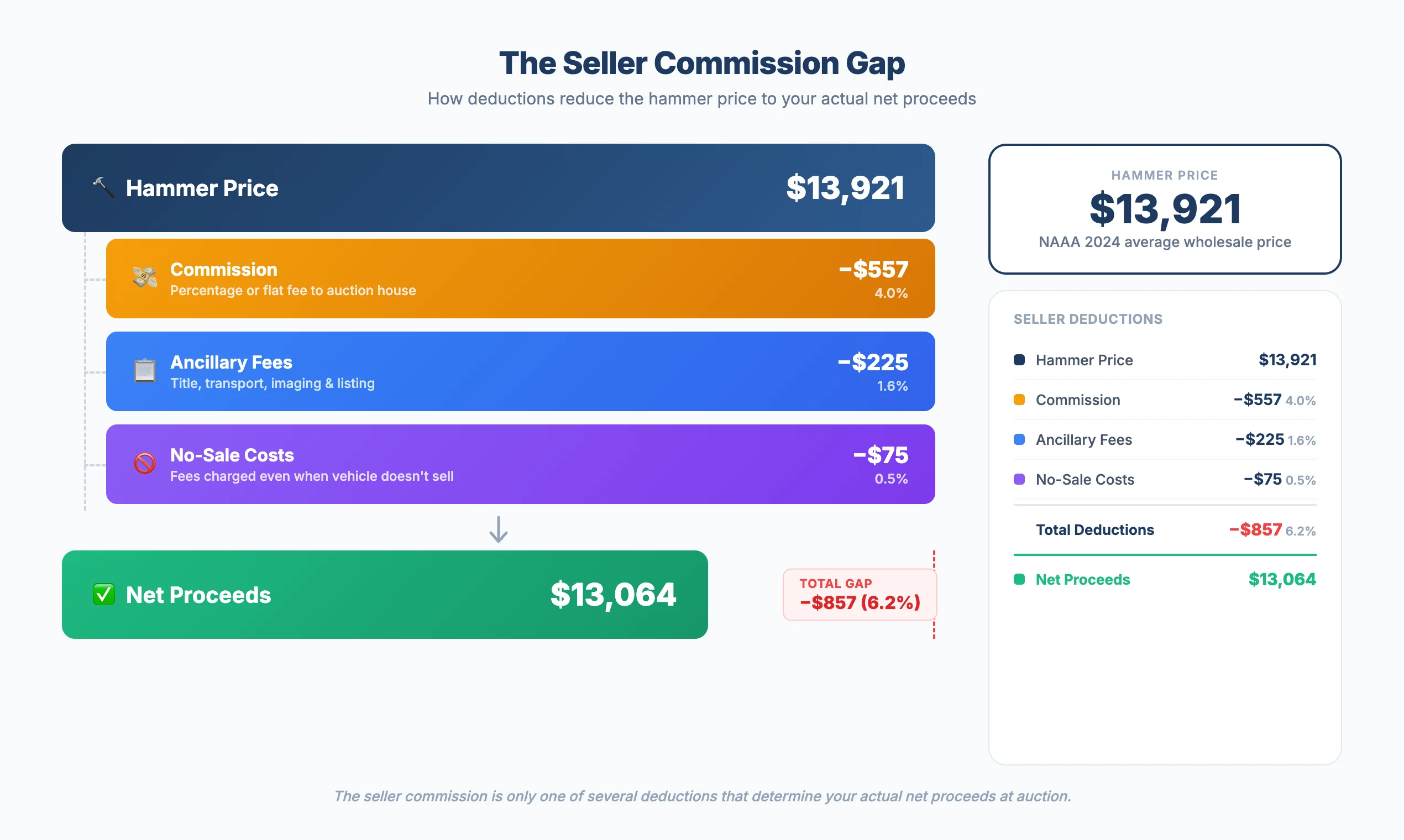
 The seller commission is only one of several deductions that determine your actual net proceeds at auction.
What Sellers Actually Net at Auction
NAAA members sold 7.6 million vehicles in 2024, generating over $105 billion in gross wholesale volume at an average hammer price of $13,921. Those figures represent what buyers paid — not what sellers received. The gap between hammer price and net proceeds is the seller commission — also called the seller fee — and it varies by platform, commission model, and contract terms.
This guide breaks down every commission structure that sellers encounter at major B2B auction platforms in North America and Europe. It complements the parent auction fees guide, which covers both buyer and seller costs at a higher level, and the buyer fees deep dive, which focuses on the buy side. Here, the focus is exclusively on what sellers pay — and how to keep more of the hammer price.
The Five Seller Commission Models
Not all seller commissions work the same way. Platforms use five distinct models, each with different implications for net proceeds depending on your vehicle mix and volume.
| Model | How It Works | Example Platform | Best Suited For |
|---|---|---|---|
| Percentage-based | Fixed % of hammer price (typically 1–5%) | Manheim (customized per account) | High-value vehicles where % cost remains proportional |
| Flat fee per vehicle | Same dollar amount regardless of sale price | ACV Auctions ($150 per vehicle sold) | Predictable budgeting; favors higher-value inventory |
| Tiered bracket | Fee increases in brackets based on hammer price | CarOnSale (EUR 99–959 across 45 brackets) | Mixed-value inventory with transparent cost scaling |
| Hybrid / bundled | Commission bundled with services (inspection, photos) | BCA UK (GBP 56.50 + 2.8% above GBP 1,000) | Sellers wanting all-inclusive pricing |
| Zero-commission (buyer-funded) | No seller fee; revenue from buyer premiums | OPENLANE Europe | Sellers seeking maximum net proceeds |
The commission model matters more than the headline rate. A flat $150 fee represents 3% of a $5,000 vehicle but only 0.6% of a $25,000 vehicle. Percentage-based commissions scale proportionally, meaning higher-value inventory carries higher absolute costs. Tiered brackets fall between the two extremes, scaling in steps rather than continuously.
Zero-commission models shift the entire platform revenue burden to the buyer side. OPENLANE Europe charges sellers nothing, funding operations entirely through buyer fees. This model maximizes seller net proceeds but may reduce buyer demand if buyer premiums are perceived as high relative to competing platforms.
Platform-by-Platform Seller Commission Comparison
The table below compares seller-side fees across six major B2B auction platforms. Fee transparency varies significantly — some platforms publish complete seller schedules while others negotiate rates on a per-account basis.
| Platform | Region | Seller Commission | No-Sale Fee | Transparency |
|---|---|---|---|---|
| Manheim | US/Canada | Customized per account (not public) | Negotiated | Not publicly disclosed |
| OPENLANE US | US | Customized per account | Not public | Not publicly disclosed |
| ACV Auctions | US | $150 flat per vehicle sold | $0 (no fee if unsold) | Published (pricing page) |
| BCA UK | UK | GBP 56.50 on first GBP 1,000 + 2.8% above | GBP 30 withdrawal fee | Partially published |
| OPENLANE Europe | EU | $0 seller commission (buyer-funded) | N/A | Published |
| CarOnSale | EU | EUR 99–959 tiered (45 brackets) | N/A | Fully published schedule |
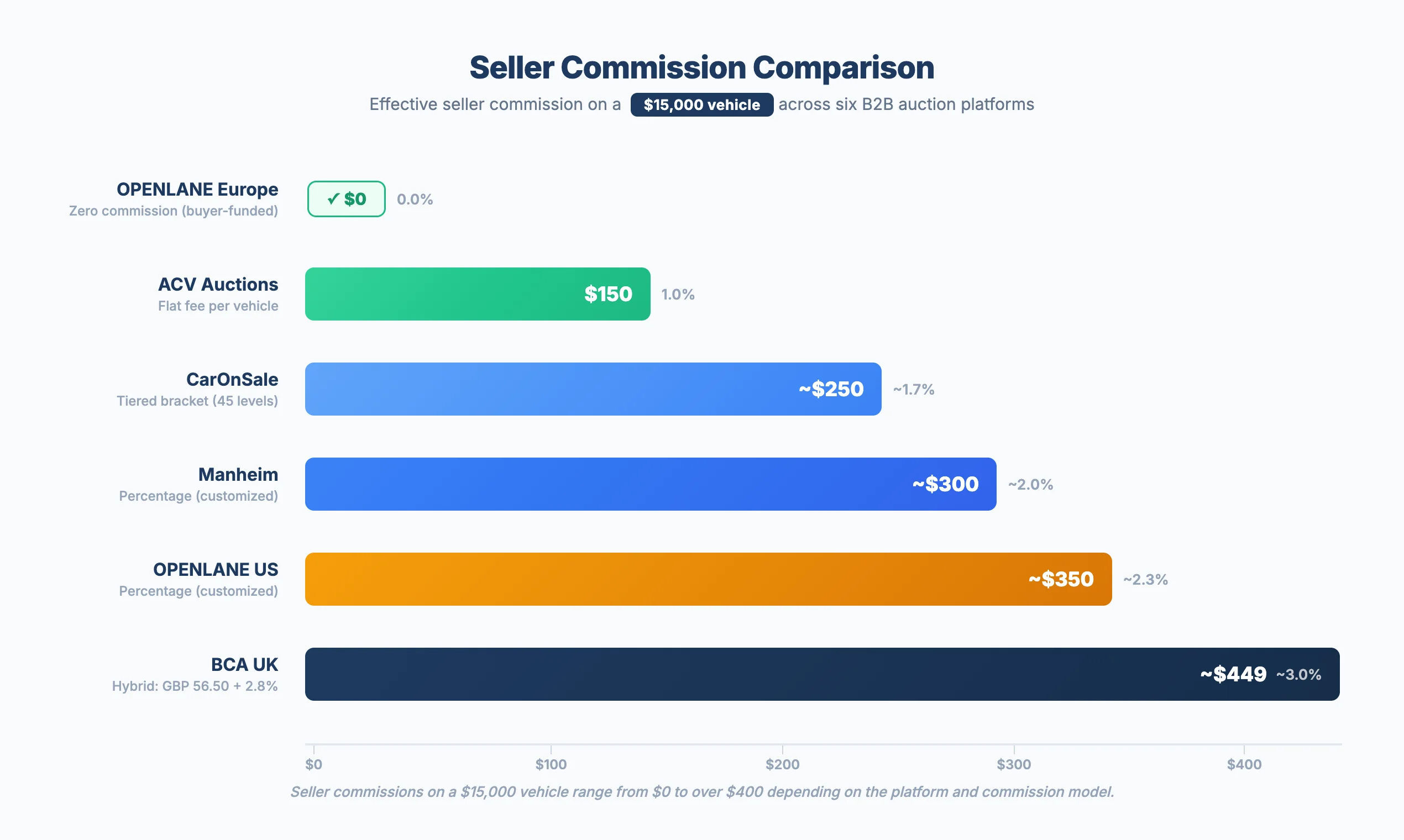 Seller commissions on a $15,000 vehicle range from $0 to over $400 depending on the platform and commission model.
Fee transparency divides the market. ACV Auctions, CarOnSale, and OPENLANE Europe publish their seller fee structures on their websites — sellers can calculate exact costs before signing a contract. Manheim and OPENLANE US negotiate rates per account, meaning high-volume sellers secure favorable terms while smaller operations lack pricing visibility until onboarding.
When evaluating platforms, compare net proceeds — not just the commission rate. A platform with a higher commission but stronger sell-through rate and faster time-to-sale may deliver better overall returns. For guidance on selecting the right platforms, see the Platform Selection Guide. Use the Auction Fee Comparator to model total seller costs across platforms for your specific vehicle mix.
Hidden Seller Costs
The seller commission captures attention, but ancillary fees accumulate across every transaction. Some are unavoidable. Others are controllable with the right process and platform selection.
| Fee | Typical Range | When Charged | Avoidable? |
|---|---|---|---|
| Condition report / inspection | $25–$150 | Per vehicle listed | Platform-dependent |
| Photography / imaging | $25–$75 | Per vehicle | Optional at some platforms |
| Storage | $10–$45/day after grace | Post-sale if buyer delays | Partially |
| No-sale / rerun fee | $25–$100 | When reserve not met | Yes — set realistic reserves |
| Early withdrawal / pull fee | $50–$200 | When seller removes vehicle | Yes — avoid late withdrawals |
| Title / documentation fee | $25–$75 | Per vehicle sold | No |
Guaranteed Sale Programs vs. Open Market
Several platforms offer guaranteed sale programs that promise to sell vehicles within a fixed time frame — typically 14–21 days — at a pre-agreed minimum price. Multi-channel remarketing programs target approximately 105% of wholesale book value with an average cycle time of 18 days. The trade-off is clear: certainty of sale and speed versus potential upside from open-market bidding.
Open-market auctions carry no guarantee of sale. Vehicles that fail to meet the reserve incur no-sale fees and require relisting, extending cycle time and adding cost. For fleet operators managing depreciation on hundreds of vehicles, every additional day on the lot reduces net proceeds.
Guaranteed sale programs make sense when:
- Depreciation risk is high — vehicles losing $50–$100/day in value benefit from faster liquidation
- Volume exceeds internal remarketing capacity — guaranteed programs handle logistics end-to-end
- Budget predictability matters — fleet managers can forecast net proceeds with confidence
- Sell-through rates on open market fall below 70% — repeated no-sale fees erode the theoretical upside of open bidding
How to Negotiate Lower Commissions
Seller commissions are negotiable at every platform that uses customized or percentage-based pricing. The following process produces consistent results for dealers, fleet operators, and remarketing companies.
Audit current per-vehicle cost
Pull 12 months of transaction data. Calculate total commissions paid, average commission per vehicle, and effective commission rate (total commissions divided by total hammer price). Include ancillary fees for a complete picture.
Consolidate volume onto fewer platforms
Spreading 200 vehicles across four platforms gives you 50 per platform — insufficient for meaningful negotiation. Consolidating onto two platforms doubles your per-platform volume and strengthens your leverage.
Obtain competing quotes
Request written seller fee schedules from at least three platforms. Focus on platforms where your vehicle mix fits the commission model — flat fee for high-value inventory, tiered for mixed portfolios.
Propose a committed-volume agreement
Offer a 12-month commitment to a specific monthly volume in exchange for reduced rates. Platforms value predictable supply and will discount commissions for guaranteed consignment flow.
Negotiate ancillary fees separately
Commission rate negotiations dominate the conversation, but ancillary fees (inspection, photography, storage grace periods) often represent equal or greater savings. Negotiate each line item independently.
Net Proceeds Worked Examples
The following table illustrates how different commission models affect net proceeds across three price points. All examples assume standard ancillary fees and no storage charges.
| Scenario | Hammer Price | Commission Model | Seller Commission | Ancillary Fees | Net Proceeds |
|---|---|---|---|---|---|
| ACV flat fee | $8,000 | $150 flat | $150 | $75 (title) | $7,775 (97.2%) |
| ACV flat fee | $15,000 | $150 flat | $150 | $75 | $14,775 (98.5%) |
| ACV flat fee | $25,000 | $150 flat | $150 | $75 | $24,775 (99.1%) |
| BCA standard | ~GBP 6,300 | GBP 56.50 + 2.8% | ~GBP 205 | ~GBP 60 | ~GBP 6,035 (95.8%) |
| BCA standard | ~GBP 11,800 | GBP 56.50 + 2.8% | ~GBP 359 | ~GBP 60 | ~GBP 11,381 (96.4%) |
| OPENLANE EU | $15,000 | $0 seller commission | $0 | ~$50 (docs) | $14,950 (99.7%) |
The flat-fee model at ACV Auctions shows a clear pattern: as vehicle value increases, the effective commission rate drops from 2.8% at $8,000 to 0.9% at $25,000. The BCA hybrid model produces a more consistent effective rate of 4.2–3.6% across the range. OPENLANE Europe’s zero-commission model delivers the highest net proceeds regardless of vehicle value. Use the Net Proceeds Calculator to model your specific vehicle mix, and the Remarketing Channel Mix Calculator to determine the optimal split across platforms.
Frequently Asked Questions
What is a typical seller commission at a B2B vehicle auction?
Seller commissions range from $0 to 5% of the hammer price depending on platform and contract terms. ACV Auctions charges a flat $150 per vehicle sold. BCA UK charges GBP 56.50 on the first GBP 1,000 plus 2.8% above that threshold. OPENLANE Europe charges no seller commission, funding operations through buyer fees. Manheim and OPENLANE US negotiate rates per account and do not publicly disclose their seller fee structures.
Can I avoid paying seller fees entirely?
Yes. OPENLANE Europe operates a zero-commission model for sellers, shifting all platform revenue to the buyer side. However, ancillary costs — listing fees, condition reports, and documentation — may still apply depending on the platform and services used. Evaluate total cost rather than commission alone.
How do no-sale fees work?
Platforms charge a no-sale fee ($25–$100) each time a vehicle fails to meet its reserve price at auction. The fee applies regardless of whether the vehicle eventually sells on a subsequent listing. At BCA UK, sellers pay a GBP 30 withdrawal fee if a vehicle is pulled before sale. Setting realistic reserves and reviewing historical sell-through data for comparable vehicles reduces no-sale frequency.
What is the difference between a seller commission and a listing fee?
A seller commission is charged when a vehicle sells successfully — it is a percentage or flat amount deducted from the hammer price. A listing fee is charged when the vehicle is listed for auction, regardless of whether it sells. Some platforms charge both; others bundle the listing fee into the commission. ACV Auctions, for example, charges $150 only upon sale with no separate listing fee, while other platforms may charge $25–$50 per listing upfront.