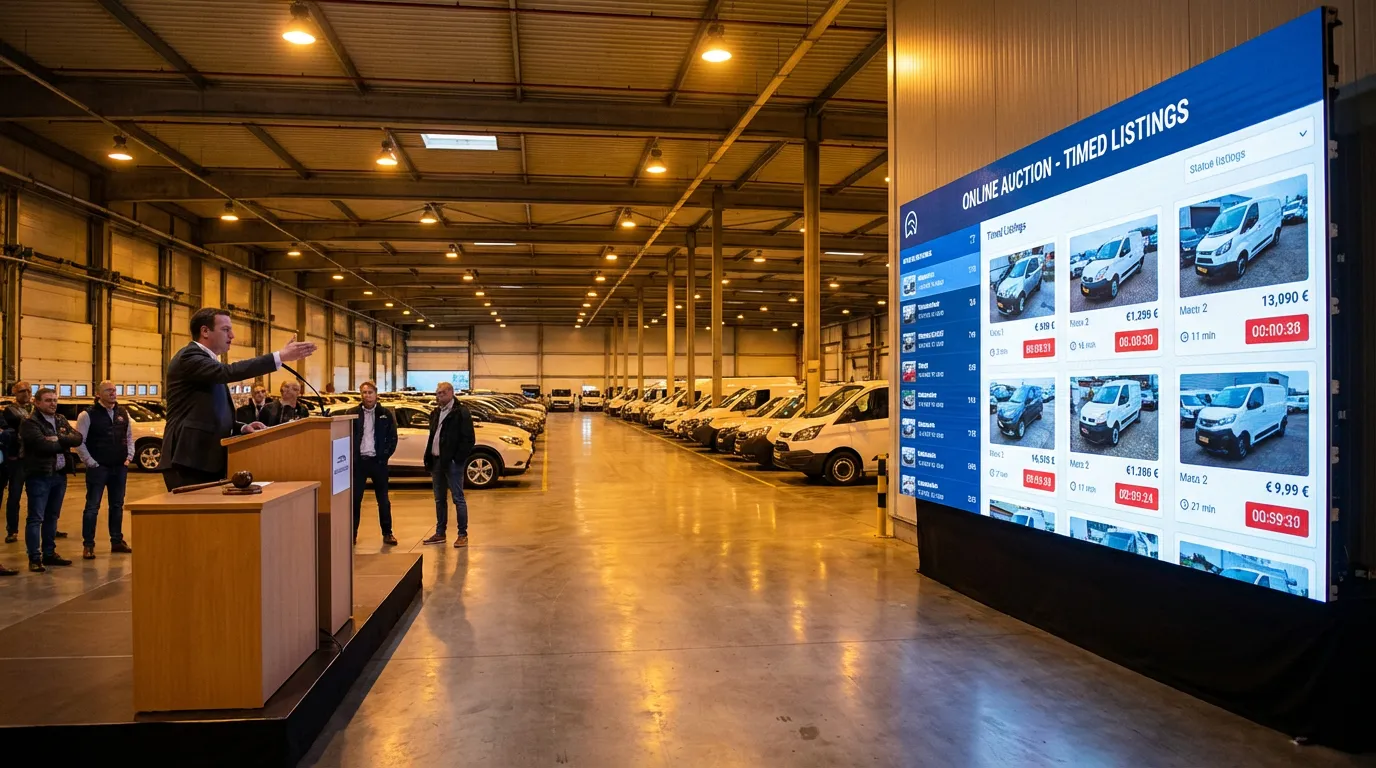
Understanding Vehicle Auction Types
NAAA members sold 7.6 million vehicles in 2024 — $105 billion in gross sales at an average wholesale price of $13,921. Those transactions moved through a range of auction types, from 60-second live lanes to 72-hour timed listings. The auction type shapes everything: who competes, how prices form, and how much time each transaction demands.
The shift toward digital is accelerating. Over 73% of Manheim transactions now go to digital buyers, 68% of wholesale bidders prefer online formats, and 58% of transactions occur via mobile devices. Yet 41% of dealers operate hybrid models, combining physical and digital channels. This guide breaks down all six B2B auction types — live physical, timed online, simulcast, sealed-bid, buy-now, and Dutch — with data to help you match the right format to your operation.
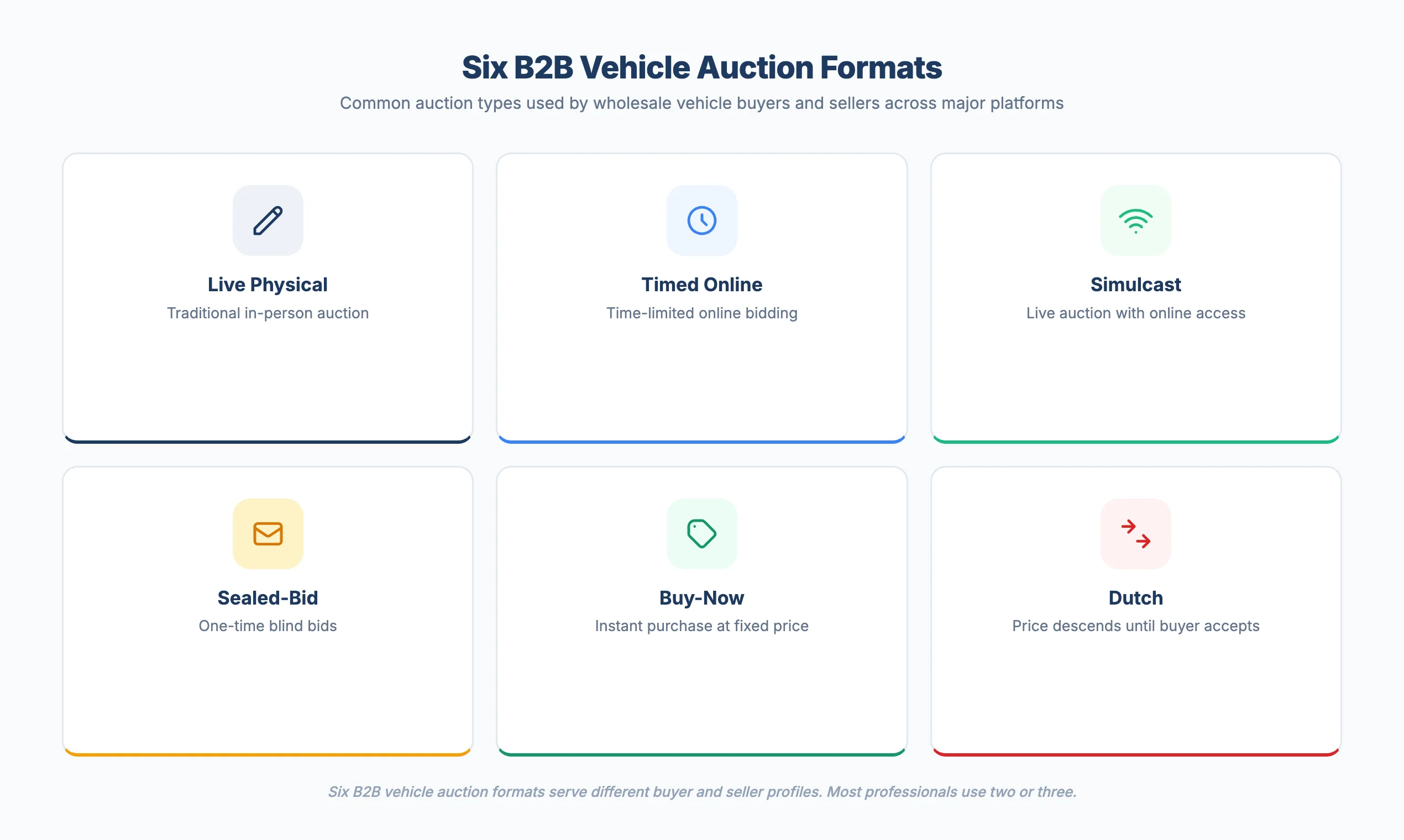 Six B2B vehicle auction formats serve different buyer and seller profiles. Most professionals use two or three.
Live Physical Auctions
Live physical auctions run on a lane system. Vehicles drive through an auction lane, an auctioneer calls bids in real time, and buyers compete with hand signals or bid cards. Each vehicle sells in 60–90 seconds. The format demands physical presence — buyers inspect vehicles beforehand, then bid in person during scheduled sale days.
North America remains the stronghold for live physical auctions. NAAA members processed 7.6 million vehicles in 2024 at a 61.3% conversion rate. ADESA operates 56 US locations offering lane-based sales, while Manheim runs 81 physical sites. In Europe, BCA processes over one million vehicles annually, with 600,000+ through UK lanes alone — though BCA increasingly runs hybrid events with simultaneous online access.
Advantages:
- Physical inspection before bidding — evaluate paint, body condition, and mechanical issues firsthand
- Competitive lane dynamics drive prices efficiently through rapid ascending bids
- Networking opportunities with other dealers, fleet managers, and remarketing professionals
- Immediate sale confirmation — know the result within 90 seconds
Disadvantages:
- Travel required to each auction location, adding time and expense
- Limited to vehicles available at that location on that sale day
- Impulse bidding risk in fast-paced lane environments
- Sales run during business hours only, restricting scheduling flexibility
Timed Online Auctions
Timed auctions operate asynchronously. Platforms list vehicles with a defined bidding window — typically 24–72 hours — and buyers place bids at any time during that period. Most platforms support proxy bidding, where buyers set a maximum and the system bids incrementally on their behalf. Anti-sniping rules automatically extend the closing time when bids arrive in the final minutes, preventing last-second tactics from dominating outcomes.
The timed format dominates digital-first platforms. ACV Auctions processed 743,000 vehicles in 2024, generating $9.5 billion in gross merchandise value across a 100% online model. In Europe, AUTO1 Group sold 689,773 vehicles across 30+ countries, connecting 44,000+ dealer buyers. OPENLANE Europe offers its Dynamic format — a timed auction with automatic extensions — alongside four other bidding options.
Advantages:
- Bid from anywhere with an internet connection, eliminating travel costs
- Research time to analyze condition reports, market data, and comparable sales before bidding
- Proxy bidding enforces discipline — set your maximum and let the system execute
- Scales to thousands of simultaneous listings across multiple platforms
Disadvantages:
- No physical inspection — rely entirely on condition reports, photos, and condition grades
- Less competitive urgency can result in slower price discovery
- Monitoring multiple auctions with overlapping close times requires active management
- Auto-extend rules vary by platform, creating confusion for buyers new to the format
For a detailed head-to-head comparison of timed and live formats — including price dynamics, technology requirements, and a decision framework — see Timed vs Live Auctions: How B2B Auction Formats Compare.
Simulcast Auctions
Simulcast auctions combine the live lane experience with remote online access. An auctioneer runs the sale in real time from a physical location while an online platform broadcasts the event to remote bidders. Floor buyers and online buyers compete in the same sale simultaneously, with bids from both channels feeding into a single auction stream.
Manheim pioneered the simulcast model in North America, where over 73% of its transactions now go to digital buyers — many of them bidding via simulcast rather than attending in person. BCA runs a similar hybrid model, processing 12,000+ vehicles per week with simultaneous floor and online participation. ADESA offers its Simulcast format alongside in-lane and digital-only options.
Advantages:
- Combines physical inspection (for floor buyers) with remote access (for online buyers) in one sale
- Generates the largest possible bidder pool by merging two channels
- Auctioneer-driven pace creates urgency and efficient price discovery
- Remote buyers access live sales without travel
Disadvantages:
- Network latency gives floor bidders a slight timing advantage over remote participants
- Reliable internet connection required for real-time participation — dropped connections mean missed vehicles
- Sales run on fixed schedules, requiring calendar commitment
- Some platforms charge a simulcast fee (Manheim charges $50 per transaction for remote bidding access)
For a deep dive into simulcast mechanics, the floor-bidder timing advantage, and platform-specific implementation details, see Simulcast Auctions: How Real-Time Online Bidding Works.
Sealed-Bid Auctions
Sealed-bid auctions require each buyer to submit a single confidential bid without knowing what others have offered. The highest bid above reserve price wins. There is no second chance to adjust — once submitted, the bid is final. This format appears most frequently in government fleet disposals, institutional remarketing, and leasing company sales where transparency and procedural fairness are priorities.
OPENLANE Europe offers its “Blind” format as a sealed-bid option, allowing sellers to collect confidential offers over a defined period. From a game theory perspective, sealed-bid auctions are strategically equivalent to Dutch auctions under rational bidding conditions — a principle known as revenue equivalence. In practice, the sealed-bid format rewards analytical buyers who invest time in accurate vehicle valuation.
Advantages:
- Encourages bidding based on true valuation rather than competitive reaction
- Transparent and procedurally fair — each participant has identical information and opportunity
- Simple administration for sellers managing large fleet disposals or institutional sales
- Efficient for bulk lots where individual lane sales would consume excessive time
Disadvantages:
- Winner’s curse risk — the highest bidder may have overpaid relative to market value
- Requires strong valuation skills since there is no market feedback during the bidding process
- Lower conversion rates than ascending-bid formats, as cautious bidders submit conservative offers
- No opportunity to adjust bids based on competitor behavior or emerging price signals
Buy-Now and Fixed-Price Formats
Buy-now formats bypass competitive bidding entirely. Sellers list vehicles at a fixed price, and the first buyer who accepts that price wins the vehicle. The transaction closes immediately — no waiting for auction end times, no bidding wars, no uncertainty about outcome. OPENLANE Europe offers both a “Buy Now” option (immediate purchase at listed price) and a “Target” option (submit an offer against a target price).
The format suits buyers who prioritize speed and price certainty over the possibility of a below-market deal. Fleet operators selling at scale use fixed-price listings to move inventory predictably, while dealers use buy-now to fill specific gaps in their stock without the time commitment of monitoring auction closings.
Advantages:
- Instant transaction — acquisition confirmed within seconds
- Fastest format from decision to ownership
- Price certainty for both buyer and seller, simplifying financial planning
- Enables precise inventory planning when specific vehicles are needed on a timeline
Disadvantages:
- Premium pricing — fixed prices typically reflect or exceed fair market value
- No opportunity to acquire vehicles below market through competitive bidding
- Limited negotiation compared to auction formats where market dynamics set the price
- Smaller vehicle selection, as most platforms offer buy-now alongside — not instead of — auction listings
Dutch Auctions
Dutch auctions reverse the standard ascending-bid model. The price starts high and decreases at set intervals until a buyer accepts the current price. The first buyer to act wins. Unlike ascending formats where patience is rewarded, Dutch auctions reward decisiveness — wait too long and another buyer claims the vehicle.
The format remains niche in B2B vehicle sales but appears in specific scenarios: aged inventory liquidation, end-of-quarter fleet disposals, and platforms experimenting with faster sale cycles. From a theoretical standpoint, Dutch auctions and sealed-bid auctions produce equivalent outcomes under rational bidding — both force buyers to commit to a price without observing competitor behavior. In practice, the time pressure of a descending clock introduces a psychological urgency absent from sealed-bid formats.
Advantages:
- Very fast resolution — vehicles sell in under 60 seconds
- Rewards decisive buyers with strong market knowledge and pre-set price targets
- Effective for aged inventory where sellers prioritize speed of sale over maximum price
- Creates urgency that drives action, reducing the no-sale rate on stale listings
Disadvantages:
- High risk of overpaying if the buyer acts too early, or losing the vehicle by waiting too long
- No price discovery through competitive interaction — the buyer sets their own threshold in isolation
- Rare in B2B vehicle auctions, limiting familiarity and platform availability
- Requires real-time attention during the descending clock, unlike timed formats that allow asynchronous participation
Auction Types Compared
| Format | Bidding Style | Typical Duration | Best For Buyers | Best For Sellers | Competition Level |
|---|---|---|---|---|---|
| Live Physical | Ascending, real-time, in-person | 60–90 sec per vehicle | Dealers who inspect physically | Sellers wanting maximum competitive pressure | Very High |
| Timed Online | Ascending, asynchronous | 24–72 hours | Remote buyers, high-volume operations | High-volume sellers, fleet disposals | Medium |
| Simulcast | Ascending, real-time, floor + online | 60–90 sec per vehicle | Buyers wanting flexibility of live or remote | Sellers wanting maximum bidder pool | Very High |
| Sealed-Bid | Single blind bid | 1–7 day window | Analytical buyers with strong valuations | Government, institutional, fleet sellers | Low (no visibility) |
| Buy-Now | Fixed price, first buyer wins | Instant | Buyers prioritizing speed and certainty | Sellers wanting guaranteed price | None |
| Dutch | Descending price, first to accept | Under 60 seconds | Decisive buyers, bargain hunters | Sellers liquidating aged inventory | Medium (speed-based) |
The choice between formats is not about finding the single correct option. Most active dealers and remarketing professionals use two or three formats depending on vehicle type, urgency, and geography.
High-competition formats (live, simulcast) maximize seller revenue but demand more buyer time. Low-competition formats (sealed-bid, buy-now) offer speed and simplicity but shift pricing power toward the seller. Timed online sits in the middle — accessible, scalable, and efficient for both sides.
Which Format Suits Your Profile?
Selecting the right auction format starts with understanding your operational constraints. Volume, geography, speed requirements, and cost tolerance all influence which formats deliver the highest return on your time and capital.
Identify your primary role
Determine whether you operate primarily as a buyer, seller, or both. Buyers prioritize inventory access and acquisition cost. Sellers prioritize reach and conversion rate. Dual operators need formats that serve both sides efficiently.
Assess your volume
Operations processing 100+ vehicles per month benefit from the scalability of timed online platforms. Lower-volume dealers gain more from the physical inspection and networking opportunities at live auctions.
Evaluate your geography
Local operations with proximity to auction sites gain from live and simulcast attendance. Regional and cross-border operations depend on timed online and buy-now formats to access inventory without travel.
Define your speed requirement
Immediate inventory needs favor buy-now and simulcast. Planned purchasing cycles align with timed auctions (24–72 hour windows). Bulk fleet disposals suit sealed-bid formats with one- to seven-day submission periods.
Calculate your cost tolerance
Compare transaction fees across formats and platforms using the Auction Fee Comparator. Factor in travel costs for physical attendance, technology fees for simulcast access, and time costs for monitoring timed auctions.
| Buyer Profile | Recommended Primary | Recommended Secondary | Why |
|---|---|---|---|
| Independent dealer (low volume, local) | Live Physical | Simulcast | Physical inspection + local inventory access |
| Mid-volume dealer (regional) | Timed Online | Simulcast | Scale + remote access; simulcast for premium units |
| High-volume dealer (national/cross-border) | Timed Online | Buy-Now | Maximum inventory reach; buy-now for urgent fills |
| Fleet operator (selling) | Timed Online | Sealed-Bid | Highest buyer reach; sealed-bid for institutional compliance |
| Remarketing company | Simulcast | Timed Online | Maximum bidder pool; timed for overflow volume |
| Government / municipal seller | Sealed-Bid | Timed Online | Transparency, compliance, and procedural fairness |
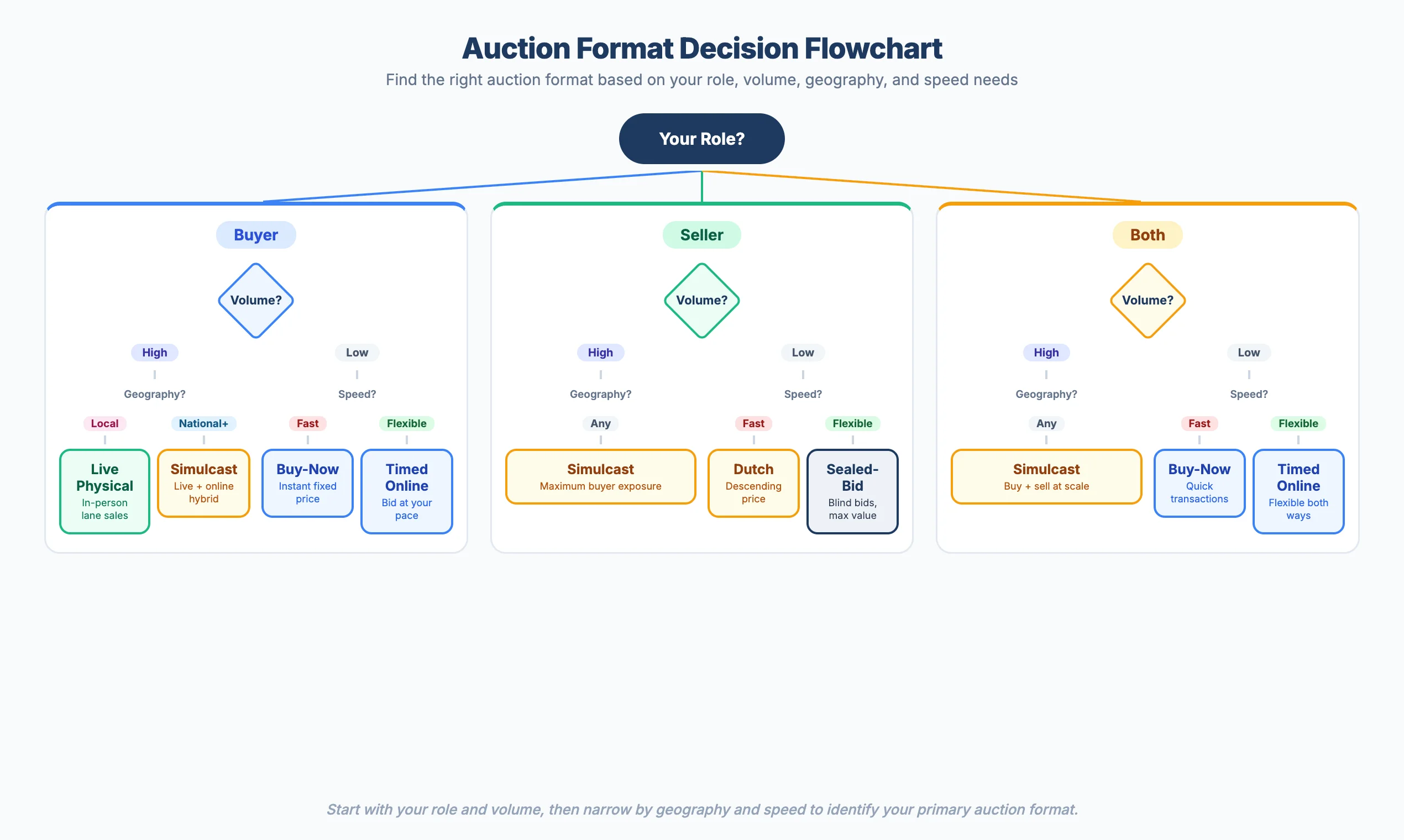 Start with your role and volume, then narrow by geography and speed to identify your primary auction format.
Regional Format Differences
Auction format adoption varies by region, shaped by market maturity, infrastructure, regulation, and buyer preferences. North America and Europe account for over 60% of the global B2B vehicle auction market, but they favor different format mixes.
| Region | Market Share | Dominant Formats | Key Platforms | Notable Trend |
|---|---|---|---|---|
| North America | ~34% of global market | Simulcast + Timed Online | Manheim, ADESA, ACV Auctions | 73%+ of Manheim transactions digital |
| Europe | ~28% of global market | Timed Online + Buy-Now | AUTO1, BCA, OPENLANE Europe, CarOnSale | Cross-border; OPENLANE offers 5 formats |
| United Kingdom | Subset of Europe | Simulcast (hybrid) | BCA (600K+ vehicles/yr) | Physical lanes + simultaneous online bidding |
| Asia-Pacific | ~26% of global market | Live Physical + Timed Online | USS (Japan), Manheim (Australia) | Rapid digitalization |
North American markets developed around large physical auction campuses — Manheim’s 81 locations and ADESA’s 56 sites — then layered simulcast technology on top. The result is a hybrid ecosystem where floor and online buyers compete in the same sales. Digital-native platforms like ACV Auctions (743,000 units, 35% franchise rooftop penetration) are growing rapidly within this structure, pushing the overall digital share above 73%.
European markets skipped the physical mega-campus model and built around digital-first platforms. AUTO1 Group connects 44,000+ dealers across 30+ countries through timed online auctions. OPENLANE Europe offers five distinct formats — Dynamic (timed), Blind (sealed-bid), Buy Now, Target (offer-based), and 24/7 Stock — giving sellers and buyers more format flexibility than any single North American platform. The global online car auction market reached $5.2 billion in 2023 and is projected to grow to $12.7 billion by 2032 at a 10.6% CAGR.
Frequently Asked Questions
What is the most common B2B format?
Timed online auctions handle the highest volume of B2B vehicle transactions globally. ACV Auctions alone processed 743,000 vehicles in 2024, while AUTO1 Group moved 689,773 across Europe. In North America, simulcast remains dominant at legacy platforms like Manheim, where 73%+ of transactions go to digital buyers participating remotely in auctioneer-led sales.
Can I use multiple formats simultaneously?
Yes. Most active dealers and remarketing professionals operate across two to three formats. A mid-volume dealer might source primarily through timed online auctions, attend simulcast sales for premium inventory, and use buy-now to fill urgent stock gaps. Platforms like OPENLANE Europe offer five formats within a single account, making multi-format participation straightforward.
Which format gets the highest price for sellers?
Simulcast and live physical auctions typically produce the highest hammer prices because they combine real-time competitive pressure with the largest bidder pools. The auctioneer-driven pace creates urgency that ascending timed auctions lack. However, timed auctions achieve competitive results at scale — ACV Auctions generated $9.5 billion in GMV across 743,000 vehicles in 2024, demonstrating strong price realization in a fully digital format.
Are Dutch auctions used in B2B vehicle sales?
Rarely. Dutch auctions appear in specific scenarios — aged inventory liquidation, end-of-quarter disposals, and experimental platform features — but they represent a small fraction of overall B2B volume. Most platforms favor ascending-bid or fixed-price formats. Buyers interested in the Dutch format should look for it as a secondary option on platforms that specialize in aged or slow-moving stock.
How do I find which platform uses which format?
The platforms directory lists every B2B vehicle auction platform with its supported auction formats, regions, and access requirements. Filter by format type to see which platforms in your region offer timed, simulcast, sealed-bid, or buy-now options. OPENLANE Europe offers the widest format selection (five types), while ACV Auctions and AUTO1 operate exclusively as timed online platforms.
Conclusion
No single auction format serves every scenario. Live physical auctions reward hands-on inspection and competitive instincts. Timed online auctions scale to hundreds of simultaneous listings across borders. Simulcast combines both channels into the largest bidder pools. Sealed-bid and Dutch formats serve institutional and niche use cases. Buy-now delivers speed and certainty when time matters more than price optimization.
The professionals who consistently outperform in wholesale vehicle sourcing and selling operate across multiple formats. With 41% of dealers already adopting hybrid models and 58% of transactions occurring on mobile, format fluency is becoming a baseline requirement — not a differentiator. Start by benchmarking your current format mix, compare auction fees across the platforms you use, and model your total costs with the Landed Cost Calculator and Net Proceeds Calculator. The format data in this guide provides the framework — your operational profile determines which combination delivers results.