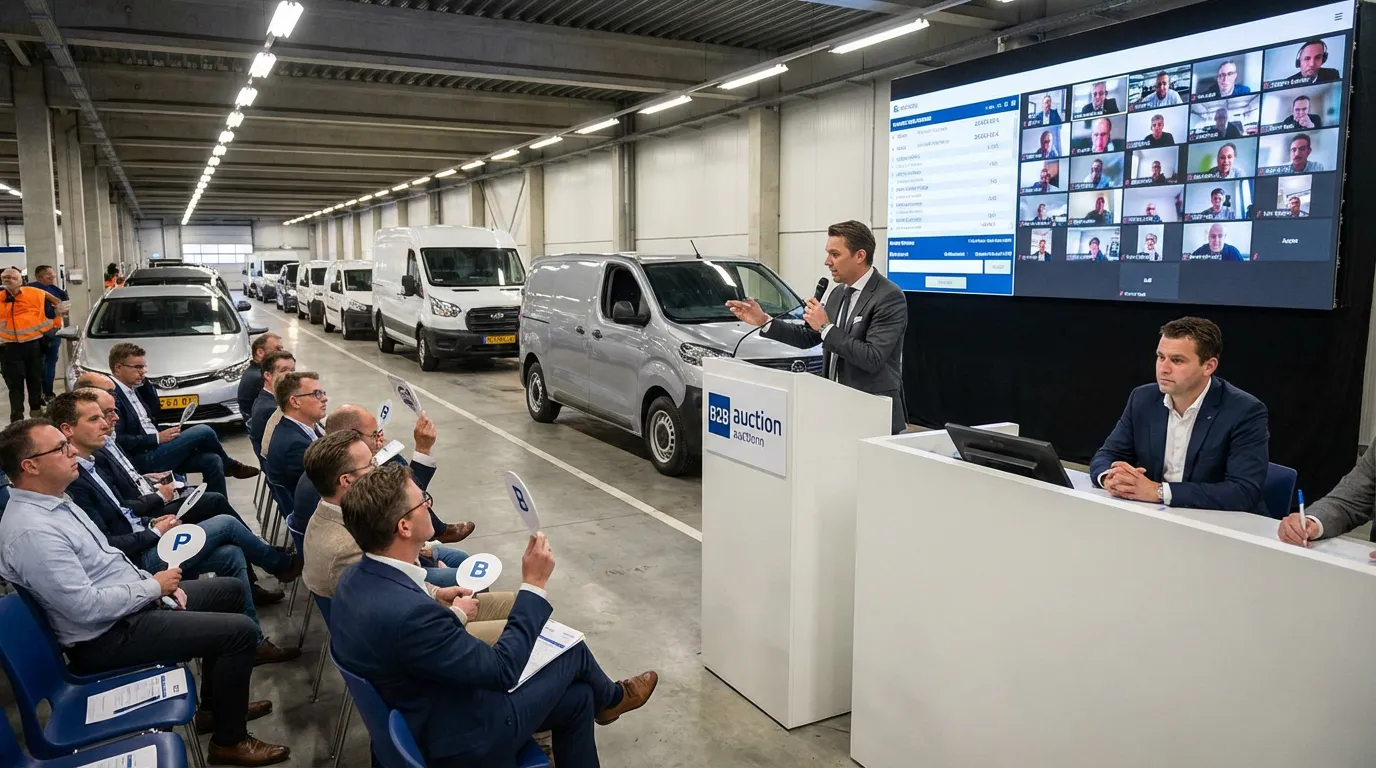
Over 73% of Manheim transactions now go to digital buyers — many of them participating in a simulcast auto auction while an auctioneer runs a physical lane sale in real time. Simulcast is the format that merges live, auctioneer-led auctions with simultaneous online participation, creating the largest bidder pools in wholesale by combining floor buyers and remote buyers in a single sale stream.
This guide covers simulcast auction mechanics, the regional landscape, step-by-step bidding strategy, and the structural timing advantage floor bidders hold over online participants. For a broader overview of all B2B auction formats, see the auction types guide. For a head-to-head comparison of the two formats simulcast bridges, see Timed vs Live Auctions.
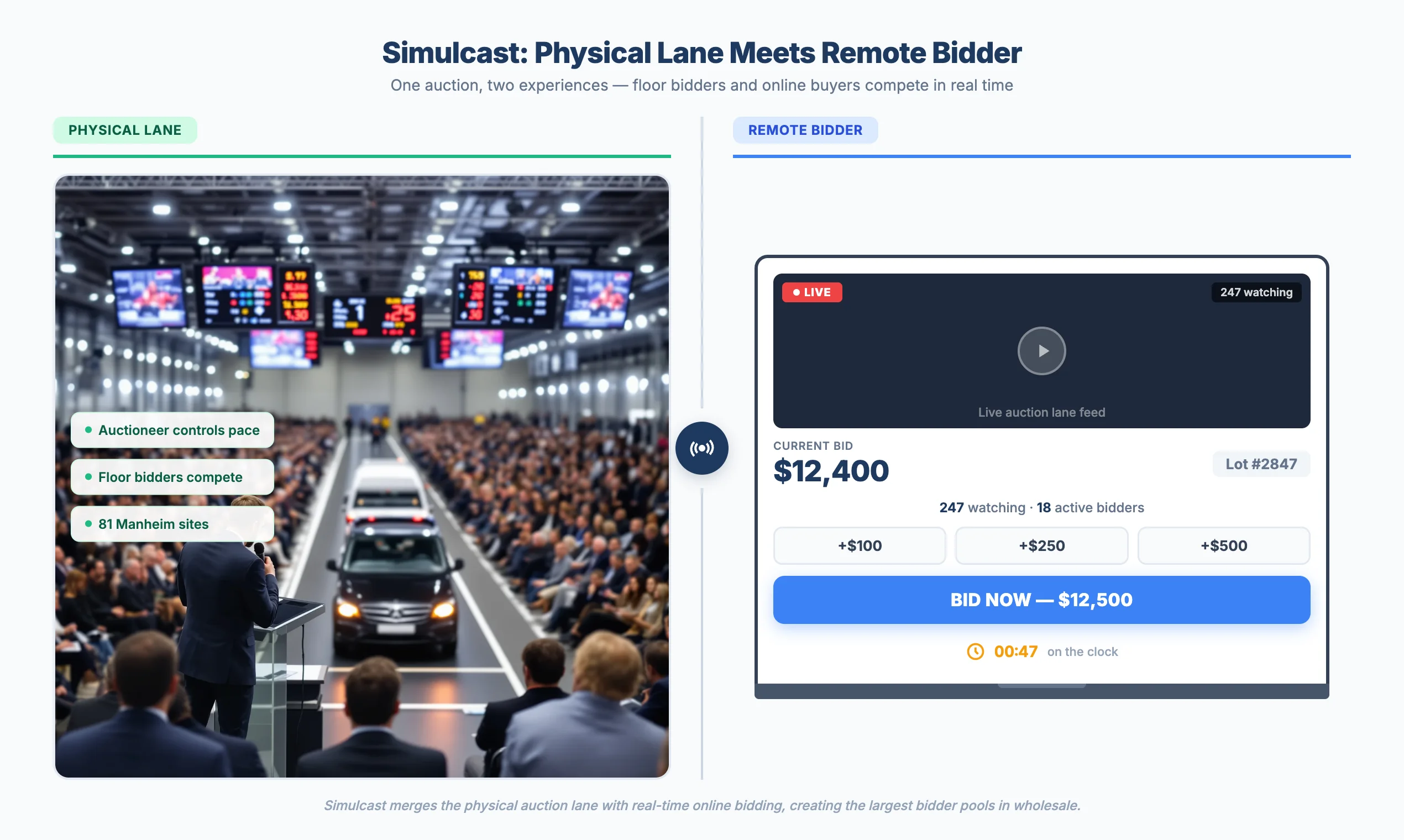 Simulcast merges the physical auction lane with real-time online bidding, creating the largest bidder pools in wholesale.
What Is a Simulcast Auction?
The term simulcast blends “simultaneous” and “broadcast.” An auctioneer runs a physical lane sale in real time while a platform broadcasts video, audio, and bidding data to remote participants. Floor bids and online bids feed into a single auction stream — the auctioneer does not distinguish between the two. Each vehicle sells in 60–90 seconds, matching the pace of a traditional live auction.
Simulcast differs fundamentally from timed auctions, which run asynchronously over hours or days with no auctioneer controlling pace. It also differs from live-only auctions that require physical attendance. Simulcast combines both channels: the competitive urgency of a live lane and the geographic reach of digital participation.
Simulcast by the Numbers
| Metric | Value | Source |
|---|---|---|
| Digital buyer share (Manheim) | 73%+ of transactions | Cox Automotive / Manheim (2023) |
| Online vs. in-lane split (NAAA) | ~50% online / ~50% in-lane at simulcast sales | NAAA 2023 Survey |
| Peak simulcast attendees per lane | ~600 average; 107,000+ unique weekly | Manheim (2021) |
| ADESA Simulcast+ bids per vehicle | ~20% more bids vs. standard simulcast | OPENLANE Corporate (2020) |
| Total NAAA member volume (2024) | 7.6M vehicles at $13,921 avg. hammer price | NAAA 2024 Annual Review |
These figures confirm simulcast as the majority transaction channel at North American wholesale auctions. Higher bidder density per lane drives competitive pricing — ADESA’s Simulcast+ platform generated approximately 20% more bids per vehicle compared to standard simulcast, processing over 400 auction events and attracting 11,000+ buying dealers.
Where Simulcast Operates
| Region | Simulcast Prevalence | Key Platforms | Notes |
|---|---|---|---|
| North America | Dominant hybrid format | Manheim (81 sites), ADESA (56 locations) | 73%+ of Manheim transactions go to digital buyers |
| United Kingdom | Active hybrid model | BCA Live Bidding, Manheim UK Simulcast | Floor and online participation in lane sales |
| Continental Europe | Low prevalence | N/A — digital-first timed platforms dominate | AUTO1, CarOnSale, OPENLANE Europe use timed formats |
| Asia-Pacific | Present but limited | USS (Japan), Manheim Australia | Japan's USS runs large-scale physical auctions with online bidding components |
North America is the simulcast heartland. Manheim and ADESA/OPENLANE US built their networks around large physical auction campuses, then layered digital technology on top through simulcast platforms. ADESA replaced its legacy LiveBlock system with ADESA Simulcast in April 2019, powered by Auction Frontier’s Velocicast cloud-based technology, completing the rollout across all US and Canadian locations by June 2019.
Continental Europe skipped the physical mega-campus model entirely. Platforms like OPENLANE Europe and ACV Auctions operate 100% digital timed auctions with no simulcast component. The UK straddles both models — BCA runs live lanes with simultaneous online access through its Live Bidding service, and Manheim UK offers simulcast at its auction centres.
Simulcast Technology and Requirements
Modern simulcast auction platforms run in standard web browsers — no plugins, downloads, or specialized hardware are required. Manheim Simulcast supports Windows 10+ and macOS 10.15+ with a recommended minimum of 8 GB RAM and an Intel i7 quad-core processor for smooth video streaming. Both Manheim and BCA also offer mobile apps (iOS and Android) with full simulcast bidding capability.
The most critical technical factor is network quality. A stable, wired internet connection minimizes the latency between clicking the bid button and the bid registering on the auction floor. Wi-Fi adds variable delay that compounds with distance from the router and network congestion. Dealers who rely heavily on simulcast sourcing should treat a wired Ethernet connection as essential infrastructure, not optional.
How Simulcast Bidding Works
Pre-sale preparation
Review the run list, inspect condition reports and photos, and set proxy bids on target vehicles. Proxy bids on Manheim must be entered in $50 increments and can only be set before the vehicle reaches the block.
Join the lane
Log into the simulcast platform, select the lane, and confirm your audio/video feed is active. Multiple lanes run simultaneously at large sites.
Follow the auctioneer
The auctioneer calls bids in real time. The interface displays the current bid, bid increments, and your position. Floor bids and online bids appear in the same stream.
Place your bid
Click the bid button when the auctioneer calls for the next increment. Your bid transmits to the auction floor, where it competes with in-lane bids in real time.
Win or pass
If you hold the high bid when the auctioneer drops the hammer, you win. The vehicle moves to your account for payment and transport arrangement.
After winning a vehicle, the post-sale process follows the same workflow as any auction purchase: the platform generates an invoice reflecting the hammer price plus applicable fees, and the buyer arranges payment within the platform’s settlement window (typically 2–3 business days). Transport can be booked directly through the platform’s logistics service or independently. Vehicles that do not meet the reserve price result in a no sale, and the buyer sees the vehicle pass without a transaction.
The Floor-Bidder Advantage
In a simulcast auction, online bidders do not compete on equal footing with floor bidders. A floor bidder’s hand signal is accepted by the auctioneer before an online bid can be transmitted, processed, and displayed on the auction floor. This structural timing gap means online bids may arrive after the auctioneer has already moved on — particularly on slower connections.
Proxy bidding and early bidding are the two primary countermeasures. Strategies to manage the floor-bidder timing advantage:
- Use proxy bids on high-priority vehicles to ensure your bid is already in the system before the vehicle reaches the block
- Bid early in each increment cycle rather than waiting for the last moment
- Use a wired connection and close bandwidth-heavy applications to minimize network latency
- Monitor multiple lanes but focus active bidding on one lane at a time to maintain response speed
- Accept that some vehicles will sell to floor bidders at the same price you intended to bid — factor this into sourcing volume targets
Simulcast Fees and Total Cost
Simulcast introduces an additional cost layer beyond standard auction fees. Manheim charges a $50 per-transaction simulcast buyer fee on top of its standard auction fees. Other platforms bundle simulcast access into their standard fee structure without a separate line item.
| Platform | Simulcast Fee | Notes |
|---|---|---|
| Manheim (US) | $50 per transaction | Publicly confirmed; in addition to standard buyer fees |
| ADESA / OPENLANE US | Bundled into standard fees | Not separately disclosed |
| BCA UK | Included in buyer fee tier | Live Bidding access included with account |
| Manheim UK | Included in buyer fee | Simulcast access included with registration |
These fees must be factored into maximum bid calculations before the sale starts. A $50 simulcast fee on a $10,000 vehicle represents 0.5% of the hammer price. At scale, that cost compounds — 100 purchases per year at $50 each adds $5,000 in additional acquisition cost. Use the Auction Fee Comparator to model per-vehicle costs across simulcast platforms, and see the buyer fees guide for a comprehensive breakdown of buyer-side fees.
Conclusion
Simulcast is the dominant transaction channel at North American wholesale auctions, merging the competitive dynamics of live lane sales with the reach of digital participation. The format demands different preparation than timed auctions — pre-sale proxy bids, real-time attention, and awareness of the floor-bidder timing gap are essential for remote buyers competing against in-lane participants.
For the broader auction format landscape, return to the auction types guide. Compare timed and live formats in the Timed vs Live Auctions sibling guide, review all buyer-side costs in the auction fees guide, and use the Landed Cost Calculator to model total acquisition cost including simulcast fees, transport, and reconditioning. To determine which auction format mix suits your operation, try the Auction Type Selector or the Remarketing Channel Mix Calculator.
Frequently Asked Questions
Is simulcast the same as a timed online auction?
No. Simulcast runs in real time with an auctioneer controlling pace — each vehicle sells in 60–90 seconds. Timed auctions run asynchronously over hours or days with no auctioneer. The competitive dynamics, speed of decision-making, and bidder pool composition differ significantly between the two formats. See Timed vs Live Auctions for a detailed comparison.
Do I need special equipment to participate in simulcast?
No. Modern simulcast platforms run in standard web browsers and on mobile apps. A stable, preferably wired, internet connection is the most important technical requirement. No specialized hardware or software is needed.
Can I set a maximum bid in simulcast like in timed auctions?
Yes, via proxy bidding. On Manheim, proxy bids must be entered in $50 increments and can only be set before the vehicle reaches the block. Once the auctioneer begins the sale, proxy bids on that vehicle cannot be entered, edited, or deleted. BCA also supports pre-sale proxy bids through its Buyer app, accepted until midnight before sale day.
Do online bidders have a disadvantage compared to floor bidders?
Yes. Floor bidders have a structural timing advantage because their bids are accepted by the auctioneer before an online bid can be transmitted and processed. The practical impact depends on connection quality — a wired connection minimizes delay. Using proxy bids and bidding early in each increment cycle are the two most effective countermeasures.
Which platforms support simulcast auctions?
In North America, Manheim (81 sites) and ADESA/OPENLANE US (56 locations) are the primary simulcast operators. In the UK, BCA Live Bidding and Manheim UK Simulcast offer remote participation in live lane sales. Independent auctions in the US use third-party simulcast platforms like EDGE Simulcast (Auction Edge) and Velocicast (Auction Frontier). Continental European platforms generally use timed auction formats rather than simulcast.