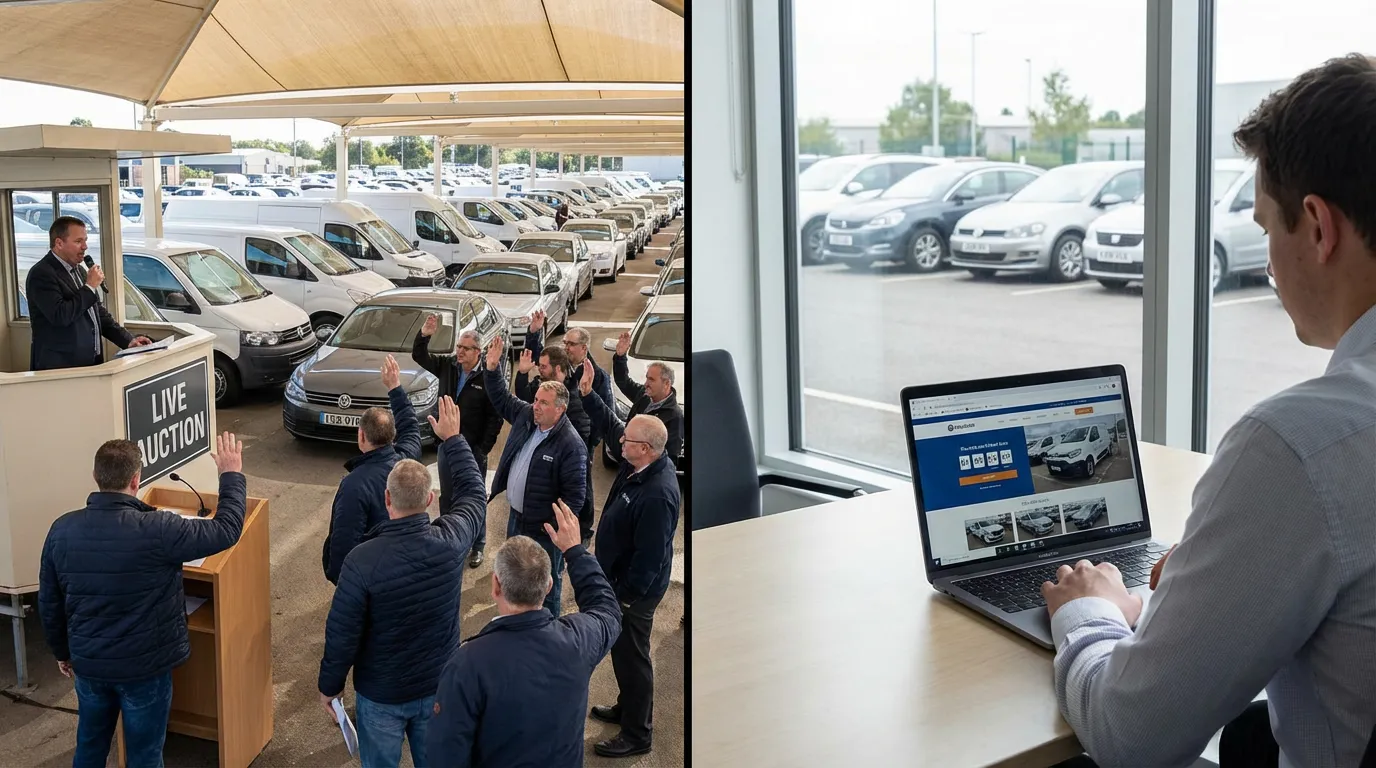
The Two Dominant Formats
NAAA members sold 7.6 million vehicles in 2024, generating $105 billion in gross wholesale volume at an average hammer price of $13,921. Those transactions moved through two dominant formats: timed online auctions, where bidding runs asynchronously over hours or days, and live physical auctions, where an auctioneer sells each vehicle in 60–90 seconds on the lane. A roughly 50/50 simulcast split at NAAA auctions — floor bidders and remote bidders competing in the same sale — reflects the ongoing convergence of the two models.
The shift toward digital continues to accelerate. Over 73% of Manheim transactions now go to digital buyers, and 58% of wholesale transactions occur via mobile devices. Yet 41% of dealers operate hybrid models that combine both formats. This guide provides a head-to-head comparison of timed and live auctions — mechanics, pricing, regional trends, and a decision framework. For a broader overview covering all six B2B auction formats (including simulcast, sealed-bid, buy-now, and Dutch), see the parent auction types guide.
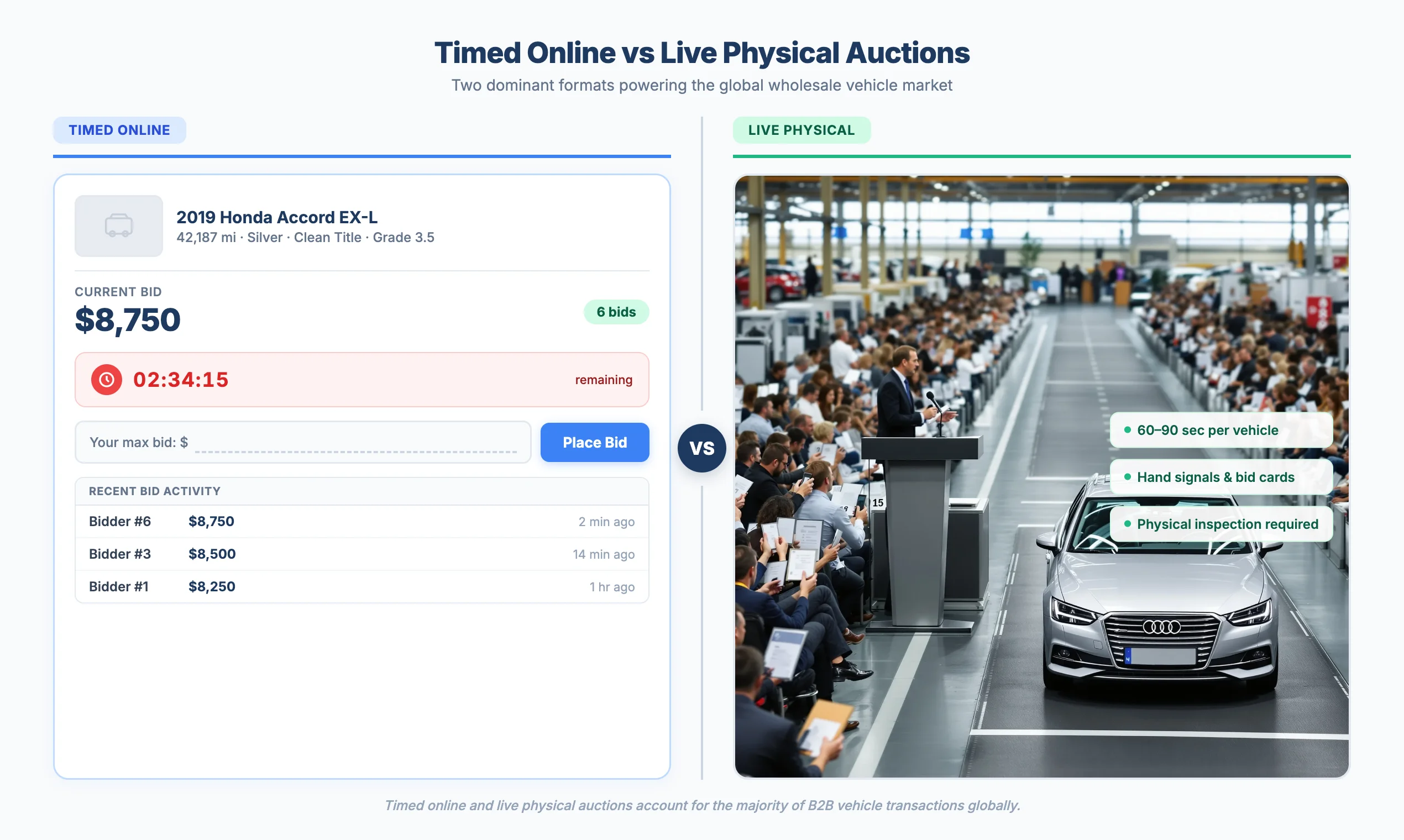 Timed online and live physical auctions account for the majority of B2B vehicle transactions globally.
How Timed Online Auctions Work
Timed auctions run asynchronously within a defined bidding window. Platforms set a start time and a closing time — ranging from 20 minutes to 72 hours depending on the platform — and buyers place bids at any point during that window. Most platforms support proxy bidding, where buyers enter a maximum amount and the system bids incrementally on their behalf up to that ceiling. No auctioneer is involved; the platform’s software manages bid increments, extensions, and closing.
The format dominates digital-first platforms. ACV Auctions processed 743,000 vehicles in 2024 using a 20-minute timed format. AUTO1 Group sold 689,773 vehicles across 30+ countries through timed listings connecting 44,000+ dealer buyers. OPENLANE Europe offers its Dynamic format — a timed auction with automatic extensions — alongside four other bidding options. CarOnSale runs timed auctions across European markets with transparent fee schedules.
Key mechanics of timed online auctions:
- Bidding window: 20 minutes (ACV Auctions) to 72 hours (varies by platform and vehicle type)
- Proxy bidding: Set a maximum bid; the system auto-bids in defined increments up to your ceiling
- Soft close / anti-sniping: Bidding window auto-extends (typically 1–5 minutes) when a bid arrives in the final moments, preventing last-second tactics
- Condition reports: Buyers rely on platform-provided inspection reports, photos, and condition grades rather than physical inspection
- No auctioneer: Price discovery happens through incremental bidding, not competitive calling
How Live Physical Auctions Work
Live physical auctions operate on a lane system at dedicated auction sites. Vehicles drive through an auction lane, a licensed auctioneer calls bids in real time, and buyers compete using hand signals or bid cards. Each vehicle sells in 60–90 seconds. The format demands physical presence — buyers arrive early to inspect vehicles on the lot, then take positions in the lane for scheduled sale events.
North America remains the stronghold for live physical auctions. Manheim operates 81 physical sites and ADESA runs 56 US locations with lane-based sales. NAAA member auctions processed 7.6 million vehicles in 2024 at a 61.3% conversion rate. In Europe, BCA runs live lanes across the UK, though it increasingly combines floor and online participation in hybrid events. Across the industry, 41% of dealers use hybrid models that include live attendance as part of a broader sourcing strategy.
Key mechanics of live physical auctions:
- Auctioneer-led: Licensed auctioneer controls pace, calls bids, and confirms sales
- Lane-based: Vehicles drive through lanes on scheduled sale days; multiple lanes run simultaneously at large sites
- 60–90 seconds per vehicle: Rapid pace demands pre-sale preparation and fast decision-making
- Physical inspection: Buyers walk the lot before the sale, examining paint, body condition, mechanical indicators, and interior wear
- Hand signals / bid cards: Bids placed through physical gestures recognized by the auctioneer and ringmen
Timed vs Live: Head-to-Head Comparison
| Dimension | Timed Online | Live Physical |
|---|---|---|
| Bidding pace | Asynchronous; 20 min–72 hours | Real-time; 60–90 sec per vehicle |
| Vehicle inspection | Condition reports, photos, grades | Physical walk-around before sale |
| Buyer pool reach | National/international; no geographic limit | Local/regional to auction site |
| Time commitment | Minutes per vehicle; bid on 20+ simultaneously | Full day per sale event (8–10 hours) |
| Price discovery | Incremental proxy bids over hours/days | Auctioneer-driven urgency in seconds |
| Impulse risk | Low — proxy bidding enforces discipline | High — fast pace and lane pressure |
| Travel cost | None | $200–$1,000+ per trip (fuel, hotel, time) |
| Technology required | Internet connection, device | Physical presence; optional simulcast access |
| Scalability | High — monitor hundreds of listings across platforms | Low — limited to one lane at a time |
| Platform examples | ACV Auctions, AUTO1, CarOnSale, OPENLANE EU | Manheim (81 sites), ADESA (56 locations) |
Neither format is categorically superior. Timed auctions offer scale, convenience, and cost efficiency — a dealer can bid on 20 vehicles across three platforms in the time it takes to attend one live sale. Live auctions offer physical inspection, real-time competitive dynamics, and networking that digital platforms cannot replicate. The right choice depends on vehicle type, volume, geography, and risk tolerance.
Price Dynamics and Competitive Pressure
Price formation differs fundamentally between the two formats. In live auctions, the auctioneer creates urgency through pace and vocal technique — competitive pressure builds rapidly as bidders react to each other in real time. In timed auctions, price discovery is slower and more deliberate; proxy bidding allows buyers to set a rational maximum before emotions enter the equation.
Industry data shows a significant gap in average transaction values: digital-only auction platforms report approximately $27,500 average transaction value (ACV Auctions, based on $9.5 billion GMV across 343,000 dealer marketplace units), compared to $13,921 overall across all NAAA member auctions. This gap reflects vehicle mix — digital platforms skew toward newer, higher-value dealer trade-ins and off-lease units — not inherent format superiority. The NAAA average includes high volumes of lower-value salvage and aged inventory sold through physical lanes.
| Metric | Timed Online | Live Physical |
|---|---|---|
| Avg. transaction value | ~$27,500 (ACV digital marketplace) | $13,921 (NAAA all-format average) |
| Conversion rate | Platform-dependent; varies widely | 61.3% (NAAA 2024 average) |
| Competitive intensity | Moderate — proxy bids set ceiling | High — auctioneer-driven urgency |
| Sniping risk | Eliminated by soft-close rules | N/A — bids are verbal/physical |
| Impulse overbidding risk | Low — pre-set maximums via proxy | High — pace and crowd pressure |
Regional Adoption and Market Trends
| Region | Dominant Format | Key Data Point | Direction of Travel |
|---|---|---|---|
| North America | Hybrid (simulcast + timed) | 73%+ of Manheim transactions go to digital buyers | Physical campuses adding digital layers; ADESA expanding digital-only offering |
| Continental Europe | Timed online | AUTO1: 689K vehicles across 30+ countries; OPENLANE EU offers 5 formats | Digital-first; cross-border timed auctions growing |
| United Kingdom | Hybrid (live lanes + online) | BCA: 600K+ vehicles/yr through UK lanes; moved to online-only during 2020 | Physical lanes returning with simultaneous online access |
| Global market | Timed online growing | Online car auction market: $5.2B (2023) → projected $12.7B by 2032 (10.6% CAGR) | Mobile transactions at 58%; digital share increasing across all regions |
North America built its wholesale infrastructure around large physical auction campuses — Manheim’s 81 sites and ADESA’s 56 locations — then layered digital technology on top through simulcast and timed platforms. The result is a hybrid ecosystem where floor buyers and online buyers compete in the same sales. Digital-native platforms like ACV Auctions (743,000 vehicles, 35% franchise rooftop penetration) are expanding rapidly within this established infrastructure. ADESA is accelerating its digital-only offering through its Clear expansion program, unlocking a seamless digital auction experience across the country.
Europe skipped the physical mega-campus model and built around digital-first platforms. AUTO1 Group connects 44,000+ dealers across 30+ countries through timed online auctions. OPENLANE Europe offers five distinct formats within a single platform. BCA transitioned to online-only auctions during 2020 and has since restored hybrid events combining live lanes with simultaneous online access. The global online car auction market reached $5.2 billion in 2023 and is projected to grow to $12.7 billion by 2032 at a 10.6% CAGR, with 58% of transactions now occurring on mobile devices.
Choosing the Right Format
Assess vehicle value and condition risk
High-value vehicles (above $25,000) or units with uncertain mechanical condition benefit from live physical inspection before bidding. Commodity vehicles under $15,000 with strong condition reports and detailed photos suit timed auctions where speed and scale matter more than hands-on evaluation.
Calculate your time cost
A live auction trip consumes 8–10 hours including travel, inspection, and lane time. In that same window, a timed auction lets you research and bid on 20+ vehicles simultaneously across multiple platforms. Quantify the hourly cost of your time and factor it into your per-vehicle acquisition calculation.
Evaluate geographic access
Dealers within 60–90 minutes of active auction sites gain clear value from live attendance. Operations spread across multiple states or countries — or located far from major auction campuses — benefit from timed formats that eliminate travel entirely.
Match format to vehicle type
Specialty, luxury, and classic vehicles benefit from the competitive lane dynamics and physical inspection of live auctions. Fleet off-lease returns, rental de-fleet units, and high-volume dealer trade-ins move efficiently through timed auctions where condition reports provide adequate information.
Default to hybrid — then optimize the ratio
41% of dealers already combine both formats. Start with a 60–70% timed / 30–40% live split, then adjust based on results. Track acquisition cost, condition accuracy, and return rates by format to find your optimal mix over 6–12 months.
Conclusion
Timed and live auctions are complementary formats, not competing ones. Timed auctions deliver scale, convenience, and cost efficiency — access to thousands of vehicles across platforms without leaving your desk. Live auctions deliver physical inspection, competitive lane dynamics, and the networking that sustains long-term dealer relationships. The 41% of dealers who already combine both formats recognize that each covers gaps the other cannot.
The operational question is not which format to use, but what ratio serves your vehicle mix, geography, and volume. Start with the decision framework above, compare auction fees across the platforms you evaluate, model total acquisition costs with the Landed Cost Calculator and Net Proceeds Calculator, and explore individual platforms in the platforms directory. For simulcast — the format that merges timed and live into a single sale — see the simulcast auctions.
Frequently Asked Questions
Are timed online auctions replacing live auctions?
Timed auctions are growing rapidly — the global online car auction market is projected to reach $12.7 billion by 2032 at a 10.6% CAGR — but they are not replacing live auctions. Over 73% of Manheim transactions go to digital buyers, yet Manheim continues to operate 81 physical sites. NAAA members processed 7.6 million vehicles in 2024 through a mix of live, simulcast, and timed formats. The trend is hybrid adoption: 41% of dealers combine both formats, using timed auctions for volume and live attendance for high-value or condition-sensitive units.
Do timed auctions get higher prices than live auctions?
The data shows higher average transaction values at digital-only platforms (~$27,500 at ACV Auctions) compared to the all-format NAAA average ($13,921). However, this gap reflects vehicle mix — digital platforms concentrate newer, higher-value trade-ins and off-lease units — not an inherent price advantage of the timed format. Identical vehicles sold through timed and live channels typically achieve comparable hammer prices. Use the Auction Fee Comparator to compare total costs by format and platform.
What is soft close in a timed auction?
Soft close is an anti-sniping mechanism used in timed auctions. When a bid arrives within the final moments of a closing window (typically the last 1–5 minutes), the platform automatically extends the auction by a set period — usually one to five additional minutes. This prevents buyers from winning vehicles by placing last-second bids that other participants cannot respond to. All major timed platforms — ACV Auctions, OPENLANE Europe, CarOnSale — use soft-close rules.
Can I bid in a live auction remotely?
Yes, through simulcast. Simulcast auctions broadcast live lane sales to remote bidders who participate in real time alongside floor buyers. Manheim charges a $50 fee per transaction for simulcast access. BCA offers simultaneous online bidding during its live UK lane sales. Remote bidders compete on equal terms with floor bidders, though slight network latency may give in-person participants a timing edge. For a detailed breakdown of simulcast mechanics and strategy, see the simulcast auctions.