
Cross-border vehicle buying is the purchase of a vehicle in one country for registration and resale in another. For B2B auction buyers, the business case rests on price differentials between markets, but the margin survives only if customs duty, VAT, transport, type approval, and currency costs are modelled before the bid. This guide covers the three corridors that matter most to dealers and remarketing professionals: trade inside the EU single market, the UK-EU corridor after Brexit, and the US-Canada-Mexico corridor under the 2025–2026 tariff regime.
Every figure in this guide was re-verified against primary sources on 21 September 2026. Where a rule changes on a known date — the 1 January 2027 EV rules of origin, the announced 50% US tariff on Canadian vehicles — the date is stated so you can plan around it.
Why Does Cross-Border Vehicle Buying Make Business Sense?
Cross-border buying pays because vehicles depreciate at different rates in different markets and because fleet disposal cycles create predictable supply surges in Western Europe that Central and Eastern European demand absorbs. Poland alone imported 948,461 used cars and vans in 2025 after a record 967,579 in 2024, and roughly 52% of them came from Germany, according to IBRM Samar. Since EU accession in 2004 Poland has imported well over 14 million used vehicles, about half of them from Germany.
The scale of the source markets explains the flow. Germany recorded more than 6.5 million used car ownership transfers in 2025 (KBA), the UK 7.81 million used car transactions (SMMT), and France 5.44 million used car registrations (AAA Data). Czechia registered 148,312 imported used cars in 2025, and Ukraine 278,630 — a 22% increase driven by a year-end rush before tax preferences changed.
Price differentials are widest where residual values diverge. Autovista24 has cited a 36-month, 60,000 km battery electric vehicle trading at an average of EUR 16,371 in France against EUR 24,553 in Spain, an EUR 8,000 gap for the same age and mileage profile. Its 2026 residual value outlook expects regional gaps to keep widening, with Croatia, Czechia, Slovenia, and Romania losing 2.0–2.3 percentage points of residual value and Italy showing the largest downside.
Beyond price, cross-border buying expands inventory access. Dealers restricted to domestic auction formats struggle with thin supply in specific segments — premium, electric, or light commercial. Pan-European platforms aggregate that supply: Autorola reports around 200,000 vehicles a year to 70,000+ registered dealers with roughly half of its sales crossing a border, OPENLANE Europe states 90,000+ vehicles a year to 120,000+ buyers in 50+ countries, and CarOnSale raised a EUR 70 million Series C in July 2025 to scale cross-border trading across 20+ markets. AUTO1 Group moved 842,271 units in 2025 on EUR 8.17 billion revenue.
What Changed for Cross-Border Buyers in 2025 and 2026?
Ten regulatory changes since the beginning of 2025 affect how cross-border vehicle deals are priced. Each is covered in detail in the corridor sections below.
- United States, 3 April 2025: 25% Section 232 tariff on imported passenger vehicles and light trucks, applied to used vehicles as well as new. Vehicles built at least 25 years before the year of entry are exempt.
- Canada, 9 April 2025: 25% surtax on US-origin vehicles, including used vehicles bought at US auctions. Still in force in September 2026.
- EU, 14 April 2025: VAT in the Digital Age (ViDA) package in force. Intra-EU B2B e-invoicing and digital reporting become mandatory on 1 July 2030, and recapitulative statements (EC Sales Lists) are abolished on the same date.
- US trade deals, August–November 2025: all-in vehicle tariff of 15% for EU (from 1 August 2025), Japan (from 16 September 2025), and South Korea (from 1 November 2025); 10% for UK vehicles within a 100,000-unit annual quota.
- EU VAT rates, 2025: Slovakia 23% (1 January), Estonia 24% (1 July), Romania 21% (1 August). No member state changed its standard rate for 2026.
- EU-UK, 1 June 2026: the last national derogations from ICS2 pre-arrival safety declarations for road and rail ended; enforcement is now full across the EU.
- Belgium, Croatia, Poland, France, 2026: domestic B2B e-invoicing mandates started (Belgium and Croatia 1 January, Poland 1 February and 1 April, France 1 September for receipt). They cover domestic invoices only.
- USMCA, 1 July 2026: the United States declined to renew the agreement at its joint review, triggering annual reviews. The agreement itself remains in force.
- EU, 13 August 2026: the End-of-Life Vehicles Regulation (EU) 2026/1738 entered into force. Restrictions on exporting non-roadworthy used vehicles outside the EU apply from 1 September 2031; intra-EU trade is not affected.
- US-Canada, 24 August 2026: after trade talks collapsed, the US administration announced 50% tariffs on all Canadian cars, trucks, parts, and steel from 1 January 2027. As of 21 September 2026 no proclamation implementing the 50% rate has been published.
One date to diary: 1 January 2027, when EU-UK electric vehicles need 55% UK/EU content to stay duty-free and when the announced 50% US tariff on Canadian-built vehicles is due to start.
How Does Intra-EU B2B Vehicle Trade Work?
Vehicles traded between EU member states move with zero customs duty, no customs declaration, and no border inspection, but the VAT treatment, transport evidence, and registration paperwork decide whether the deal is clean. A Polish dealer buying at a German auction owes no duty; they owe a correctly documented intra-Community acquisition and a Certificate of Conformity that the Polish registration office will accept.
Zero duty, but not zero compliance
Free movement of goods applies to all vehicle types regardless of where the vehicle was originally manufactured. A Japanese-built car first registered in Germany is a Union good and moves to Poland duty-free. The compliance work sits elsewhere: the vehicle needs a valid EU Certificate of Conformity (CoC) or national type approval, deregistration in the origin country, and re-registration under the destination country’s national procedure.
Roadworthiness certificates should transfer under Article 9 of Directive 2014/45/EU, which obliges the re-registering member state to recognise a valid test certificate from another member state. In practice several registration authorities still demand a fresh national test before first registration. Budget for one: a Polish technical inspection costs PLN 149, a German HU with a TÜV or DEKRA station EUR 150–300.
The VAT reverse charge: what the 2020 Quick Fixes require
For B2B sales between VAT-registered businesses in different member states, the seller invoices at 0% as an exempt intra-Community supply under Article 138 of the VAT Directive, and the buyer self-assesses VAT at the destination rate on their own return. For a fully VAT-registered dealer the output and input VAT cancel, so the cash impact is zero. Since the 2020 Quick Fixes the exemption has five substantive conditions:
- The buyer holds a valid VAT identification number in a member state other than the country of departure and has communicated it to the seller before the sale
- The seller validates that number through VIES and keeps the consultation reference
- The seller reports the sale correctly in the recapitulative statement (EC Sales List, in Germany the Zusammenfassende Meldung); a missing or wrong report voids the exemption unless the seller can justify it
- The seller holds transport evidence: under Article 45a of Implementing Regulation 282/2011, two non-contradictory documents issued by two parties independent of each other and of both buyer and seller, for example a signed CMR plus the carrier’s invoice or the transport insurance policy
- Where the buyer collects the vehicle, the buyer also provides a written statement confirming the destination by the tenth day of the month following the supply
National alternatives such as the German Gelangensbestätigung remain valid; Article 45a is a safe harbour, not the only route. Platforms like CarOnSale and OPENLANE Europe verify VAT numbers at onboarding and offer transport that produces the CMR, but the legal responsibility for the exemption stays with seller and buyer.
Margin-scheme vehicles cross the border differently
A used vehicle sold by a taxable dealer under the margin scheme (Articles 311–325 of the VAT Directive) is taxed in the seller’s country on the dealer’s margin. The invoice must carry the mention “Margin scheme — Second-hand goods”, must not show VAT separately, and the buyer cannot deduct any VAT. There is no intra-Community acquisition to declare and the sale does not appear in the EC Sales List.
The two regimes do not mix. A vehicle acquired as a 0% intra-Community supply cannot be resold under the margin scheme, and a margin-scheme vehicle cannot be invoiced as a 0% intra-Community supply. Check the invoice wording on every auction purchase, because a “VAT-qualifying” (regelbesteuert) vehicle and a margin-scheme (differenzbesteuert) vehicle at the same hammer price have different net costs for a buyer who cannot deduct VAT. The EU VAT Rules for Vehicle Purchases deep dive covers rates, registration taxes, and the “new means of transport” rule (under six months old or under 6,000 km, either condition) in full.
Deregistration, export plates, and driving the vehicle home
In Germany, the seller or buyer deregisters the vehicle (Außerbetriebsetzung) at the Zulassungsstelle with a declaration of where it is going. Three plate types then matter.
A Kurzzeitkennzeichen is valid for a maximum of five days, requires an eVB insurance confirmation and normally a valid HU, and is meant for domestic use, so it is not reliably accepted abroad. An Ausfuhrkennzeichen (export plate) is valid from 15 days up to 12 months, is insured through the classic paper Doppelkarte rather than an eVB, requires a valid HU, and is the correct tool for driving a vehicle to another country.
Red 06 dealer plates are for a registered dealer’s own test and transfer drives and cannot be handed to a foreign buyer.
Most volume buyers avoid the question entirely by shipping on a transporter with a CMR consignment note, which also produces the Article 45a transport evidence.
E-invoicing mandates arriving in 2026
Structured e-invoicing is becoming the default for domestic B2B trade across the EU, and dealers who invoice cross-border need to know which mandates touch them. Belgium and Croatia made domestic B2B e-invoicing mandatory on 1 January 2026, Poland’s KSeF system became mandatory on 1 February 2026 for businesses with 2024 turnover above PLN 200 million and on 1 April 2026 for everyone else, and France requires all businesses to be able to receive e-invoices from 1 September 2026. Germany has required businesses to receive e-invoices since 1 January 2025 and will require issuance from 1 January 2027 for turnover above EUR 800,000 and from 1 January 2028 for all.
All of these mandates cover domestic invoices only. A German dealer invoicing a Polish dealer is not yet within the German mandate. The intra-EU obligation arrives with ViDA on 1 July 2030, when structured e-invoices must be issued within ten days of the supply and reported to the tax authority in near real time, replacing the EC Sales List.
How Does the UK-EU Corridor Work After Brexit?
Since 1 January 2021 the UK-EU Trade and Cooperation Agreement (TCA) governs vehicle trade between Great Britain and the EU, and vehicles now need customs declarations in both directions, proof of origin to avoid a 10% duty, pre-arrival safety declarations, and destination-market type approval. The corridor still works, but it works for buyers who understand that a vehicle’s manufacturing origin, not its last country of registration, decides the duty.
Rules of origin: 55% for combustion cars, EV rules tighten on 1 January 2027
Under the TCA a car qualifies for 0% duty when at least 55% of its ex-works value originates in the UK or EU. Vehicles that do not meet the rule, or for which origin cannot be evidenced, pay the Most Favoured Nation (MFN) duty of 10% in both directions. A Japanese-built car driven in the UK for five years is still a Japanese car for origin purposes, and re-exporting it to the EU triggers the full 10%.
Electric vehicles and batteries have been under transitional, less demanding rules since 2021. In December 2023 the EU-UK Partnership Council extended those transitional rules to 31 December 2026 and locked the schedule so it cannot be changed again before 2032 without a fresh decision.
From 1 January 2027, electric vehicles need 55% UK/EU originating value, battery packs 70%, and battery cells 65%. ACEA estimated in June 2026 that 82% of the roughly 520,000 EU-built electric cars and vans expected to be exported to the UK in 2027 would fail the new rule, and wrote to EU leaders again on 16 September 2026 asking for flexibility to 2029. As of 21 September 2026 no extension has been agreed.
Vans are classified under heading 8704 and their MFN duty depends on gross weight and engine size, not weight alone: diesel vans up to 5 tonnes pay 10% at engine sizes up to 2,500 cc and 22% above it, petrol vans switch at 2,800 cc, and vehicles over 5 tonnes pay 22%. The UK Global Tariff mirrors these rates.
| Scenario | Duty Rate | Key Requirement | Common Pitfall |
|---|---|---|---|
| UK-built car (e.g., Sunderland, Solihull) to EU | 0% | Statement on origin or importer's knowledge evidencing 55% UK/EU content | No manufacturer evidence for a used car |
| Japanese-, Korean-, or US-built car re-exported UK to EU | 10% | Customs declaration, duty on customs value plus import VAT | Assuming UK registration confers UK origin |
| EU-built car returning from UK to EU within 3 years | 0% via Returned Goods Relief | Proof of original export from the EU, vehicle unaltered | Missing the 3-year window; import VAT still due |
| Chinese-built used EV (MG, Tesla Shanghai, BYD) UK to EU | 10% | Standard customs procedure; countervailing duty applies to new EVs only | Pre-registered zero-mileage cars classed as new attract the CVD |
| EU-built car to Great Britain | 0% | EU origin statement, GB EORI, CDS declaration, NOVA within 14 days | No GB EORI before shipment |
| Diesel van over 2,500 cc without origin proof, either direction | 22% | Full customs procedure | Budgeting 10% instead of 22% |
Proving origin on a used car
The TCA has no separate proof-of-origin regime for second-hand goods. Preference is claimed with an exporter’s statement on origin (UK exporters need an EORI number; EU exporters above EUR 6,000 need REX registration) or on importer’s knowledge, meaning the importer holds documents showing how the vehicle met the 55% rule when it was built. Origin is fixed at manufacture, so a used UK-built car qualifies only if that manufacturer evidence can be produced — something most dealers never obtain from the OEM.
For EU-built cars that were exported to the UK new and are now coming back used, the practical route is Returned Goods Relief: 0% duty if the vehicle re-enters the EU within three years of leaving and has not been altered. Import VAT remains due — 23% in Ireland, 19% in Germany. The UK operates an equivalent relief for UK-origin vehicles returning within three years.
Chinese-built EVs: the countervailing duty applies to new cars only
Regulation (EU) 2024/2754 imposes countervailing duties on new battery electric vehicles originating in China — 17.0% for BYD, 18.8% for Geely, 35.3% for SAIC (MG), 7.8% for Tesla Shanghai, 20.7% for other cooperating producers, and 35.3% otherwise, all on top of the 10% MFN duty. The regulation’s product scope is new BEVs under CN code 8703 80 10. A genuinely used, UK-registered MG4, BYD, or Shanghai-built Tesla re-exported to the EU falls under CN 8703 80 90 and pays 10% MFN plus import VAT, but no countervailing duty.
Two caveats apply. Customs decide “new versus used” by classification, so a pre-registered car with near-zero mileage can be treated as new and attract the full duty. And the duty is origin-based, so routing new cars through the UK does not avoid it. The Commission published guidance on price undertakings on 12 January 2026 and accepted the first one on 10 February 2026 for the Volkswagen Anhui-built Cupra Tavascan, but no blanket EU-China minimum-price deal replacing the duties exists as of September 2026.
Importing an EU used car into Great Britain
A commercial import into Great Britain requires a GB EORI number, an import declaration through the Customs Declaration Service (CDS) usually filed by a customs agent, and a NOVA notification to HMRC within 14 days of arrival; DVLA will not register the vehicle until NOVA is cleared. Import VAT of 20% is charged on the customs value (price plus freight plus any duty), and VAT-registered businesses can use postponed VAT accounting on their return. A vehicle on which import VAT has been paid becomes VAT-qualifying and is excluded from the UK second-hand margin scheme.
Type approval follows a simple decision tree. Vehicles first registered or manufactured more than ten years ago generally need no approval, only an MOT. Younger right-hand-drive vehicles with an EU Certificate of Conformity can be registered on the CoC.
Younger left-hand-drive vehicles, or vehicles with km-only speedometers or headlamps for right-hand traffic, need a GB Conversion IVA certificate from the Vehicle Certification Agency (GBP 100 for cars and vans up to 3.5 tonnes) alongside the CoC. A full Individual Vehicle Approval (IVA) test costs GBP 199 for a standard car and GBP 450 for the basic test used for amateur-built or rebuilt vehicles. MSVA is the Motorcycle Single Vehicle Approval scheme and does not apply to cars of any age.
Since 31 January 2025 the carrier must lodge an entry summary (safety and security) declaration before arrival for goods moving from the EU into Great Britain, including vehicles on transporters.
Registering a UK vehicle in the EU
Three questions decide whether a UK vehicle can be registered in an EU member state: Does it hold an EU Certificate of Conformity? Is it right-hand drive? And does the destination country accept it?
Vehicles type-approved before 2021 under an EU approval issued in the UK (e11 marks) carry a valid EC CoC from the time of production and are registrable across the EU as used vehicles. Vehicles built since 2021 under GB-only type approval, which the EU does not recognise, need either an EU CoC from the manufacturer — often available because most models are also EU-approved — or a national individual approval such as the German Einzelabnahme under Paragraph 21 StVZO, which is slow and expensive.
Right-hand drive is legal to register in Poland since 15 August 2015, subject to headlamps dipping to the right, a left-side rear fog lamp, a left mirror giving a 2.5 m field of view at 10 m, and a km/h speedometer; no steering conversion is required. Germany and the Netherlands register RHD vehicles after similar lighting and mirror adaptations. Ireland, Cyprus, and Malta drive on the left, so RHD is standard there.
For goods moving from Great Britain into the EU, carriers have had to lodge pre-arrival ENS declarations in the EU’s Import Control System 2 (ICS2) since 1 April 2025 for road and rail, with a transition to 1 September 2025 and national derogations that all ended by 1 June 2026. Enforcement is now full across the EU.
VAT on exports from Great Britain
A UK dealer exporting a used vehicle to an EU business does not sell it under the margin scheme; the export is zero-rated under VAT Notice 703 provided proof of export is held within the time limit, and EU import VAT is then due in the destination state. Since 1 May 2023 the Second-hand Motor Vehicle Payment Scheme allows businesses that buy second-hand vehicles in Great Britain and move them to Northern Ireland or the EU for resale to claim a VAT-related payment; EU VAT-registered businesses buying in Great Britain are eligible.
Ireland: the corridor that shows what Brexit did
Ireland was the largest market for UK used cars before Brexit, and its statistics show what customs formalities and 10% duty do to a corridor. In 2019 more than 108,000 used imports came from the UK, a 95% share. In 2025 Ireland imported 71,813 used cars, up 16.6%, but only 12,847 (18%) came from the UK against 36,043 from Japan. In the first half of 2026 Japan supplied 33,065 (55%) and Great Britain 8,475 (14%).
| Year | Total Used Imports | From UK | UK Share | From Japan |
|---|---|---|---|---|
| 2019 | n/a | 108,000+ | 95% | minor |
| 2024 | 61,583 | n/a | n/a | n/a |
| 2025 | 71,813 | 12,847 | 18% | 36,043 |
| H1 2026 | n/a | 8,475 (GB) | 14% | 33,065 (55%) |
The Irish process for a Great Britain import: customs declaration before arrival, 10% duty unless UK origin is proven or Returned Goods Relief applies, 23% import VAT, then Vehicle Registration Tax (VRT) plus the NOx levy, an NCTS inspection appointment within seven days of arrival, and registration within 30 days. Vehicles that were in Northern Ireland in accordance with the Windsor Framework — evidenced by an NI import declaration for a GB car moved after 31 December 2020, or genuine NI use — enter Ireland without duty or import VAT.
Platforms on the UK-EU corridor
BCA remains part of Constellation Automotive Group (TDR Capital), with BCA Europe operating centres in around ten continental countries. Constellation acquired Aston Barclay in April 2025; the UK Competition and Markets Authority cleared the deal unconditionally on 5 March 2026 and the five Aston Barclay centres are now BCA-branded. Manheim UK (Cox Automotive) continues to run UK physical and online remarketing, OPENLANE Europe sells into the UK through its UK operation, and Autorola has operated in the UK since 2006.
What Do the 2025–2026 Tariffs Mean for the US-Canada-Mexico Corridor?
Since April 2025 the US-Canada corridor has carried tariffs in both directions on top of the 0% USMCA/CUSMA base rate: a 25% US Section 232 tariff on imported vehicles and a 25% Canadian surtax on US-built vehicles, both applying to used units. USMCA’s 75% regional value content rule still determines the base duty, but it no longer determines the total. The rules below are current as of 21 September 2026.
US Section 232: 25% on imported vehicles, used included
Proclamation 10908 imposed a 25% Section 232 duty on passenger vehicles and light trucks entering the United States from 3 April 2025. According to U.S. Customs and Border Protection, used passenger vehicles and trucks are subject to the duty, except those manufactured in a year at least 25 years before the year of entry. A car built in 2001 entered at any point in 2026 qualifies for the exemption under HTSUS 9903.94.04 and pays only the 2.5% MFN base rate.
The Section 232 duty stacks on the MFN base — 2.5% for cars (heading 8703) and 25% for light trucks (heading 8704, the “chicken tax”) — so vehicles from countries without a deal pay 27.5% on cars and 50% on light trucks. Negotiated rates are all-in figures that cap MFN plus Section 232: 15% for EU-origin vehicles from 1 August 2025, 15% for Japan from 16 September 2025, 15% for South Korea from 1 November 2025, and 10% for UK-origin vehicles within an annual quota of 100,000 units, with 27.5% above it. USMCA-qualifying vehicles from Canada and Mexico pay 25% on their non-US content only; non-qualifying vehicles pay 25% on the full value.
The Supreme Court’s ruling of 20 February 2026 in Learning Resources v. Trump struck down tariffs imposed under the International Emergency Economic Powers Act, and those “reciprocal” and border tariffs ended on 24 February 2026. Section 232 vehicle tariffs rest on a different statute and were not affected.
| Origin of Vehicle | Rate into the US (cars) | Basis | Effective |
|---|---|---|---|
| EU (e.g., Germany, Sweden) | 15% all-in | US-EU framework | 1 Aug 2025 |
| Japan | 15% all-in | US-Japan deal | 16 Sep 2025 |
| South Korea | 15% all-in | US-Korea deal | 1 Nov 2025 |
| United Kingdom | 10% all-in within 100,000 units/yr; 27.5% above | US-UK deal | 30 Jun 2025 |
| Canada or Mexico, USMCA-qualifying | 25% on non-US content | Section 232 | 3 Apr 2025 (50% announced for 1 Jan 2027) |
| Canada or Mexico, non-qualifying | 25% on full value + MFN | Section 232 | 3 Apr 2025 |
| Any origin, built 25+ years before year of entry | 2.5% MFN only | Section 232 exemption | 3 Apr 2025 |
| All other origins | 27.5% (cars), 50% (light trucks) | MFN + Section 232 | 3 Apr 2025 |
Canada’s 25% surtax on US-built vehicles
Canada’s United States Surtax Order (Motor Vehicles 2025) has applied a 25% surtax to US-origin vehicles since 9 April 2025. Non-CUSMA-compliant US vehicles pay 25% on the full value for duty; CUSMA-compliant US vehicles pay 25% only on their non-Canadian and non-Mexican content, and the Canada Border Services Agency assumes roughly 85% of the value is surtaxable unless the importer documents otherwise. The surtax applies to new and used vehicles alike, so a dealer buying a US-built truck at a Manheim or ADESA sale in Michigan pays it at the Canadian border.
When Canada removed most of its counter-tariffs on 1 September 2025 it kept those on steel, aluminium, and autos. A remission order renewed on 8 April 2026 covers named OEM importers with Canadian production commitments until 8 April 2027; it does not cover dealers or personal imports. On 8 September 2026 Canada added counter-tariffs of 15–50% on a further CAD 27.6 billion of US goods after talks collapsed, without changing the vehicle rate.
The commercial effect is visible in trade data: US vehicle exports to Canada fell USD 5.6 billion, or 22%, in the twelve months to March 2026, and the US share of Canadian light-vehicle imports dropped from 49.1% to 43.7%. Canadian used-vehicle exports to the US, which had run at around 350,000 units a year when the Canadian dollar was weak, have also slowed as dealers keep inventory at home.
USMCA was not renewed on 1 July 2026
At the joint review on 1 July 2026 the United States declined to renew USMCA for a further 16 years, so the agreement now enters annual joint reviews until an extension is confirmed or it expires on 1 July 2036. The rules of origin — 75% regional value content for passenger vehicles and light trucks, 70% North American steel and aluminium, and a labour value content of 40% for cars — remain in force unchanged. The US negotiating priority is to tighten those rules; US content in Canadian-built vehicles fell from about 85% in 2017 to about 50% in 2024.
US-Canada negotiations collapsed around 21–22 August 2026. On 24 August the US administration announced that tariffs on all Canadian cars, trucks, parts, and steel would rise to 50% on 1 January 2027, with zero tariffs for companies that build in the US. Separately, Section 338 duties of 50% on selected Canadian goods took effect on 22 August 2026 and were expanded on 15 September 2026; standard passenger cars were carved out of those lists, but small-engine vehicles and golf-cart-type vehicles were added, so check the current annex before shipping niche vehicles.
Mexico’s used-vehicle import decree
Mexico’s decree on used vehicle imports, renewed on 5 November 2025, runs until 30 November 2026. In the northern border region vehicles aged five to nine years pay 1% ad valorem and vehicles aged ten years or more pay 10%; in the rest of the country vehicles eight years or older pay 10%. Vehicles whose VIN shows manufacture in Mexico, the US, or Canada get preferential treatment without a certificate of origin.
Every import needs the title, a VIN theft check, NOM-041 emissions verification, a customs broker’s pedimento, and 16% IVA. The informal “autos chocolate” regularisation programme ended on 31 December 2025, and since 1 January 2026 Mexico applies tariffs of up to 50% on light vehicles from countries without a free trade agreement, including China.
Importing a US auction vehicle into Canada, step by step
Establish origin and the total duty
Read the VIN's first character (1, 4, or 5 for the US) and the manufacturer's label. A US-built, CUSMA-qualifying vehicle pays 0% MFN plus the 25% surtax on its non-Canadian/non-Mexican content; a non-qualifying US-built vehicle pays 6.1% MFN plus 25% on the full value. A Japanese-built vehicle bought at a US auction pays 6.1% and no surtax.
Secure clear title and the bill of sale
Obtain the US Certificate of Title free of liens and the auction bill of sale, which serves as proof of purchase price for customs valuation. Confirm the vehicle is admissible under Transport Canada's list and that all open recalls can be cleared.
File the US export notification
The exporter, usually your customs broker or transport provider, files Electronic Export Information in AES at least 72 hours before the vehicle reaches the border and provides the Internal Transaction Number (ITN). Without the ITN, US Customs will not release the vehicle.
Clear Canadian customs
Present Vehicle Import Form 1 through the RIV system, the title, bill of sale, and ITN. Pay the applicable MFN duty and surtax, 5% GST (or full HST in HST provinces), the CAD 100 air-conditioning excise tax, and the green levy of CAD 1,000–4,000 if fuel consumption is 13 L/100 km or worse. Vehicles over CAD 100,000 also attract the luxury tax.
Complete the RIV programme within 45 days
Pay the Registrar of Imported Vehicles fee of CAD 325 plus GST/HST (GST plus QST in Quebec), obtain recall clearance, and pass the RIV inspection at an authorised centre. Vehicles 15 years or older are exempt from RIV but still need Form 1 and duties.
Obtain provincial registration
Complete the provincial safety inspection, pay provincial sales tax where not collected at the border, and register with the provincial licensing authority. The RIV inspection certificate is a prerequisite.
Platforms on the US-Canada corridor
OPENLANE Canada combines the former ADESA Canada and TradeRev businesses and acquired Manheim Canada from Cox Automotive in a deal announced in December 2023, so Cox no longer runs Canadian auctions; Canadian dealers still buy at US Manheim sales. Copart announced on 10 September 2026 that it will acquire ACV Auctions for about USD 1.9 billion, with closing expected by the end of 2026. EBlock (E INC) has refocused on Canada, adding hybrid auction hubs in Halifax and Edmonton in 2025.
Import Duties by Corridor
Import duty is the single line item that can eliminate a cross-border price advantage. The table compares the duty on a EUR 15,000 vehicle (or local equivalent) across the corridors relevant to B2B auction buyers. VAT, registration taxes, and Canadian federal taxes come on top.
| Corridor | Duty Rate | Conditions | Duty on EUR 15,000 Vehicle |
|---|---|---|---|
| DE → PL (intra-EU) | 0% | EU free movement | EUR 0 |
| UK → DE, UK-built (TCA eligible) | 0% | Statement on origin, 55% UK/EU content | EUR 0 |
| UK → DE, EU-built, returning within 3 years | 0% | Returned Goods Relief, unaltered | EUR 0 |
| UK → DE, Japanese- or US-built | 10% | Full customs procedure | EUR 1,500 |
| DE → UK (EU-built) | 0% | EU origin, GB EORI, NOVA | EUR 0 |
| US → CA, US-built, CUSMA-qualifying | 0% MFN + 25% surtax on non-CA/MX content | Roughly 85% of value surtaxed by default | About CAD 3,200 on CAD 15,000 |
| US → CA, Japanese-built | 6.1% | Standard MFN rate, no surtax | CAD 915 on CAD 15,000 |
| CA → US, CUSMA-qualifying | 25% on non-US content | Section 232; 50% announced for 1 Jan 2027 | Varies with US content |
| JP → US | 15% all-in | US-Japan deal | USD 2,250 on USD 15,000 |
| DE → US | 15% all-in | US-EU framework | USD 2,250 on USD 15,000 |
| DE → CH | CHF 12–15 per 100 kg unless EU origin proven | Plus 4% Automobilsteuer and 8.1% VAT | About CHF 200 on a 1,500 kg car |
| DE → NO | 0% | 25% VAT plus one-off tax by weight, CO2, and NOx | EUR 0 duty; one-off tax dominates |
Switzerland and Norway are EFTA markets with their own regimes. Switzerland charges customs duty of CHF 12–15 per 100 kg unless EU preferential origin is proven with an EUR.1 certificate or origin declaration, which is rarely possible for a used car, plus a 4% Automobilsteuer and 8.1% VAT, all evidenced by customs Form 13.20 A. Norway charges no customs duty on passenger cars but 25% VAT and a one-off registration tax (engangsavgift) based on weight, CO2, and NOx with an age deduction for used imports. Norway’s VAT exemption for electric vehicles now covers only the first NOK 300,000 of the price since 1 January 2026, falls to NOK 150,000 in 2027, and ends in 2028.
Use the Landed Cost Calculator to model the full acquisition cost — hammer price plus duty, VAT, transport, and fees — before placing a bid. For a detailed breakdown of every cost layer with three corridor examples (USA to Germany, UK to the Netherlands, Germany to Poland), see the Vehicle Import Costs Breakdown.
VAT and Tax Implications
VAT is the largest tax variable in any cross-border vehicle deal, and whether it is recoverable depends on the regime, not the rate. EU standard rates in September 2026 range from 17% in Luxembourg to 27% in Hungary, with Germany at 19%, France 20%, the Netherlands, Belgium, and Spain 21%, Romania 21% since 1 August 2025, Italy 22%, Poland, Portugal, Ireland, and Slovakia 23%, Estonia 24% since 1 July 2025, and Finland 25.5%. No member state changed its standard rate for 2026.
For a VAT-registered B2B buyer the reverse charge makes intra-EU VAT cash-neutral: the acquisition is declared and deducted on the same return. For margin-scheme purchases the VAT is embedded in the seller’s price and cannot be recovered. For third-country imports — UK, US, Japan — import VAT is due at the border and is recoverable only through the normal input VAT mechanism of a VAT-registered importer.
Registration taxes are a separate, non-recoverable layer that can exceed the VAT: the Dutch BPM, Irish VRT of up to 37% of open market selling price, Polish akcyza of 3.1% or 18.6% by engine size, Portuguese ISV, and Danish registration tax of up to 150% of vehicle value. Model these before calculating a maximum bid with the Break-Even Max Bid Calculator.
The five VAT mistakes that recur in cross-border vehicle deals:
- Failing to declare the intra-Community acquisition on the destination-country VAT return
- Not validating the seller’s or buyer’s VAT number through VIES on the day of supply
- Applying the reverse charge to a sale to a private individual (it applies to B2B only)
- Holding only one item of transport evidence, or two items from the same party, which fails the Article 45a presumption
- Treating a margin-scheme vehicle as VAT-qualifying, or the reverse
For rates, registration taxes, the “new means of transport” rule, and documentation, see the EU VAT Rules for Vehicle Purchases deep dive.
Required Documentation by Corridor
Documentation decides whether a vehicle clears customs, qualifies for a duty exemption, and registers at the destination. A single missing document can add weeks of storage and demurrage. Assemble the complete pack before the vehicle ships.
Intra-EU Cross-Border Documents
0 of 9 completedUK-EU Post-Brexit Documents
0 of 9 completedUS to Canada Documents
0 of 7 completedFor a printable version with additional corridor-specific requirements, see the Cross-Border Documents Checklist. The V5C glossary entry explains what the UK logbook does and does not prove about title.
Transport Logistics and Costs
Transport is the second-largest variable in a cross-border landed cost after duty and VAT, and in 2026 it is moving against buyers. TIMOCOM’s Transportbarometer recorded carriers asking 9.7% more year on year in the first quarter of 2026 and a 10.8% fall in available vehicle capacity in the second quarter, while the German truck toll has carried a CO2 surcharge of EUR 200 per tonne since 1 December 2023, extended to 3.5–7.5 tonne vehicles on 1 July 2024. The method you choose depends on distance, vehicle value, volume, and timeline.
| Transport Method | Typical Quoted Range (Europe) | Transit Time | Best For |
|---|---|---|---|
| Open car transporter | EUR 300–800 per vehicle | 2–5 days | Standard vehicles, short to medium distance |
| Enclosed transporter | EUR 600–1,500 per vehicle | 2–5 days | Premium vehicles, weather protection |
| Roll-on/Roll-off shipping | USD 1,000–1,800 per vehicle | 3–6 weeks | Drivable vehicles, intercontinental |
| Container (20 ft) | USD 2,000–4,500 | 4–8 weeks | Non-running, high-value, or multiple units |
| Driven on export plates | EUR 200–600 plus plate and insurance | 1–3 days | Single vehicles, short distance |
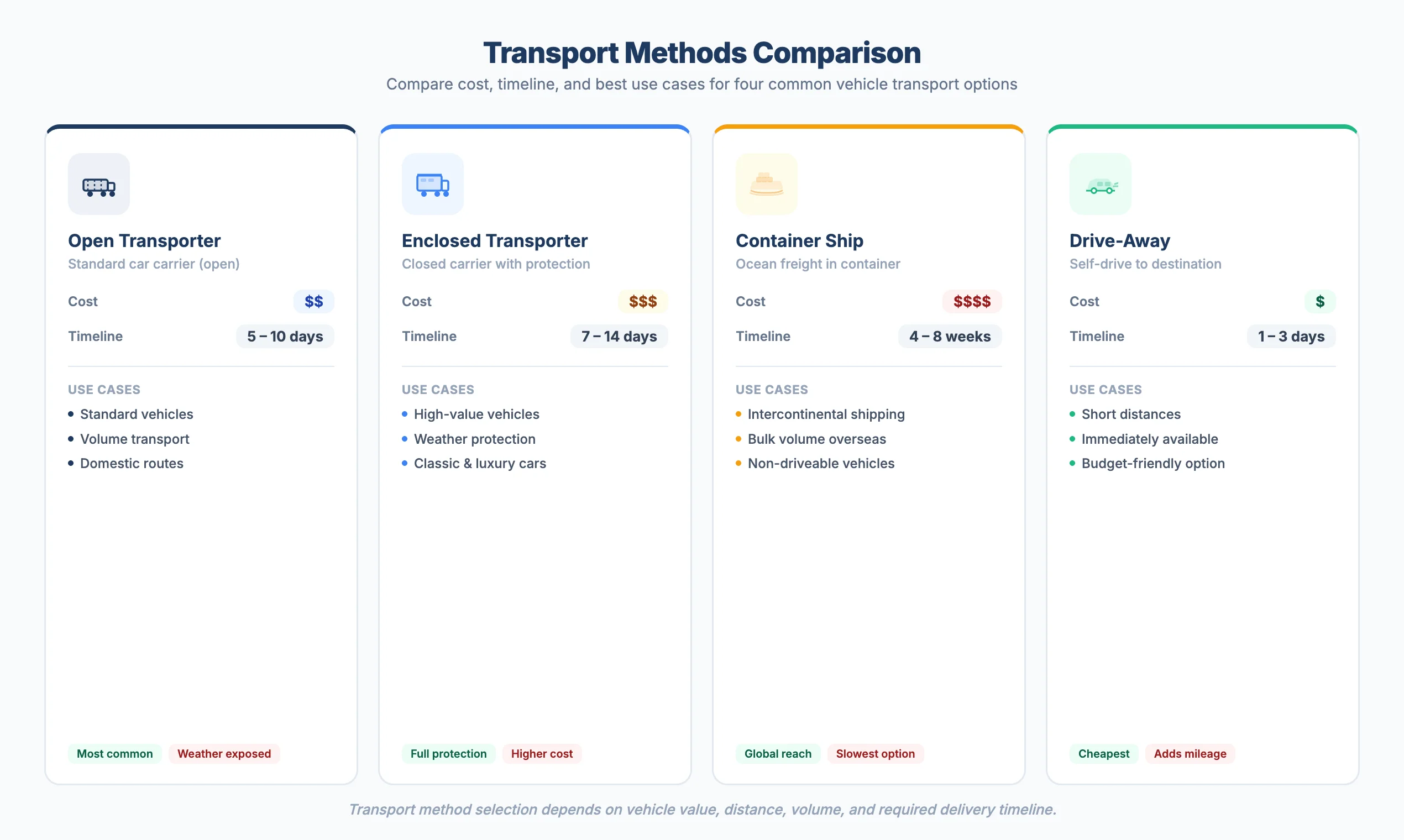 Transport method selection depends on vehicle value, distance, volume, and required delivery timeline.
Open car transporters handle most European cross-border moves. Costs scale with distance and, above all, with whether the carrier has a return load: West-to-East routes such as Germany to Poland or the Netherlands to Romania run on strong backhaul demand and price lower than the reverse direction. Enclosed transport adds 50–100% to the cost. For the UK and North America, Roll-on/Roll-off shipping is the standard method for drivable vehicles, and container shipping is used for non-runners, high-value units, or consolidated loads.
Digital transport marketplaces run by the platforms themselves — CarOnSale’s transport service, OPENLANE’s used car transport, TransConnect — quote on the auction lot and produce the CMR that doubles as VAT transport evidence. Electronic consignment notes are gaining ground: under the EU’s eFTI Regulation, authorities may accept electronic freight data from 2026 and must accept it from 9 July 2027, which will make the e-CMR the default proof of movement.
Currency and Payment Considerations
Currency conversion is a hidden line item that can match the entire duty saving on a cross-border deal. Retail bank spreads on USD/CAD or EUR/GBP run 2–3.5% above the mid-market rate, while specialist business providers such as Wise Business, OFX, or Corpay quote 0.3–0.7%. On a EUR 20,000 vehicle the difference is EUR 300–600 per unit.
Exchange rate volatility adds a second layer. USD/CAD traded between 1.3483 and 1.4248 in 2026 to date after touching 1.4793 in February 2025, a 20-year high; a 2% move between winning a bid and settling the invoice shifts the landed cost of a CAD 20,000 vehicle by CAD 400. For volume buyers moving ten or more units a month, unmanaged FX exposure compounds quickly.
Five practices that limit the damage:
- Multi-currency accounts — Hold EUR, GBP, USD, and CAD balances to avoid converting on every transaction
- Forward contracts — Lock in a rate for committed purchases and remove volatility from the margin calculation
- Payment timing — Where the platform’s settlement terms allow, settle when the rate is favourable rather than on the default date
- Specialist providers — Route settlements through a dedicated FX provider rather than a retail bank wire
- 2% FX buffer — Build a 2% currency buffer into every cross-border maximum bid
How to Model a Cross-Border Deal Before You Bid
The order of operations is the same on every corridor: establish the duty rate from the vehicle’s manufacturing origin, add the destination country’s VAT and registration tax, add transport and FX, then subtract the total from the achievable resale price to find the maximum bid. Three worked outlines:
- Germany to Poland, EUR 15,000 VAT-qualifying fleet car: 0% duty; 23% Polish VAT declared and deducted under the reverse charge (net zero); akcyza of 3.1% (EUR 465) for a 1.6-litre engine or 18.6% (EUR 2,790) above 2,000 cc; transport EUR 300–500; Polish technical inspection PLN 149; buyer fee per the platform. Landed cost before recon: roughly EUR 15,900–16,200 for the small engine.
- UK to the Netherlands, GBP 12,000 Japanese-built car: 10% duty on the customs value (price plus freight); 21% Dutch import VAT on price plus freight plus duty, recoverable by a VAT-registered importer; BPM on the CoC CO2 figure, non-recoverable and often the largest single item; RoRo or truck via the tunnel; ICS2 ENS filed by the carrier. Landed cost typically 30–50% above the hammer price before BPM.
- Michigan to Ontario, USD 15,000 US-built pickup: 0% MFN under CUSMA; 25% surtax on roughly 85% of value (about CAD 4,400 on CAD 20,700); 13% HST at the border; CAD 100 air-conditioning tax; green levy if applicable; RIV CAD 325 plus tax; transport and broker CAD 600–1,200. The surtax alone consumes most of the price gap that made US sourcing attractive before April 2025.
Run the same arithmetic for every unit with the Landed Cost Calculator and compare platform fees with the Auction Fee Comparator before committing.
Conclusion and Next Steps
Cross-border vehicle buying is a margin game in which the price differential creates the opportunity and duty, VAT, registration tax, transport, currency, and documentation decide whether it converts into profit. Inside the EU the mechanics are stable and the risks are procedural. On the UK-EU corridor the manufacturing origin of the vehicle decides the duty, and the EV rules change on 1 January 2027. On the North American corridor the 2025 tariffs have rewritten the arithmetic, and the announced 50% US rate on Canadian vehicles for 1 January 2027 means every US-Canada deal now needs a date check as well as a duty check.
Before bidding on any cross-border vehicle, model the full landed cost, factor in all auction fees — buyer fees, seller fees, and platform charges — and read the condition report with the destination country’s roadworthiness test in mind. If the number leaves margin, bid. If it does not, move on.
Frequently Asked Questions
Do I pay customs duty when buying a vehicle from another EU country?
No. Vehicles traded between EU member states move under free movement of goods with zero customs duty, no customs declaration, and no border inspection, regardless of where the vehicle was originally manufactured. VAT obligations still apply: a B2B buyer self-assesses VAT in the destination country under the reverse charge, and the seller’s 0% invoice is valid only with a VIES-validated VAT number, an EC Sales List entry, and transport evidence.
What is the VAT reverse charge for cross-border vehicle purchases?
The reverse charge is the mechanism for B2B intra-EU sales under which the seller invoices at 0% as an exempt intra-Community supply and the buyer declares VAT at the destination rate on their own return, deducting it on the same return so the cash effect is zero for a fully VAT-registered business. Since 2020 the exemption requires the buyer’s valid VAT number, the seller’s correct recapitulative statement, and two independent items of transport evidence. It does not apply to margin-scheme vehicles or to sales to private individuals.
Does the US Section 232 tariff apply to used vehicles?
Yes. U.S. Customs and Border Protection applies the 25% Section 232 duty to used passenger vehicles and trucks in the same way as new ones. The only age-based exemption covers vehicles manufactured in a year at least 25 years before the year of entry, which pay just the 2.5% MFN base rate. Negotiated all-in rates of 15% (EU, Japan, South Korea) and 10% (UK, within a 100,000-unit quota) also cover used vehicles of those origins.
Can Canadian dealers still buy vehicles at US auctions?
Yes, but the economics changed on 9 April 2025. US-built vehicles, new or used, pay Canada’s 25% surtax — on the full value if not CUSMA-compliant, or on the non-Canadian/non-Mexican content (about 85% by default) if compliant — plus GST/HST, the CAD 100 air-conditioning tax, any green levy, and the CAD 325 RIV fee within a 45-day window. Vehicles built outside the US, for example a Japanese-built car sold at a US auction, pay the 6.1% MFN duty and no surtax. Vehicles 15 years or older are exempt from RIV inspection.
What documents do I need for a UK-to-EU vehicle purchase after Brexit?
An export declaration in Great Britain and an import declaration in the destination member state, an EU EORI number, a commercial invoice with Incoterms, the V5C or equivalent title document, an EU Certificate of Conformity, and the ENS declaration lodged by the carrier in ICS2. For 0% duty you need either a statement on origin or importer’s knowledge evidencing 55% UK/EU content, or proof that an EU-built vehicle left the EU less than three years ago for Returned Goods Relief. Without either, the duty is 10% of the customs value plus import VAT.
Do EU countervailing duties on Chinese electric cars apply to used EVs from the UK?
No. Regulation (EU) 2024/2754 covers new battery electric vehicles originating in China under CN code 8703 80 10. A genuinely used, UK-registered Chinese-built EV falls under the used-vehicle code and pays the 10% MFN duty plus import VAT but no countervailing duty. A pre-registered vehicle with near-zero mileage can be classified as new by customs and attract the full duty, so treat such units as new when modelling the deal.
How do I calculate the total landed cost of a cross-border vehicle?
Total landed cost equals the hammer price plus every cost required to register and resell the vehicle in the destination market: import duty (0% intra-EU, 0–22% UK-EU depending on origin and vehicle type, 6.1% plus a 25% surtax for US-built vehicles into Canada, 15–27.5% into the US), VAT (17–27% in the EU, recoverable only for B2B under the correct regime), non-recoverable registration taxes, transport (EUR 300–1,500 by truck in Europe, USD 1,000–4,500 by sea), currency conversion (0.3–3.5% depending on provider), documentation, inspection, and platform buyer fees. Use the Landed Cost Calculator to model these variables before bidding.
What Changed in This Update (21 September 2026)
This guide was rewritten and re-verified against primary sources on 21 September 2026. The material changes from the February 2026 version:
- Replaced the US-Canada section: added the 25% Section 232 tariff (used vehicles included, 25-year exemption), Canada’s 25% surtax, the all-in rates of 15% (EU, Japan, Korea) and 10% (UK quota), the non-renewal of USMCA on 1 July 2026, and the 50% rate announced for 1 January 2027. Corrected the Japan-to-US rate from 2.5% to 15% and the RIV fee to CAD 325 plus tax.
- Corrected the UK-EU section: EV rules of origin move to 55% on 1 January 2027 (the previous version cited an incorrect 45% transitional figure); added Returned Goods Relief for EU-built vehicles, the used-vehicle origin problem, van duty rates of 10% or 22%, the countervailing duty scope for Chinese-built EVs, GB Conversion IVA, and ICS2/ENS dates. Removed the incorrect statement that MSVA applies to cars over ten years old.
- Added the 2020 Quick Fixes conditions for the reverse charge, Article 45a transport evidence, margin-scheme rules, German export plates, and 2026 e-invoicing mandates.
- Replaced unverifiable market statistics (a USD 59 billion market size and a 13.5 million Poland-Germany import figure) with IBRM Samar, KBA, SMMT, AAA Data, and SIMI data for 2024–2026.
- Added Switzerland, Norway, and Mexico, an Ireland import table, a US-Canada document checklist, and worked landed-cost outlines for three corridors.