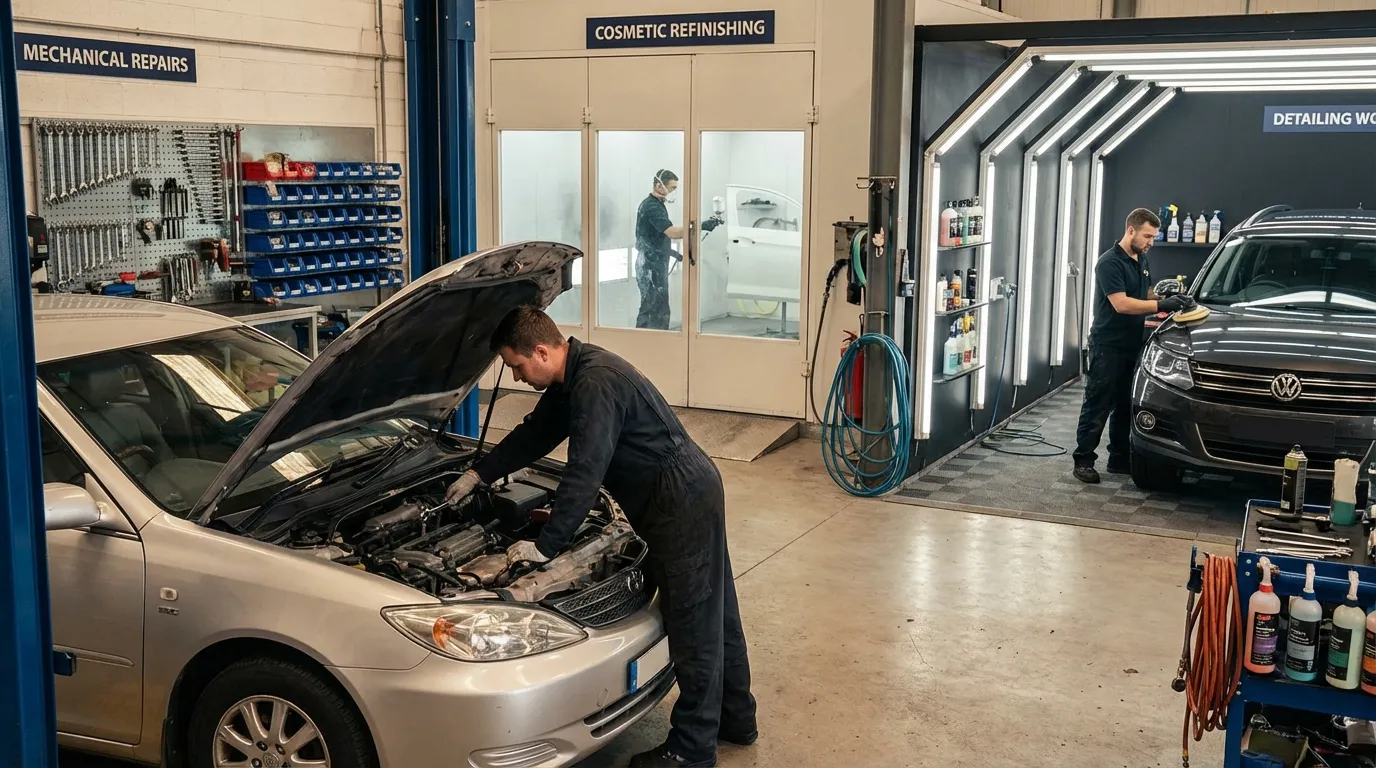
Dealers spend an average of $500–$2,000 per vehicle on reconditioning costs, yet many authorize work without a clear picture of where that money goes. A $1,200 reconditioning estimate means different things depending on whether it covers brake replacement, a full respray, or a combination of interior and detailing work — and each category carries a different ROI profile.
This guide breaks down reconditioning costs into six categories — mechanical, cosmetic, interior, detailing, inspection, and certification — with typical price ranges, ROI signals, and budgeting context. For the decision framework on whether to recondition at all, see When to Recondition vs. Sell As-Is. For the full ROI methodology, see the Reconditioning ROI guide.
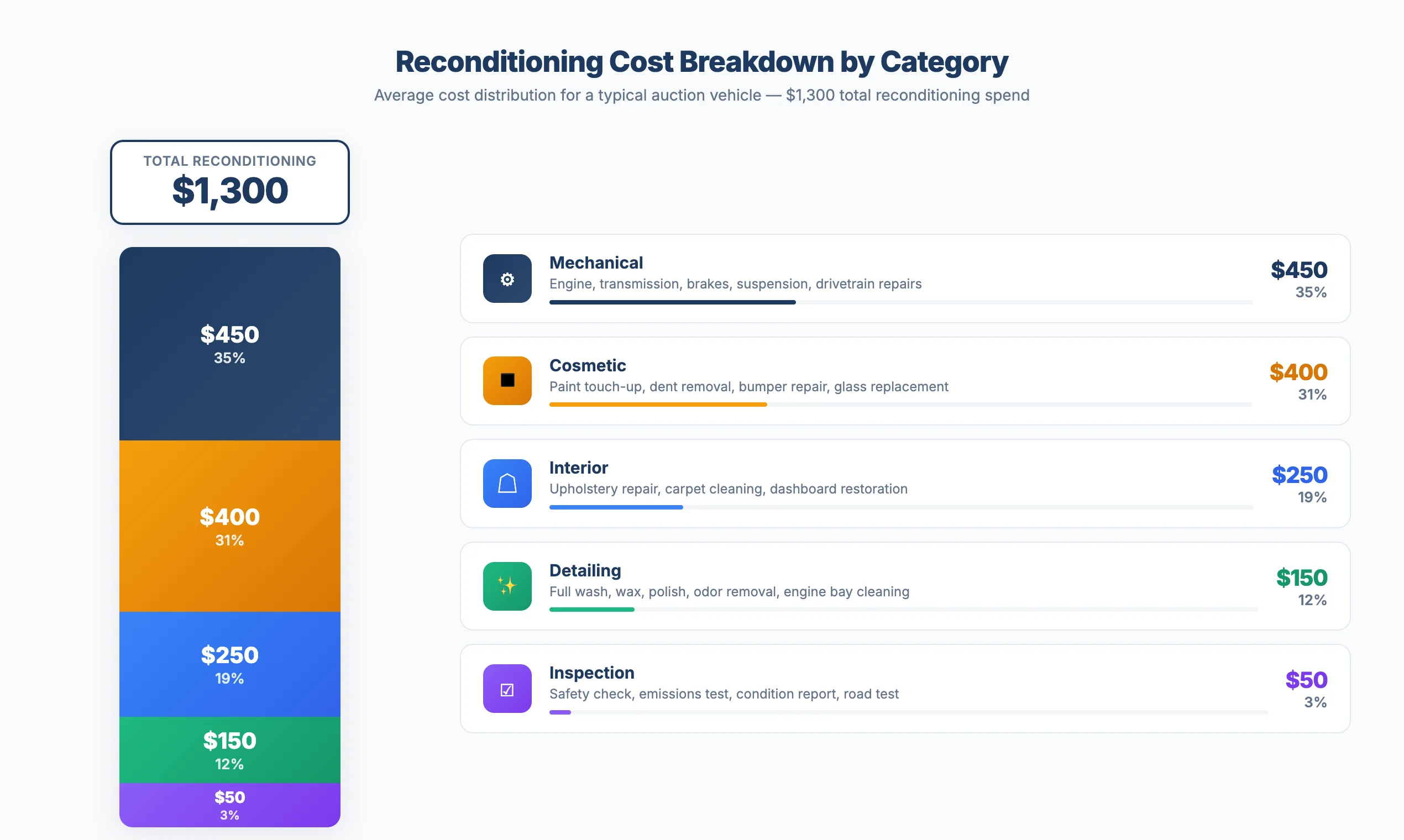 Average reconditioning spend distribution across five categories. Mechanical and cosmetic repairs account for the largest share.
Mechanical Reconditioning Costs
Mechanical repairs represent the widest cost range in reconditioning. A brake job and an engine replacement both fall under “mechanical,” but the budget implications differ by an order of magnitude.
| Repair Item | Typical Cost Range (USD) | ROI Signal | Budget Note |
|---|---|---|---|
| Brakes (pads, rotors, calipers) | $150–$600 | High — safety item buyers expect | Almost always recovers cost at retail |
| Suspension (shocks, struts, links) | $200–$1,200 | Moderate — depends on severity | Front-end work more visible to buyers than rear |
| AC compressor | $150–$750 | Seasonal — high in warm markets | Non-functional AC suppresses retail price significantly |
| Cooling system (radiator, hoses, thermostat) | $150–$900 | Moderate — prevents overheating flags | Overheating history kills buyer confidence |
| Exhaust / catalytic converter | $100–$2,500 | Variable — cat converter theft drives cost | Converter replacement alone can reach $2,500 |
| Electrical diagnostics | $75–$200 | Low cost, high information | Identifies hidden issues before committing to larger repairs |
| Transmission (repair or replace) | $300–$3,400 | Low — high cost, uncertain recovery | Rarely recovers full cost on vehicles over seven years old |
| Engine (repair or replace) | $500–$7,000+ | Low — typically exceeds value gap | Break-even math critical; wholesale often the better option |
Mechanical costs divide into two tiers. The first tier — brakes, suspension, AC, cooling, and exhaust — covers safety and comfort items that buyers expect to function. These repairs typically cost $100–$1,200 each and recover their cost reliably at retail because buyers either require them or discount heavily for their absence.
The second tier — transmission and engine work — enters a different budget category entirely. A transmission rebuild at $1,800–$3,400 or an engine replacement at $3,000–$7,000+ can exceed the entire value gap between wholesale and retail, especially on older vehicles. Run the break-even math with the Reconditioning ROI Calculator before authorizing any second-tier mechanical work.
Cosmetic and Body Repair Costs
Cosmetic reconditioning has the widest variation in cost-per-outcome because of the gap between modern repair techniques and traditional bodywork. The same dent can cost $75 or $750 depending on the method used.
| Repair Item | Typical Cost Range (USD) | vs. Traditional Alternative |
|---|---|---|
| Paintless dent repair (PDR) | $50–$500+ | 40–70% less than traditional body fill and paint |
| Paint touch-up (chip repair) | $150–$250 | Fraction of a panel respray for minor damage |
| Single panel respray | $400–$1,200 | Required for deep scratches or large damaged areas |
| Full respray | $1,000–$5,000+ | Rarely justified except on high-value or specialty vehicles |
| Bumper repair / replacement | $300–$2,500 | SMART repair at $300–$600 vs. full replacement at $1,000+ |
| Windshield replacement | $250–$1,500 | ADAS recalibration adds $150–$300 on newer vehicles |
| Traditional body repair (fill, sand, paint) | $300–$1,000+ | Standard method for structural or large-area damage |
The cost advantage of SMART repair and PDR over traditional bodywork is substantial. A door ding that costs $75–$150 via PDR would run $300–$500 through conventional body fill and repaint. However, these techniques have limits — PDR requires intact paint, and SMART repair works on localized damage only. Assess damage type before selecting the method.
Windshield replacement on vehicles with advanced driver-assistance systems (ADAS) carries a hidden cost. Cameras and sensors mounted to the windshield require recalibration after replacement, adding $150–$300 to the base cost of $250–$1,500. Factor this into your pre-bid estimate when the condition report notes windshield damage on newer vehicles.
Interior Reconditioning Costs
Interior condition directly affects buyer perception at the point of sale. A stained seat or lingering odor can suppress the retail price by several hundred dollars — often more than the cost to fix it.
| Service | Typical Cost Range (USD) |
|---|---|
| Deep cleaning (full interior) | $100–$350 |
| Seat repair (tear, burn, scuff) | $50–$150 |
| Full seat reupholstery | $200–$1,500 |
| Dashboard repair (crack, fade) | $100–$300 |
| Headliner replacement | $200–$1,000 |
| Carpet replacement | $500–$1,500 |
| Odor elimination (ozone, enzyme) | $50–$150 |
Three interior items deliver the highest ROI relative to their cost:
- Deep cleaning ($100–$350): The single highest-impact interior investment. A thorough interior detail transforms buyer perception for a fraction of the cost of any repair.
- Seat repair ($50–$150): Small tears, cigarette burns, and leather scuffs are inexpensive to fix but highly visible to buyers during walkarounds.
- Odor elimination ($50–$150): Smoke or pet odor is the fastest way to lose a retail buyer. Ozone or enzyme treatment resolves most cases for under $150.
Full reupholstery ($200–$1,500) and carpet replacement ($500–$1,500) sit at the other end of the spectrum. These are high-cost items that rarely recover fully except on premium vehicles where buyers expect flawless interiors.
Detailing and Presentation Costs
Detailing is the final reconditioning step and often the highest-ROI category. Manheim’s certified reconditioning program averaged a return of $2.27 for every $1 spent, and professional detailing accounts for a significant share of that uplift.
Presentation quality directly influences hammer price at auction and retail asking price on the lot. A vehicle that photographs well and presents cleanly in person sells faster and at a higher price than an identical unit with swirl marks, hazy headlights, and dull paint.
| Service | Typical Cost Range (USD) | When Justified |
|---|---|---|
| Exterior detail (wash, clay, wax) | $50–$350 | Every retail unit — baseline presentation standard |
| Interior detail (vacuum, shampoo, condition) | $100–$350 | Every retail unit — combine with exterior for full detail |
| Full detail (exterior + interior) | $150–$500+ | Standard for retail-bound vehicles; skip only on wholesale units |
| Paint correction (compound, polish) | $200–$1,000 | Vehicles with swirl marks, oxidation, or light scratches |
| Ceramic coating | $500–$5,000 | Rarely justified at wholesale; consider for high-value retail units only |
| Wheel restoration (per wheel) | $65–$200/wheel | Curb-rashed alloys on premium vehicles — visible ROI |
| Headlight restoration | $50–$150 | Hazy or yellowed lenses; immediate visual improvement |
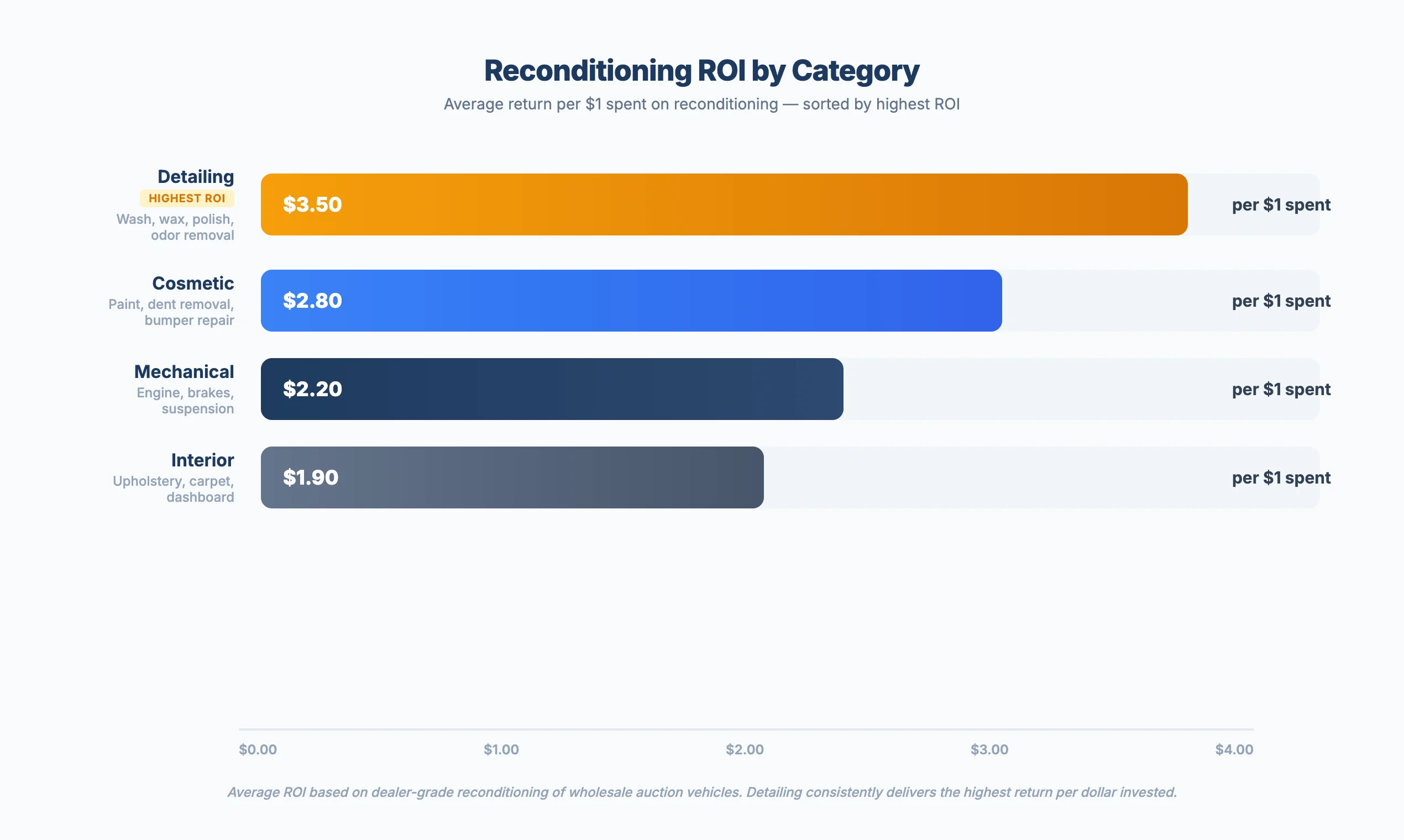 Detailing consistently delivers the highest ROI per dollar spent across reconditioning categories.
Inspection and Certification Costs
Inspections and certifications are not optional expenses — they are either legally required (state safety, emissions, MOT) or commercially required (CPO programs). Budget for them as fixed costs, not discretionary reconditioning items.
| Inspection Type | Cost Range | Market |
|---|---|---|
| Pre-sale / third-party inspection | $100–$270 | US |
| State safety inspection | $7–$80 | US (varies by state) |
| Emissions inspection | $20–$75 | US (required in ~30 states) |
| CPO preparation and certification | $500–$2,000+ | US (franchise dealers) |
| MOT test | £30–£54.85 | UK (annual requirement) |
| TÜV / HU (Hauptuntersuchung) | €70–€120 | Germany (biennial requirement) |
US dealers face the widest cost range in this category. A state safety inspection may cost as little as $7, while CPO preparation — which includes reconditioning to manufacturer standards, extended warranty enrollment, and certification documentation — runs $500–$2,000+ per vehicle. European statutory inspections (MOT in the UK, TÜV/HU in Germany) carry regulated fees but failure triggers additional repair costs to bring the vehicle into compliance.
Putting It All Together — Budgeting Per Vehicle
Reconditioning budgets group into three tiers based on condition grade at acquisition. Light reconditioning covers clean, late-model units needing only detailing and minor cosmetic work. Moderate reconditioning addresses vehicles with a mix of cosmetic, interior, and routine mechanical needs. Heavy reconditioning applies to units requiring drivetrain, structural, or extensive bodywork.
The three tiers break down as follows: light reconditioning runs $300–$800 per vehicle (detail, touch-up paint, headlight restoration, minor interior repair). Moderate reconditioning costs $800–$2,000 (brakes, suspension, PDR, full detail, interior deep clean, inspection). Heavy reconditioning exceeds $2,000 and involves engine or transmission work, panel respray, windshield replacement, or full reupholstery — run break-even math on every heavy-tier unit before authorizing work.
Pre-Bid Reconditioning Budget Checklist
0 of 8 completedFrequently Asked Questions
What is the average reconditioning cost per vehicle?
Average dealer reconditioning spend ranges from $500–$2,000 per vehicle, depending on condition at acquisition and target retail standard. NIADA reports that dealers who track reconditioning costs by category consistently spend less per unit than those who estimate in bulk, because itemized tracking exposes unnecessary work before it starts.
Which reconditioning category has the highest ROI?
Detailing and presentation consistently delivers the highest return per dollar spent. Manheim’s certified reconditioning program averaged $2.27 for every $1 invested, with professional detailing driving a significant share of that uplift. Interior deep cleaning ($100–$350) and headlight restoration ($50–$150) rank among the highest individual ROI items.
How do reconditioning costs differ by region?
US and European markets diverge primarily on inspection costs and labor rates. US CPO preparation runs $500–$2,000+, while European statutory inspections (UK MOT at £30–£54.85, German TÜV at €70–€120) are lower but legally mandatory. Labor rates for mechanical and body work also vary — US shop rates average $75–$150/hour depending on market, while European rates range from €60–€130/hour.
Should I include holding costs in my reconditioning budget?
Yes. Holding costs run $37–$50 per day per vehicle and accumulate throughout the reconditioning cycle. A five-day reconditioning cycle adds $185–$250 to the true cost of the work. Exclude holding costs and the break-even calculation understates total reconditioning expense, leading to overbidding at auction.