
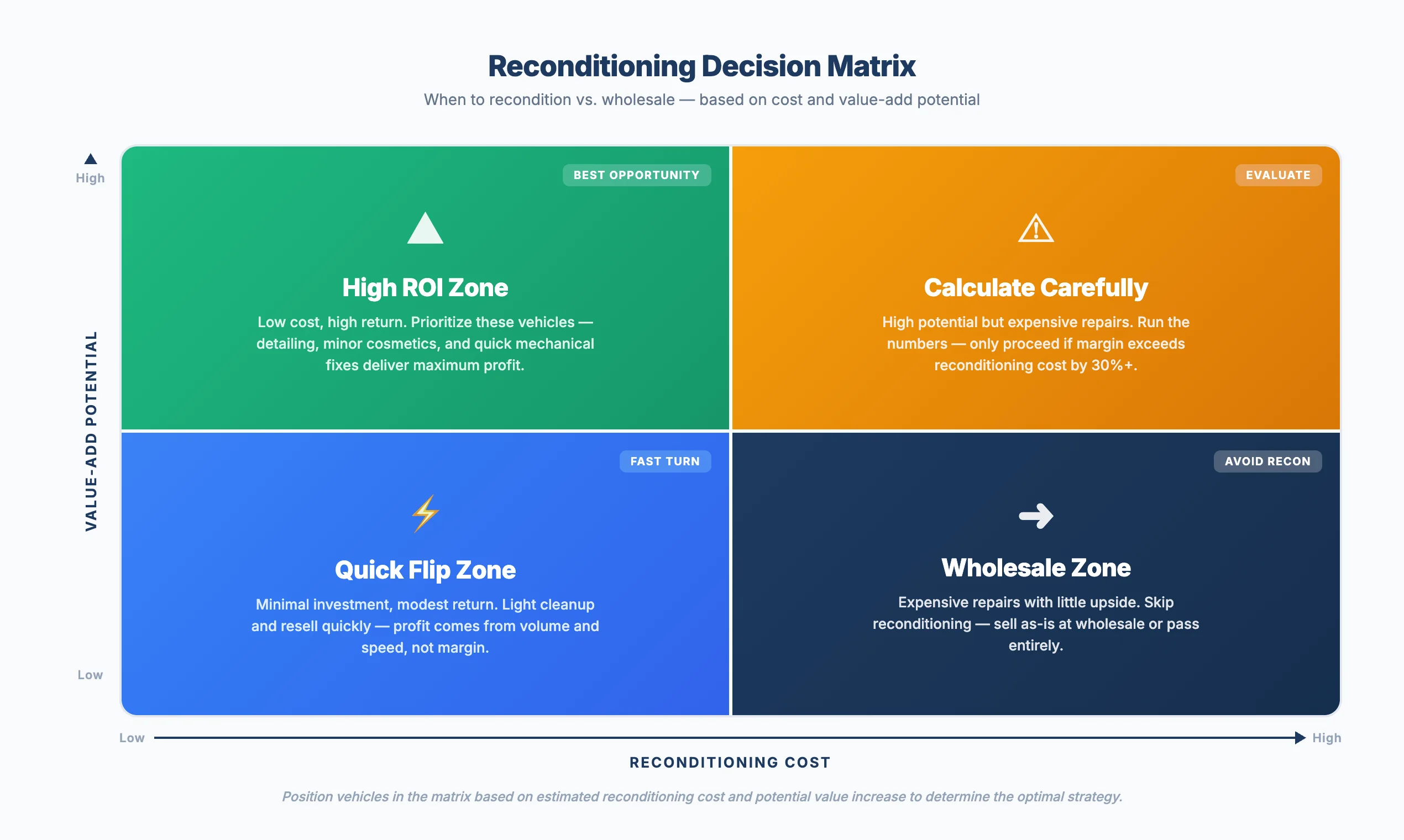
 Map every unit to a quadrant before authorizing reconditioning spend. The two axes — value-add potential and reconditioning cost — drive the decision.
Average used vehicle front-end gross profit runs $1,528–$1,668 per unit, with gross margins at 5.4% (Haig Partners, Q2–Q3 2025). In that margin environment, a single bad reconditioning call — spending $2,000 on a unit that returns $800 in price uplift — eliminates the entire profit on the vehicle and then some.
This article provides a repeatable decision framework, category-specific guidance, a break-even calculation method, and a quick-assessment checklist for the recondition-vs.-sell-as-is decision. For the full ROI methodology, worked examples, and platform grading systems, see the Reconditioning ROI guide.
The Core Decision Framework
The recondition-or-sell decision reduces to two variables: how much additional value the market will pay for the work, and how much that work costs including holding time. Plotting every unit on a two-axis matrix — value-add potential on one axis, reconditioning cost on the other — produces four quadrants with distinct strategies.
| Quadrant | Value-Add Potential | Reconditioning Cost | Decision |
|---|---|---|---|
| High ROI Zone | High | Low | Always recondition — highest margin opportunity |
| Calculate Carefully | High | High | Run break-even math; margin depends on execution speed and cost control |
| Quick Flip Zone | Low | Low | Cosmetic basics only; consider selling as-is |
| Wholesale Zone | Low | High | Sell as-is or wholesale immediately |
Most vehicles cluster in the Calculate Carefully and Quick Flip quadrants. The High ROI Zone — late-model units needing only detailing and minor cosmetic work — is the exception, not the norm. The Wholesale Zone catches vehicles where the market ceiling prevents reconditioning from recovering its cost, regardless of how well the work is executed.
Value-Add Analysis by Vehicle Category
Reconditioning ROI varies sharply by vehicle category. Where you focus the spend — cosmetic vs. mechanical — depends on what buyers in each segment prioritize.
| Vehicle Category | Highest ROI Focus | Typical ROI Range | Common Pitfall |
|---|---|---|---|
| Luxury / Premium (0–5 years) | Cosmetic — paint correction, interior detail, wheel refurb | 150–300% | Diminishing returns past showroom-grade; market ceiling still applies |
| Economy / Mainstream | Mechanical — brakes, tires, fluid service | 100–200% | Buyers prioritize function over finish; cosmetic spend rarely recovers |
| Trucks / SUVs | Cosmetic + Mechanical — bed, undercarriage, tow package check | 120–250% | Bed and undercarriage damage often missed in initial inspection |
| High-Mileage (120,000+ mi) | Minimal — safety items only | 50–100% | Market ceiling limits price uplift regardless of reconditioning scope |
Luxury and Premium Units
Luxury buyers expect a near-showroom presentation. A $300 professional detail with paint correction and wheel refurbishment can add $1,000–$1,500 to the retail asking price on a late-model premium unit. The ROI ceiling arrives once the vehicle reaches Grade 4+ on the condition grade scale — additional cosmetic spend beyond that point produces minimal uplift.
Economy and Mainstream Sedans
Economy segment buyers shop on mechanical confidence, not cosmetic appeal. Brakes, tires, and fluid services address the items these buyers worry about most. Spending $300 on detailing an economy sedan recovers less than the same $300 spent replacing worn brake pads and tires.
Trucks and SUVs
Trucks and SUVs command strong demand, which absorbs reconditioning cost more reliably than sedans. Bed liners, undercarriage rust treatment, and tow package verification are high-ROI items specific to this segment. Inspect the bed and undercarriage before authorizing cosmetic work — hidden damage in these areas is the most common missed cost.
High-Mileage Vehicles
Vehicles above 120,000 miles face a firm market ceiling. Reconditioning scope should stay narrow: safety-critical items (brakes, tires, lights) and a basic detail. Mechanical overhauls rarely recover their cost because the market will not pay a premium for a high-mileage unit regardless of condition.
Reconditioning Break-Even Calculation
Every reconditioning decision should pass a break-even test before work begins. The calculation determines whether the expected price uplift exceeds the total cost of the work, including holding time.
Estimate as-is wholesale value
Pull comparable wholesale results from recent auctions on platforms in the platform directory. This is the baseline — what the vehicle is worth right now with zero additional investment.
Estimate post-recon retail value
Research retail comparables for the same make, model, year, and mileage in reconditioned condition. Use local market listings and platform data to set a realistic retail target.
Itemize all reconditioning costs
List every planned repair with parts and labor costs. Include detailing, sublet work, and shop overhead. Add holding costs at $37–$50 per day for the estimated cycle time.
Calculate the value gap
Subtract the as-is wholesale value from the post-recon retail value. Then subtract total reconditioning costs (including holding) to get net reconditioning profit.
Apply your minimum margin threshold
If net reconditioning profit exceeds your minimum acceptable margin (typically $500–$1,000 per unit), recondition. If not, sell as-is or wholesale. Model the math with the Reconditioning ROI Calculator.
Worked Example: 2019 Chevrolet Equinox
A 2019 Chevrolet Equinox with 68,000 miles arrives with worn brakes, a tired interior, and minor paint chips. As-is wholesale value: $12,500. Retail target after reconditioning: $16,000. Reconditioning plan: brake replacement, full detail, paint touch-up, and headlight restoration — $1,400 in parts and labor, plus five days in the bay at $40/day ($200 holding cost). Total reconditioning cost: $1,600.
Value gap: $16,000 − $12,500 = $3,500. Net reconditioning profit: $3,500 − $1,600 = $1,900. That exceeds a $1,000 minimum margin threshold. Decision: recondition. Use the Reconditioning ROI Calculator to model your own scenarios, and set your maximum acquisition bid with the Break-Even Max Bid Calculator.
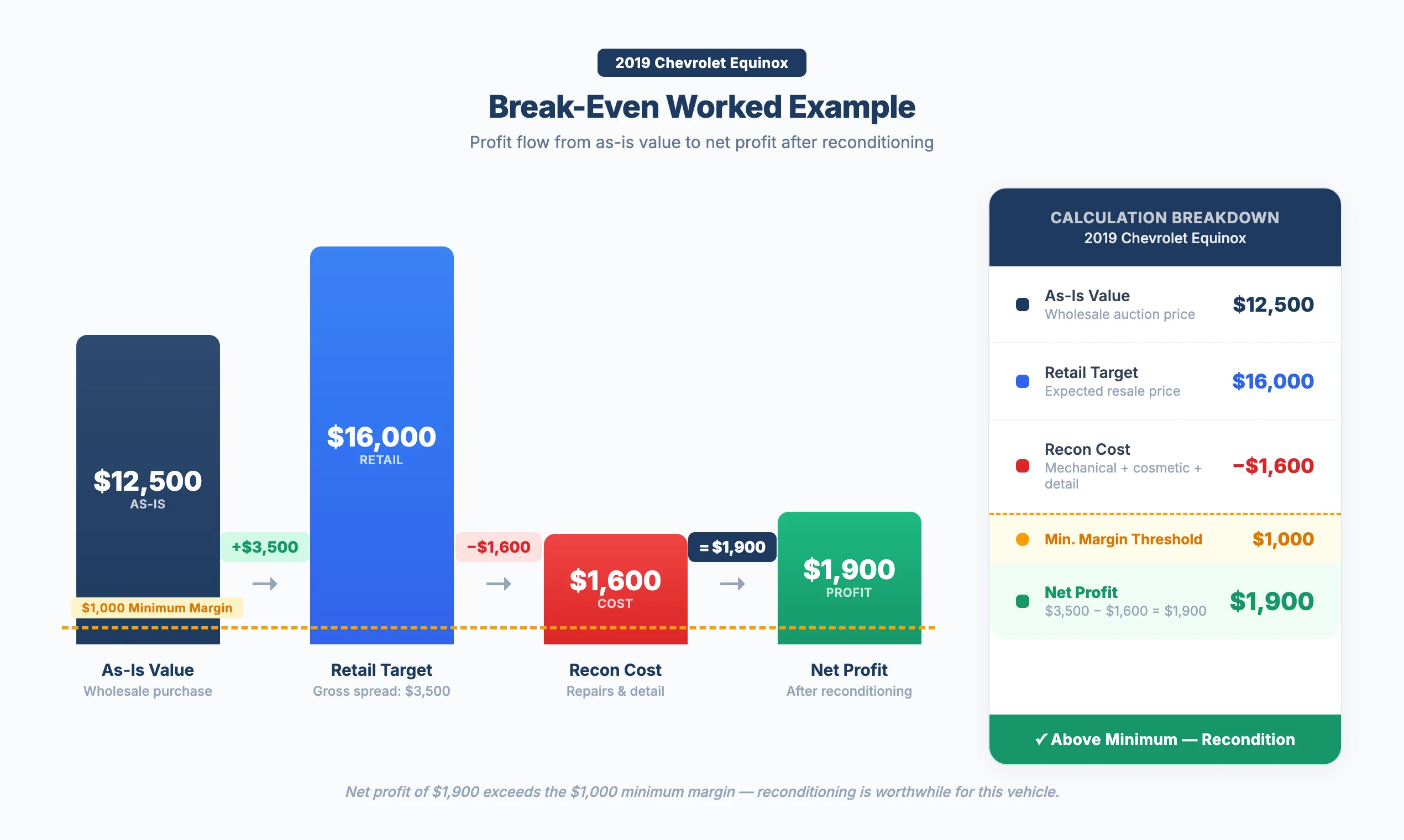 Break-even math in action — this unit clears the $1,000 minimum margin threshold.
When Wholesale Is the Better Option
Not every vehicle warrants reconditioning spend. Five scenarios consistently favor selling as-is or wholesaling immediately, regardless of the vehicle’s apparent potential.
- Aged inventory (60+ days): Holding costs compound daily at $37–$50 per vehicle. The longer a unit sits, the deeper the loss. Use the Inventory Aging Risk Score to quantify urgency.
- Niche vehicles with limited local demand: Specialty units — unusual trims, colors, or configurations — may not find retail buyers within a reasonable timeframe in your market.
- Major mechanical work required: Engine or transmission replacement ($3,500–$6,000+) frequently exceeds the value gap, especially on vehicles older than seven years.
- Regulatory or compliance issues: Emissions failures, open recalls with no parts available, or branded titles limit the retail buyer pool and suppress price uplift.
- Shop capacity constraints: Tying up a reconditioning bay with a marginal unit delays higher-ROI work on vehicles already in the queue.
When the math does not work, the discipline is to wholesale and move on. Capital locked in a low-ROI reconditioning project is capital unavailable for the next acquisition.
Quick Assessment Checklist
Use this checklist before authorizing reconditioning on any unit. Score seven or more for recondition, four to six is the gray zone requiring break-even math, three or fewer means wholesale.
Recondition vs. Sell As-Is: Quick Assessment
0 of 10 completedCommon Reconditioning Traps
Three reconditioning traps erode margin more frequently than any others. Each is preventable with a pre-authorization check.
| Trap | What It Looks Like | How to Avoid It |
|---|---|---|
| Over-reconditioning | Spending $3,000+ on a unit the market values at $8,000 wholesale | Cap reconditioning spend at 15% of target retail price; enforce the cap before work starts |
| Cosmetic-only on mechanical needs | Fresh detail and paint touch-up on a vehicle with worn brakes or a check-engine light | Complete a mechanical inspection before authorizing any cosmetic work |
| Ignoring market comparables | Reconditioning to premium retail standard in a market flooded with similar units | Check active retail listings and days-on-market for comparable vehicles before committing spend |
Over-reconditioning is the most common trap for dealers who default to “make it retail-ready” without checking whether the market supports the investment. A $3,000 reconditioning spend on a vehicle with an $8,000 wholesale value requires the retail market to return at least $11,000 — and that assumes zero holding cost. Pull comparable retail listings and verify active demand before authorizing work.
Frequently Asked Questions
What is a good reconditioning ROI target?
Most dealers target 200% or higher — $2 in additional retail value for every $1 spent. Units below 150% ROI are generally better wholesaled. Manheim’s certified reconditioning program averaged $2.27 per $1 spent, but that reflects a curated program with professional inspections and controlled scopes, not independent dealer operations.
Should I recondition salvage-title vehicles?
Salvage or rebuilt-title vehicles sell at a 20–40% discount to clean-title equivalents. Reconditioning can work if the break-even math accounts for that discounted retail ceiling, but the margin is thin. Run the full calculation with the discounted retail target before committing spend.
How do I account for labor costs in the break-even calculation?
Include fully loaded labor costs — wages, benefits, and shop overhead — at your internal rate per hour. For sublet vendors, use invoice cost plus a 10% buffer for rework or coordination delays. Underestimating labor is the most common source of break-even calculation error.
When should I get a second opinion on a reconditioning estimate?
Whenever the estimate exceeds $2,500 or involves transmission, engine, or structural work. A second estimate from an independent shop can catch scope creep before it erodes your margin. Review the condition report against both estimates to confirm scope alignment.
The recondition-vs.-sell-as-is decision is a math problem, not a judgment call. Map every unit to a quadrant, run the break-even calculation on anything in the gray zone, and enforce a hard dollar cap before work starts. For the full ROI methodology with three worked examples and platform grading systems, see the Reconditioning ROI guide. Model your scenarios with the Reconditioning ROI Calculator.