Why a Professional Arbitration Claim Email Matters
Frame damage accounts for roughly 20% of wholesale arbitration claims, title issues represent 15%, and odometer discrepancies make up 12%. In each case, the outcome depends not on defect severity but on how clearly and completely the buyer documents the issue. A structured arbitration claim email creates the documentation trail that supports your portal filing and gives the arbitrator a clear, fact-based summary of the dispute.
Most platforms — Manheim, ADESA, and ACV Auctions — require formal filing through their arbitration portal. The portal creates the official record. Email serves a different purpose: it establishes a written communication trail with arbitrators, supplements the portal filing with narrative context, and provides the primary filing method for independent auctions that lack a dedicated portal. For a full overview of arbitration policy frameworks and filing procedures, see the Arbitration Claims Guide.
Before You Send
ADESA reviews only the issues described in the initial claim submission. Manheim assigns five calendar days per milestone to respond. ACV allows just two calendar days for evidence. Your first communication must be comprehensive — omitted defects and missing condition report references cannot be added later at most platforms. Confirm you have every item ready before composing the email.
Pre-Filing Readiness Check
0 of 6 completedFor a full evidence preparation workflow, use the Arbitration Evidence Pack Checklist.
Primary Claim Email Template
This template covers the most common arbitration scenario: an undisclosed mechanical defect. The subject line includes the claim reference number for traceability. The evidence list is numbered to match file attachments. The closing confirms the vehicle remains unrepaired — unauthorized repairs void arbitration rights at most platforms.
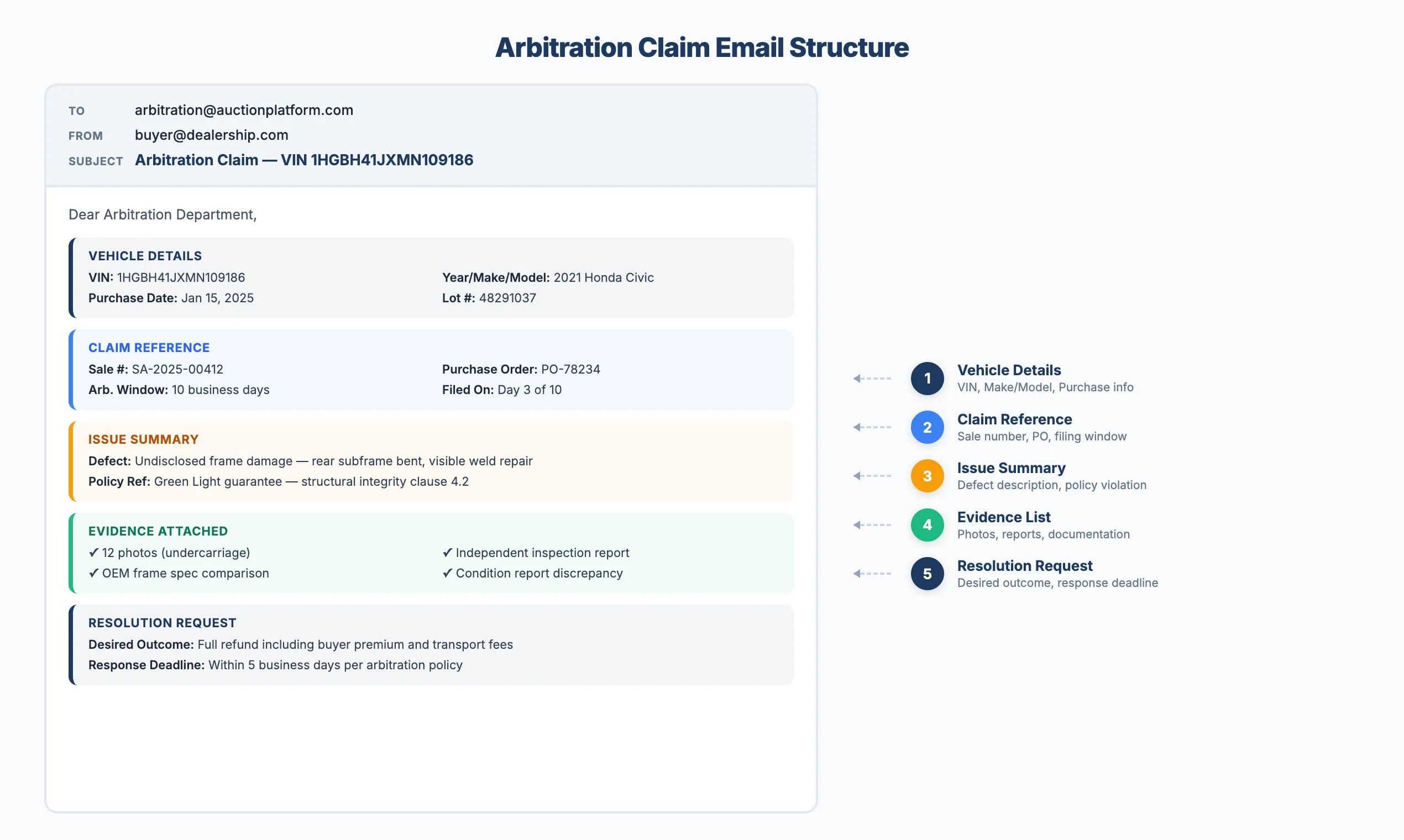 A professional arbitration claim email includes five structured sections that give the arbitrator everything needed to evaluate your case.
Three design choices in this template warrant explanation. First, the subject line includes the claim reference number so that every reply in the thread is traceable to the portal filing. Second, the evidence list is numbered to match the attached files — arbitrators review claims faster when attachments correspond to a clear index. Third, the closing confirms the vehicle remains unrepaired, which preserves your arbitration rights and demonstrates procedural compliance.
Template Variations
Each variation below replaces only the ISSUE SUMMARY and REQUESTED RESOLUTION sections of the primary template. All other sections — vehicle details, evidence list, vehicle status — remain the same.
Structural / Frame Damage
Frame damage remains arbitrable even on vehicles sold under Red Light (As-Is) designation when the damage was not disclosed. Include certified frame measurement data with specific deviation figures, not general descriptions.
Odometer / Mileage Discrepancy
Mileage discrepancies warrant a full return request rather than a price adjustment. When the odometer reading is fraudulent, the vehicle’s actual condition and remaining service life cannot be accurately assessed.
Title Issue
Title claims operate under extended deadlines at some platforms. ADESA allows 30 calendar days for title-related claims. A salvage vehicle title brand that was not disclosed in the listing constitutes a material misrepresentation regardless of the vehicle’s physical condition.
Communication Tips
The language you use in claim emails directly affects how arbitrators evaluate your case. Specific, evidence-backed statements outperform vague complaints. Write as if the arbitrator has never seen the vehicle and has 15 minutes to review your case file.
| Element | Strong Claim Language | Weak Claim Language |
|---|---|---|
| Defect description | Rod knock audible at idle, confirmed by ASE-certified technician | Engine makes a noise |
| Evidence reference | See attached inspection report (Exhibit 3), page 2, findings section | I had it looked at |
| Cost quantification | $2,400 repair — 8 hrs at $90/hr labour + $1,680 parts | It will cost a lot to fix |
| Condition report reference | Section 4 of condition report dated Jan 10 lists engine as 'Good' with no disclosures | The condition report was wrong |
| Tone | Requesting price adjustment of $2,400 per attached estimate | This is unacceptable and I demand a refund |
| Resolution request | Price adjustment of $2,400 reflecting documented repair cost | I want my money back |
When and How to Escalate
Most platform arbitration decisions are final and binding. Manheim, ADESA, and ACV Auctions all state this explicitly in their policies. However, limited escalation paths exist when you believe the process was not followed correctly or new evidence emerges.
Request a formal review from the arbitration department
Contact the platform's arbitration team in writing and cite the specific policy section you believe was misapplied. Include any evidence that was submitted but not addressed in the decision. Most platforms allow one review request within five business days of the ruling.
Escalate to platform management
If the formal review upholds the original decision, escalate to the regional or national arbitration manager. Reference your claim number, the review outcome, and the specific procedural concern. This is not a second appeal on the merits — focus on process errors.
File a complaint with NAAA
The National Auto Auction Association oversees arbitration policy standards for member platforms. File a written complaint documenting the timeline, evidence submitted, and the specific NAAA policy provision you believe was violated. NAAA does not overturn individual decisions but investigates systemic policy non-compliance.
Consult legal counsel
For claims involving federal violations — odometer fraud (49 USCS §32705, penalties up to 3x actual damages or $10,000), undisclosed salvage brands, or title fraud — consult an attorney specializing in automotive or commercial law. Legal action operates outside the platform's arbitration framework.
For platform-specific filing procedures and deadline details, see How to File an Arbitration Claim.
Frequently Asked Questions
Should I send this email before or after filing through the portal?
File through the platform’s arbitration portal first. The portal filing creates the official timestamped record and starts the formal review process. Send the email immediately after filing, referencing the portal claim number in the subject line. This gives the arbitrator both the structured portal submission and a narrative email trail. At platforms without a portal, the email serves as the primary filing — send it within the filing window (10 calendar days at most North American platforms, 48 hours at BCA in the UK).
What if the platform does not have a formal arbitration portal?
Use this email template as your primary claim filing. Send it to the platform’s arbitration or operations email address and request written confirmation of receipt. Independent auctions and smaller regional platforms often handle claims entirely via email. In these cases, the email is the official record, so include every detail and attachment in the first message — you may not get a second opportunity to add evidence.
Can I send the same email to the seller directly?
You can, but send it to the platform first. Most auction arbitration policies require the buyer to file through the platform, not directly with the seller. Sending a copy to the seller is acceptable as a courtesy and may prompt a faster resolution, but it does not replace the formal platform filing. If the seller contacts you directly to negotiate outside the platform, document the conversation and notify the arbitration department before accepting any settlement.
What is the NAAA $800 disclosure threshold?
Under NAAA arbitration policy, sellers must disclose any known mechanical defect with a repair cost exceeding $800 based on the NAAA wholesale labour rate. Defects below $800 are generally not arbitrable unless they involve frame damage, odometer discrepancy, title brands, or flood damage — these categories are arbitrable regardless of dollar amount. The $800 threshold applies to the wholesale repair cost, not the retail repair estimate. Vehicles 20 model years or older are sold as-is under NAAA policy and are not eligible for mechanical arbitration. For more on arbitration policy details, see the Arbitration Claims Guide.
Next Steps
This template provides a repeatable, professional format for communicating undisclosed defects to auction platforms and arbitrators. Customize the relevant variation for your claim type, attach numbered evidence files, and send the email within the platform’s filing window.
For an interactive version of this template, try the Claims Template Builder. For related arbitration resources:
- Arbitration Claims in Vehicle Auctions — full policy framework covering NAAA standards, platform-specific rules, and resolution outcomes
- Arbitration Evidence Pack Checklist — 29-item checklist for assembling complete evidence before filing
- How to File an Arbitration Claim — platform-specific filing procedures with step-by-step instructions
- Condition Report Verification Checklist — 35-item checklist to catch discrepancies before you bid