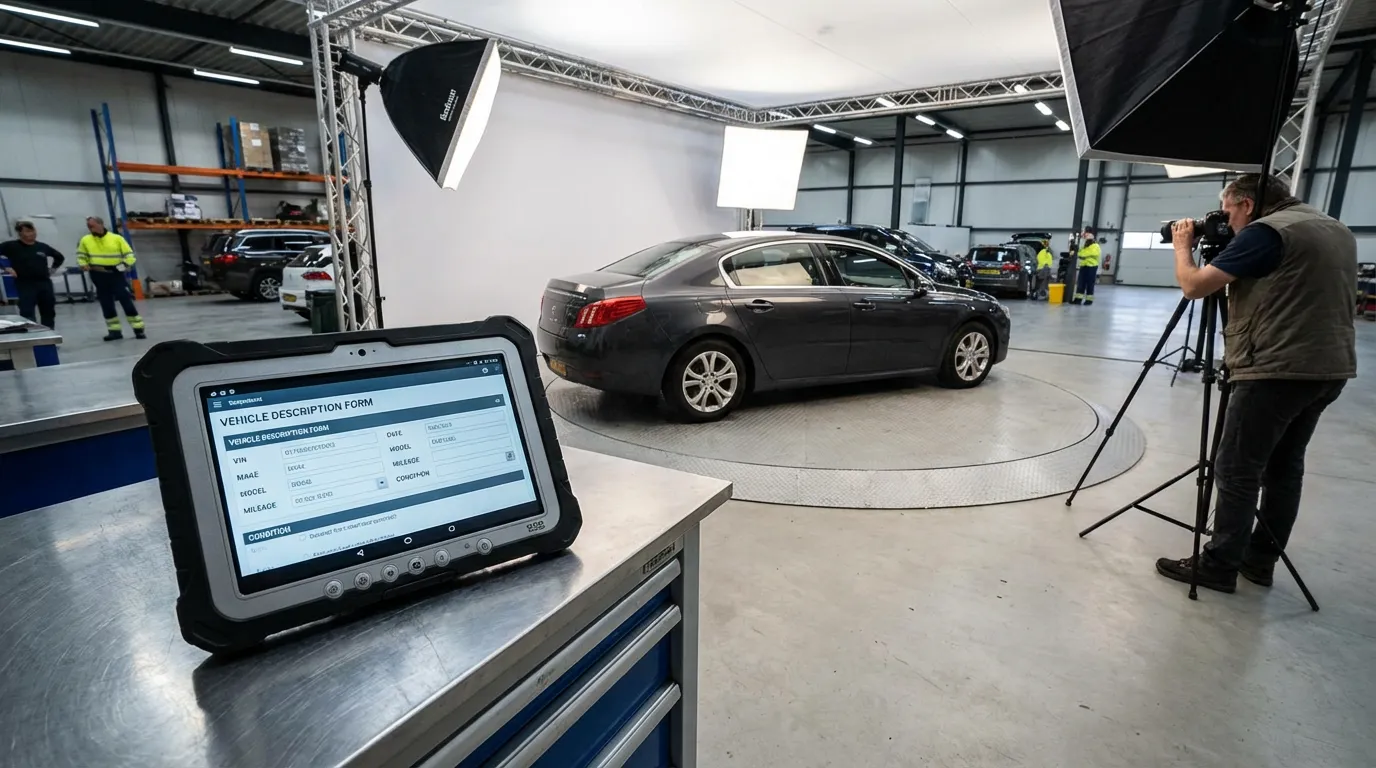
Why Description Quality Determines Sale Outcomes
Approximately 93% of auction vehicles include photos, but only 63% include a condition report. Buyers bidding remotely rely on written descriptions to bridge that gap. A structured vehicle description is the single most controllable factor in whether a listing converts to a sale.
This template covers five sections — Vehicle Identity, Condition Summary, Mechanical Status, Documentation, and Additional Equipment — meeting listing requirements at Manheim, ACV Auctions, and OPENLANE Europe. Vehicles with condition reports sell up to 2.5 times more often via simulcast, and arbitration rates drop by seven percentage points when sellers provide structured condition information.
Vehicle Description Template
Copy this template, fill in every bracketed field, and delete annotations in parentheses before publishing. Write “not tested” for any unverified system rather than leaving the field blank.
Practices for Each Field Category
Specificity drives buyer confidence. The difference between a listing that converts and one that stalls often comes down to field-level detail — exact measurements, traceable codes, and honest “not tested” entries where verification has not occurred.
| Category | Do | Do Not | Why It Matters |
|---|---|---|---|
| Vehicle Identity | Use full 17-character VIN, manufacturer colour codes, exact trim level | Abbreviate VIN, guess at trim, omit drive type | Buyers verify VIN against history reports — mismatches erode trust and trigger arbitration |
| Condition Summary | Note defect location, size, and type for every panel. Include tyre tread depth per position | Say 'minor wear' or 'normal for age' without specifics | NAAA requires disclosure of defects costing $800+ to repair. Vague descriptions invite disputes |
| Mechanical Status | List DTC codes if check engine light is on. State 'not tested' for unverified systems | Omit warning lights, leave mechanical fields blank, assume 'runs fine' covers everything | Blank fields read as intentional omissions. 'Not tested' is honest; blank is suspicious |
| Documentation | State title status and whether title is physically in hand. Include MOT/inspection expiry | Omit title presence, skip recall check, assume clean title without verification | Vehicles with titles present achieve 86.2% conversion vs. 42% without |
| Equipment | Count key fobs, list what is NOT included, note aftermarket modifications | List only notable options and ignore missing standard items | Missing keys cost $250–$600 to replace. Buyers price these omissions into bids |
A description that reads “2cm scratch below driver door handle” outperforms “minor scratches” every time. Buyers calculate repair costs from specific details — they cannot calculate anything from vague language.
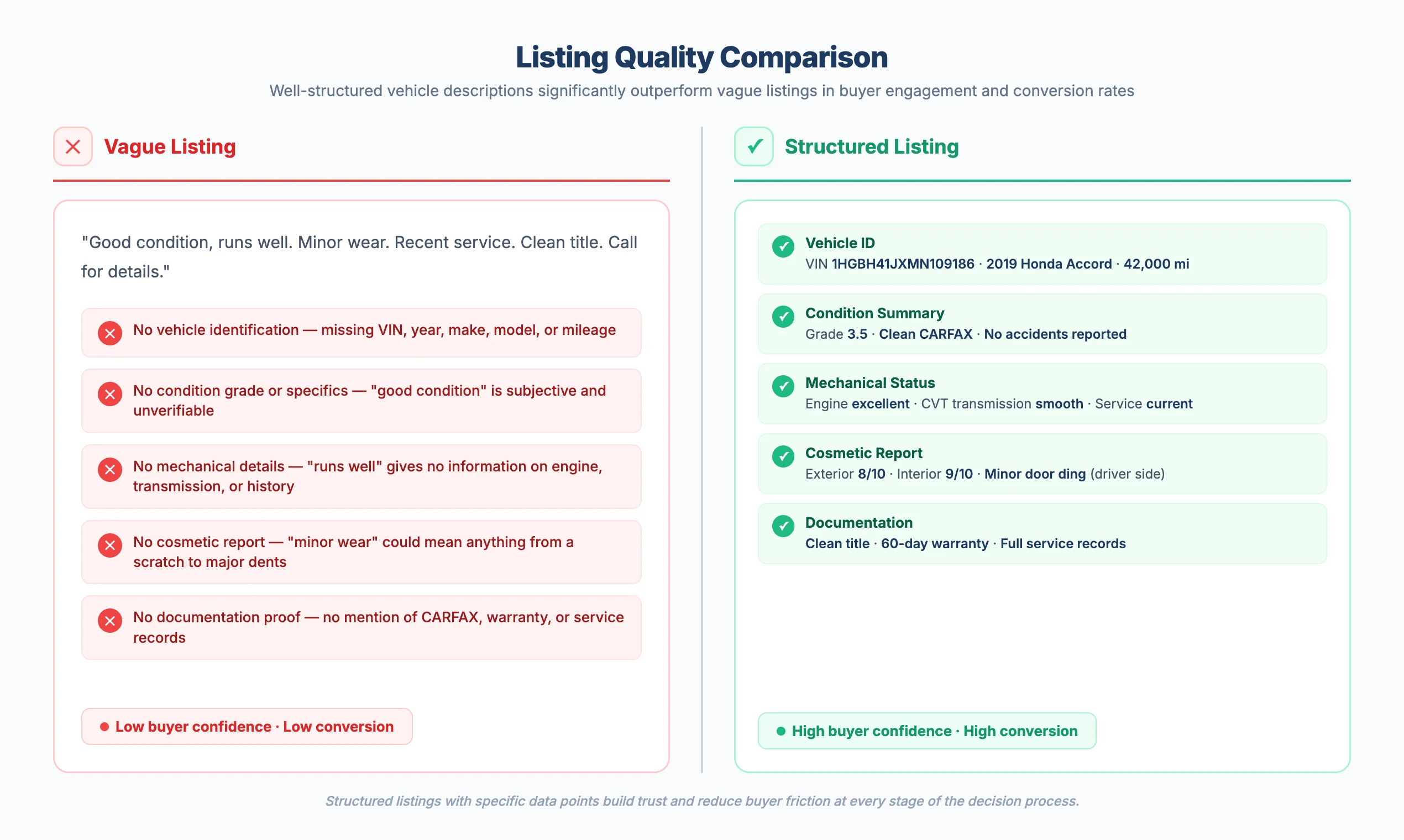 A structured five-section description converts significantly more often than a vague listing with generic condition language.
Five Vehicle Description Mistakes That Kill Buyer Confidence
Blanket disclaimers instead of specific disclosures
Announcing “as-is, all defects possible” does not protect sellers under NAAA policy. Arbitrators evaluate whether specific known defects were disclosed, not whether the seller added a generic disclaimer. A blanket statement paired with an undisclosed $1,200 transmission issue results in a lost arbitration case.
Relying on photos alone without written condition details
Photos show surfaces; descriptions explain severity. A photo of a dent does not tell a buyer whether the damage is cosmetic or structural, whether it affects adjacent panels, or what the estimated repair cost is. The 30% of listings missing condition reports lose buyers who need written detail to bid with confidence.
Leaving mechanical fields blank instead of writing “not tested”
A blank engine field next to a listed condition grade suggests the seller is hiding information. “Not tested” protects the seller by documenting that the system was not verified. Blank fields invite the buyer to assume a defect exists — and to reduce their bid accordingly.
Omitting title presence status
Vehicles with a physical title present at sale achieve an 86.2% conversion rate. Vehicles without title documentation convert at 42%. If the title is pending, state the expected date. Omitting title status entirely is the single largest conversion killer in wholesale remarketing.
Ignoring EV-specific fields for hybrid and electric vehicles
Battery state of health, charging capability, and range estimate are what EV buyers evaluate first. Omitting these fields on a hybrid or battery electric vehicle is equivalent to omitting engine condition on a petrol vehicle. As EV volume in wholesale channels grows, incomplete EV descriptions leave significant money on the table.
Pre-Listing Description Checklist
Before publishing your listing, verify every field against this checklist. A single missing disclosure can trigger an arbitration claim that costs more than the time spent completing the description.
Description Quality Check
0 of 10 completedFor a comprehensive vehicle preparation workflow, use the Auction Readiness Checklist.
Frequently Asked Questions
Do I need to fill in every field for every vehicle?
Fill in every field. Write “not tested” for unverified systems and “not applicable” for inapplicable lines — such as EV fields on petrol vehicles. Delete inapplicable sub-lines (Battery SOH, Charging, Range Estimate) to keep the listing clean. Blank fields signal withheld information to buyers, and that perception reduces bids or eliminates them entirely.
Does a detailed description replace a condition report?
No. A description is seller-provided; a condition report is inspector-provided. Both together achieve the highest conversion rates. ACV Auctions captures 45+ data points per inspection, and platforms weigh third-party condition reports more heavily than seller descriptions in arbitration cases. Use this template for the seller side, and verify buyer-side documentation with the Condition Report Verification Checklist.
What happens if I fail to disclose a defect that a buyer discovers?
Defects costing $800 or more to repair at NAAA-standard rates can trigger arbitration within 10 calendar days of purchase. Frame damage, odometer discrepancies, and title brands are arbitrable regardless of repair cost. The burden falls on the seller to prove disclosure — not on the buyer to prove non-disclosure. Document every known issue in the Announcements and Mechanical Status fields.
How do I adapt this template for different platforms?
The five-section structure works across platforms. Map each field to the corresponding input on the platform’s listing form. For free-text listing boxes, paste the completed template directly. OPENLANE Europe requires a minimum of six exterior images alongside the description. Fleet managers who use systematic description formats across all channels report 10–15% higher returns compared to ad-hoc listings.
Next Steps
Use this template for every vehicle listing. Fill in all five sections, mark unverified systems as “not tested,” and disclose every defect costing $800 or more to repair. A complete, structured description reduces arbitration risk, increases buyer confidence, and improves conversion rates across all auction formats.
Related resources for listing preparation and post-sale claims:
- Auction Readiness Checklist — 29-item preparation workflow covering inspection, documentation, and listing
- Condition Report Verification Checklist — buyer-side checklist for verifying condition report accuracy before bidding
- Arbitration Claims in Vehicle Auctions — full NAAA policy framework covering disclosure requirements and resolution outcomes
- Arbitration Claim Email Template — buyer perspective on filing claims for undisclosed defects
- Missing Items Claim Email Template — template for claiming missing keys, manuals, and accessories after purchase