Why Document Completeness Determines Cross-Border Success
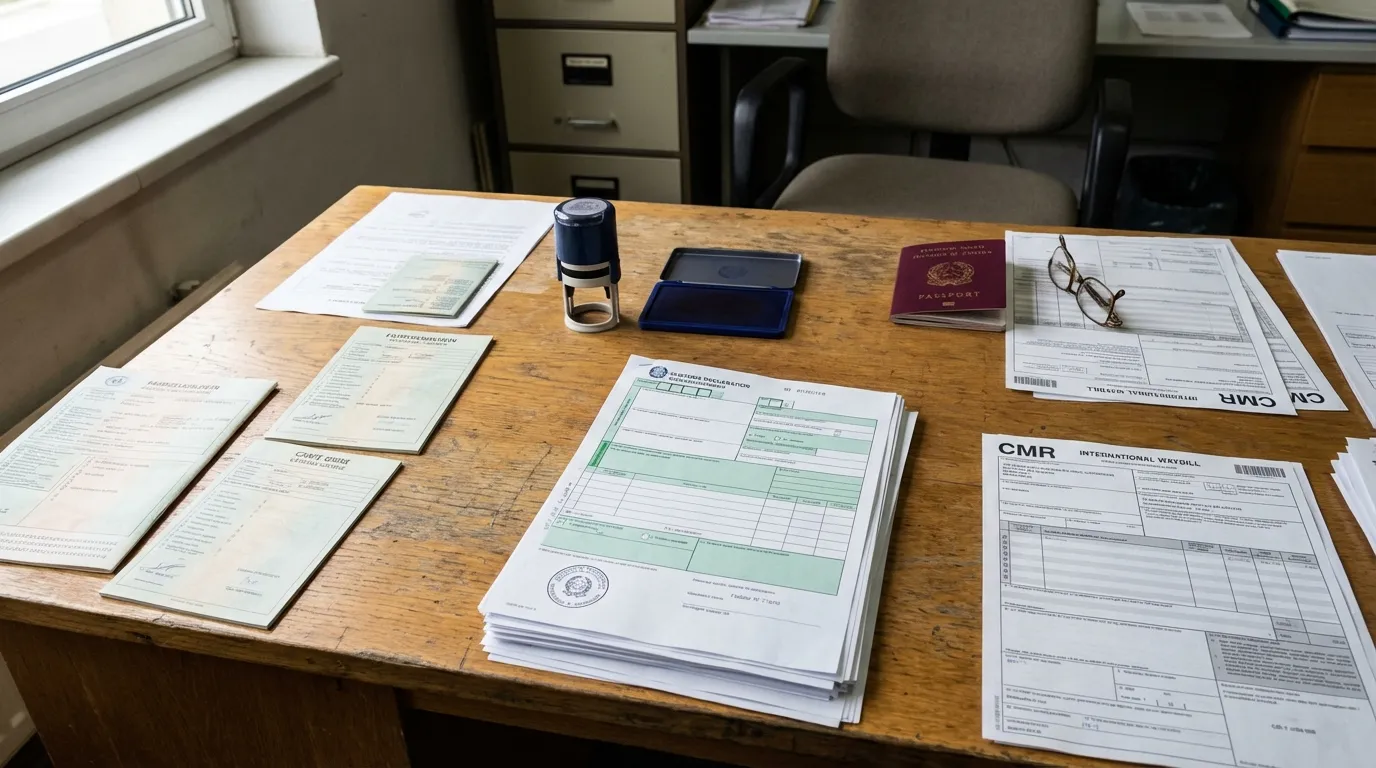
Autorola reports approximately 20 pages of paperwork per export transaction, with roughly 50% of its platform sales crossing national borders. A single missing document can delay customs clearance by days or weeks — adding storage costs that erode margins on vehicles already in transit. The Cross-Border Vehicle Buying Guide covers the full acquisition workflow; this checklist focuses specifically on the documentation required to complete it.
This checklist covers 26 items across six categories: purchase, vehicle identity, export, import, financial, and transport documents. Each checkbox saves to your browser, so you can track progress across multiple sessions. The page is print-friendly for use at the shipping desk or customs office. In 2024, EU member states exported 5.4 million passenger cars worth EUR 165.2 billion (Eurostat) — documentation accuracy at that scale is a competitive requirement, not an administrative formality.
 Twenty-six documents across six categories cover the full paperwork requirements for cross-border B2B vehicle transactions.
Purchase Documents
Purchase documents establish the legal transfer of ownership and the financial terms of the transaction. Every customs authority requires proof that a legitimate sale occurred at a declared value, and the hammer price on the auction invoice serves as the baseline for duty and VAT calculations.
Purchase Documents
0 of 4 completedVehicle Identity Documents
Vehicle identity documents prove what the vehicle is, where it came from, and whether any legal encumbrances exist. Customs authorities cross-reference these documents against the physical vehicle at the border. A condition report supports valuation but is not a legal identity document — the title and registration serve that function.
Vehicle Identity Documents
0 of 5 completedExport Documents
Export documents authorise the vehicle to leave the origin country and enter the international logistics chain. Germany is the dominant source of used car imports in 12 of 16 European countries studied, accounting for 26.6% of cross-border used vehicle flows. The export process differs significantly depending on whether the vehicle moves within the EU single market or crosses a customs border.
Export Documents
0 of 4 completedImport Documents
Import documents authorise the vehicle to enter and be registered in the destination country. The EU applies a 10% customs duty on vehicles imported from non-EU countries, while the US charges 2.5% on passenger vehicles. Preferential trade agreements (TCA for UK-EU, USMCA for US-CA) can reduce or eliminate these duties — but only with the correct origin documentation.
Import Documents
0 of 4 completedFinancial Documents
Financial documents track the money side of the transaction: invoicing, VAT treatment, duty payments, insurance, and currency conversion. For B2B transactions within the EU, VAT treatment follows the reverse charge mechanism — but only if both parties hold valid VAT identification numbers. The EU VAT Rules for Vehicle Purchases guide covers the full compliance framework.
Financial Documents
0 of 5 completedTransport Documents
Transport documents prove the vehicle physically moved from the origin country to the destination. Customs authorities use these to verify that the goods described in the commercial invoice actually crossed the border — a requirement for VAT reverse charge eligibility and duty exemption claims.
Transport Documents
0 of 4 completedCountry-Specific Corridor Requirements
Documentation requirements vary significantly by trade corridor. The three most common B2B vehicle corridors — UK to EU, intra-EU (Germany to Poland), and US to Canada — each operate under different regulatory frameworks. Poland imported more than 800,000 used cars in 2023, the majority sourced from Germany through the intra-EU free movement framework.
| Requirement | UK → EU | DE → PL (Intra-EU) | US → CA |
|---|---|---|---|
| Customs declaration | Required (export + import) | Not required | Required (export + import) |
| Duty | 0% with TCA origin proof; 10% without | 0% (EU free movement) | 0% under USMCA if eligible; 6.1% otherwise |
| VAT treatment | Import VAT at destination rate | Reverse charge (0% invoice + buyer self-assessment) | GST/HST on customs value at import |
| Type approval | IVA (UK) or EU national approval | CoC or mutual recognition | RIV + CMVSS inspection (CAD 325) |
| Key extra document | EORI number + origin declaration | VIES-validated VAT-IDs + sworn translation | EPA compliance letter + DOT HS-7 form |
Printable Document Checklist
Print this condensed reference and keep it with your transaction files. It covers all six document categories in a single-page format.
Frequently Asked Questions
How many documents do I need for an intra-EU vehicle purchase?
Intra-EU B2B transactions require fewer documents than cross-border customs corridors. The core set includes a commercial invoice with both VAT-IDs, a purchase contract, proof of payment, the vehicle title, registration certificate, Certificate of Conformity, CMR consignment note, and a VAT self-assessment declaration. Export declarations, customs duties, and EORI numbers do not apply within the EU single market. Expect eight to 12 documents depending on the destination country’s registration requirements.
What happens if I am missing a document at the border?
Customs authorities hold the vehicle until the missing document is provided. Storage fees at border facilities typically range from EUR 20–50 per day, and delays of five to 15 business days are common for missing origin declarations or incorrect VAT documentation. Some customs offices allow provisional release with a financial guarantee, but the guarantee amount can equal the full duty and VAT liability on the vehicle. Assembling the complete document set before the vehicle ships eliminates this risk.
Do auction platforms handle cross-border documentation?
Several platforms offer documentation services for an additional fee. OPENLANE charges EUR 110 per vehicle for export documentation management across European corridors. Autorola provides integrated logistics and documentation support for its cross-border transactions. Platform-managed documentation reduces the administrative burden but does not eliminate the buyer’s responsibility to verify accuracy — errors in platform-prepared documents still create customs delays attributed to the importer.
Do I need different documents for electric vehicles?
Electric vehicles require the same core documentation as combustion vehicles, plus additional items in some corridors. The US-CA corridor requires an EPA compliance letter confirming the EV meets emissions equipment standards (even though EVs have no tailpipe emissions, the onboard diagnostics system must comply). EU imports may require a battery declaration of conformity under the EU Battery Regulation for vehicles manufactured after February 2024. Check destination country requirements for EV-specific homologation rules, as type approval processes for EVs vary more widely than for combustion vehicles.
Next Steps
This checklist provides the documentation framework for cross-border B2B vehicle transactions. Use it for every international purchase — whether you are moving a single unit from the UK to Germany or running volume imports across the US-CA corridor. Consistent documentation prevents the customs delays and storage costs that erode transaction margins.
For deeper guidance on cross-border acquisition strategy, explore these related resources:
- Cross-Border Vehicle Buying Guide — full workflow for sourcing vehicles internationally
- EU VAT Rules for Vehicle Purchases — reverse charge mechanics, VIES validation, and invoice requirements
- Vehicle Import Costs Breakdown — duty rates, VAT calculations, and landed cost components by corridor
- Landed Cost Calculator — estimate total acquisition cost including duties, VAT, transport, and fees
- Auction Readiness Checklist — 29-item preparation checklist for vehicles entering the wholesale channel
- Condition Report Verification Checklist — 35-item verification checklist for buyers evaluating vehicles before bidding