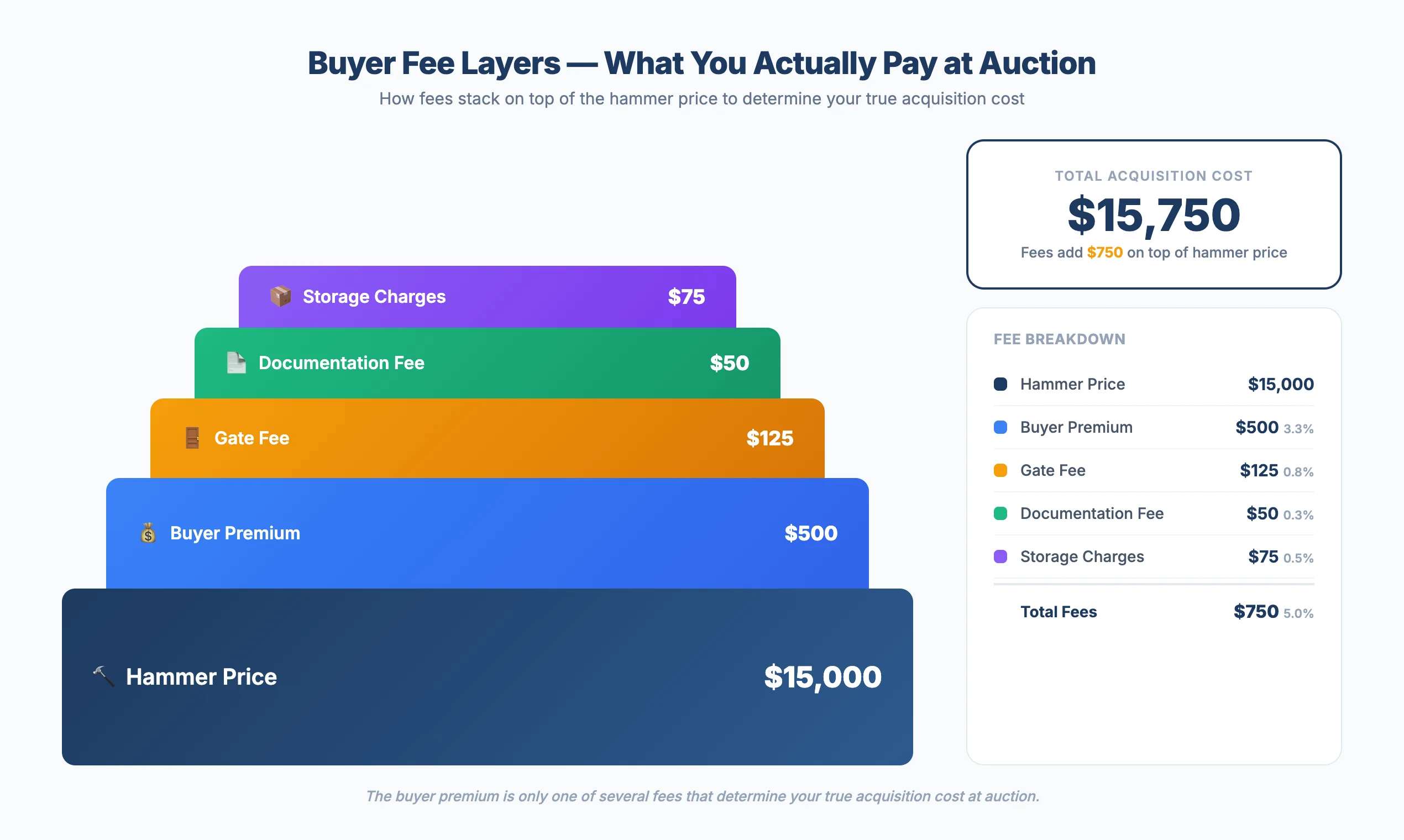
 The buyer premium is only one of several fees that determine your true acquisition cost at auction.
Beyond the Buyer Premium
Most dealers assume the buyer fee — commonly called the buyer premium — is the only cost added to the hammer price. It is not. Gate fees, documentation charges, environmental levies, credit card surcharges, and storage penalties stack on top of the premium at every major platform. On a $20,000 vehicle, the gap between buyer premium alone and total buyer-side cost can exceed $500.
This guide breaks down every fee category that buyers encounter across nine B2B auction platforms in the US and Europe. It complements the parent auction fees guide, which covers both buyer and seller costs at a higher level. Here, the focus is exclusively on what buyers pay — and how to pay less.
The Four Buyer Premium Models
Not all buyer premiums work the same way. Platforms use four distinct fee models, each with different implications for your per-vehicle cost depending on the price range you buy in.
| Fee Model | How It Works | Example Platforms | Best For |
|---|---|---|---|
| Tiered flat-fee | Fixed dollar/euro amount per price bracket | Copart (US), CarOnSale (EU) | Predictable budgeting; favors high-value purchases |
| Percentage-based | % of hammer price, no cap | BCA UK (standard tier above GBP 5,000), BCA Germany (2.62% net) | Platforms with wide price ranges; penalizes premium vehicles |
| Percentage-with-cap | % of hammer price, capped at a max amount | ACV Auctions (~$350 cap) | Balanced; limits upside cost on high-value vehicles |
| Hybrid/layered | Base auction fee + country-specific or service-specific surcharges | OPENLANE Europe (auction fee + country fee) | Cross-border platforms with variable logistics |
The model a platform uses determines how costs scale with vehicle value. A tiered flat-fee model charges the same amount whether you buy a $15,000 sedan or a $25,000 SUV within the same bracket. A percentage-based model charges proportionally more as vehicle value increases — 14% on a GBP 20,000 vehicle at BCA standard tier is GBP 2,800, compared to $350 at ACV Auctions for a vehicle at the same price point.
Hybrid models add complexity. OPENLANE Europe layers a base auction fee with country-specific surcharges that vary depending on where the vehicle is located and where it ships. Buyers sourcing across multiple countries face different total costs on identical vehicles depending on origin and destination.
Platform-by-Platform Buyer Fee Comparison
The table below compares buyer-side fees across nine major B2B auction platforms. Transparency varies significantly — some platforms publish complete fee schedules while others disclose rates only during onboarding.
| Platform | Region | Buyer Premium | Gate/Access Fee | Other Buyer Fees | Transparency |
|---|---|---|---|---|---|
| Copart | US | Tiered flat $25–$900+ (varies by license status) | $79–$95 gate fee | $10 environmental fee | Published schedule |
| IAA | US | 10% of hammer (min $150, cap $500) | $65 gate fee | $18.50 environmental; $75 documentation | Published |
| Manheim US | US | ~$500 est. (tiered, not public) | N/A | $50 simulcast fee | Not publicly disclosed |
| ADESA/OPENLANE US | US | Tiered (not public) | N/A | Claims 'most competitive' | Not publicly disclosed |
| ACV Auctions | US | 2–10% variable, ~$350 cap | N/A | ~$360 total per vehicle | Published (pricing page) |
| BCA UK | UK | Up to 14% standard; Gold/Platinum <50% | N/A | GBP 61 Assured + GBP 22 V5 | Published by tier |
| BCA Germany | DE | 2.62% net (min EUR 350) | N/A | Varies | Partially published |
| CarOnSale | EU | 45 flat brackets EUR 99–959 | N/A | N/A | Fully published schedule |
| OPENLANE Europe | EU | Auction fee + country fee | N/A | EUR 85 pickup; EUR 110 export docs | Partially published |
Fee transparency divides the market into two camps. CarOnSale and ACV Auctions publish complete fee schedules on their websites — buyers can calculate exact costs before registration. Manheim and ADESA/OPENLANE US do not publicly disclose buyer premium schedules, requiring buyers to request quotes or discover fees during onboarding.
This opacity matters. Platforms with undisclosed fees often have negotiable rates, meaning high-volume buyers may secure favorable terms. However, smaller dealers lack the leverage to negotiate and may pay rates that exceed those at transparent platforms. When evaluating platforms for the first time, compare total per-vehicle cost — not just the buyer premium — using the Auction Fee Comparator.
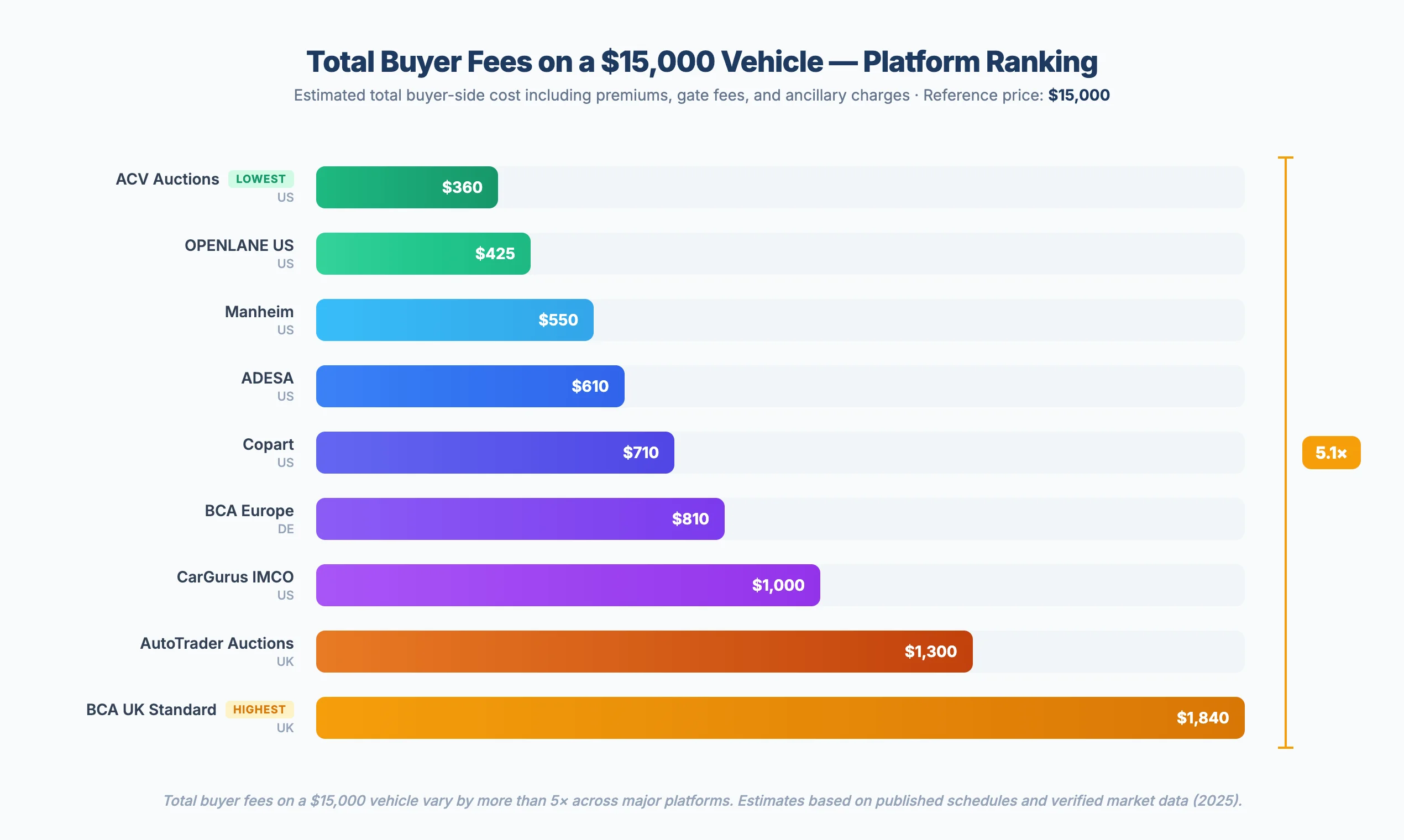 Total buyer fees on a $15,000 vehicle vary by more than 5x across major platforms.
Ancillary Buyer Fees That Compound
The buyer premium captures attention, but ancillary fees accumulate across every transaction. Some are unavoidable. Others are entirely within your control.
| Fee Category | Typical Range | Avoidable? |
|---|---|---|
| Credit card surcharge | 2–5% of total invoice | Yes — switch to wire/ACH |
| Gate/release fee | $25–$100 | No |
| Documentation/title fee | $20–$75 | No |
| Environmental fee | $10–$50 | No |
| Virtual bidding fee (simulcast) | $0–$149 per session | Platform-dependent |
| Late payment penalty | $50–$150+ per invoice | Yes — pay on time |
The two avoidable categories — credit card surcharges and late payment penalties — represent the largest savings opportunity. A dealer processing 100 vehicles per month at an average hammer price of $14,000 pays $28,000–$70,000 annually in credit card surcharges alone (2–5% of total invoices). Switching to wire transfer or ACH eliminates this cost entirely.
Unavoidable fees like gate charges and documentation fees are smaller per transaction but add up at volume. At Copart, a $79–$95 gate fee plus $10 environmental fee adds $89–$105 to every purchase — $10,680–$12,600 annually on 120 vehicles. At IAA, the equivalent combination ($65 gate + $18.50 environmental + $75 documentation) totals $158.50 per vehicle.
Storage and Demurrage
Every platform imposes storage fees after a grace period. Grace periods range from two to seven days depending on the platform, and daily rates escalate the longer a vehicle sits. Delays in arranging transport turn a profitable acquisition into a loss.
| Platform | Free Grace Period | Daily Storage Rate | Notes |
|---|---|---|---|
| Copart | 3 days | Varies by lot | Relist fee 10% (min $600) if not picked up |
| IAA | 3 business days | $10/day | Charged after grace period |
| Manheim US | 2–3 business days | $15–$40/day | Varies by location |
| ADESA/OPENLANE US | 2–7 calendar days | Up to $45/day | 7-day limit on some lots |
| BCA UK | Varies by sale type | GBP 10–20+VAT/day | 3 free days typical |
| Manheim UK | 3 free days | GBP 10+VAT/day | Storage escalates after extended periods |
Storage costs compound rapidly. A vehicle sitting 10 days past the grace period at Manheim US ($40/day) accumulates $400 in storage fees — nearly matching the buyer premium itself. At ADESA, the $45/day maximum rate produces $315 in charges after just seven days past grace. Copart applies a 10% relist fee (minimum $600) on vehicles not collected, which can exceed the original buyer premium on lower-value salvage vehicles.
How Volume Tier and Account Status Reduce Buyer Fees
Most platforms offer tiered buyer fee structures that reward higher purchase volumes with lower per-vehicle costs. BCA UK operates five buyer account tiers where the highest tier (Premier+, 400+ purchases per year) pays less than half of the standard buyer premium. Achieving the right tier requires deliberate planning.
The process starts with understanding your current position. Many dealers spread volume across four or five platforms without realizing that consolidating onto two would push them into a higher tier on each — reducing per-vehicle costs by 20–50%. For guidance on selecting the right platforms for consolidation, see the Platform Selection Guide.
Audit your current volume
Pull 12 months of transaction data across every platform. Calculate total vehicles purchased, total buyer fees paid, and average per-vehicle cost on each platform.
Identify tier thresholds
Request the tier structure from each platform's account manager. Map your current annual volume against each threshold to find where you sit and how close you are to the next tier.
Consolidate volume onto fewer platforms
Redirect purchases from low-volume platforms toward one or two primary platforms where you are closest to the next tier threshold. Even shifting 20–30 vehicles per year can trigger a tier upgrade.
Request a tier review
Contact your account manager with updated volume data. Platforms conduct periodic tier reviews, but requesting one proactively — with documentation — accelerates the process.
Negotiate a committed-volume agreement
Offer a 12-month volume commitment in exchange for the next tier's rates immediately. Use the Break-Even / Max Bid Calculator to quantify how lower fees translate to higher bid capacity.
Conclusion
Three actions produce the highest return on effort when managing buyer fees. First, know the fee model each platform uses — tiered flat-fee, percentage-based, percentage-with-cap, or hybrid — and select platforms where the model favors your vehicle price range. Second, eliminate avoidable fees by switching from credit card to wire/ACH payments and arranging transport before bidding. Third, consolidate volume to optimize your account tier and negotiate committed-volume agreements.
Use the Auction Fee Comparator to model per-vehicle costs across platforms, the Break-Even / Max Bid Calculator to set maximum bids that preserve margin after all fees, and the Landed Cost Calculator to calculate total acquisition cost including transport and reconditioning. For the full picture of both buyer and seller fees, return to the Understanding Auction Fees parent guide.
Frequently Asked Questions
What is a buyer premium at a vehicle auction?
A buyer premium is a fee charged by the auction platform to the winning bidder on top of the hammer price. It is the platform’s primary revenue from the buy side. The premium may be a flat dollar amount (tiered by price bracket), a percentage of the hammer price, or a percentage with a cap. At US platforms, buyer premiums typically range from $100 to $900 per vehicle. European platforms commonly charge 1–14% of the hammer price depending on account tier.
Which auction platform has the lowest buyer fees?
Total buyer fees vary by vehicle value, volume tier, and ancillary charges. Among US platforms, ACV Auctions charges approximately $360 total per vehicle with a transparent published schedule. Among European platforms, CarOnSale publishes flat-bracket fees starting at EUR 99. However, high-volume buyers on platforms with negotiated rates (Manheim, BCA Premier+) may achieve lower effective costs through tier discounts.
Can I negotiate buyer fees at auction?
Yes. Platforms negotiate buyer fees for accounts with consistent volume. Thresholds for meaningful negotiation typically start at 50–100 vehicles per month. Consolidating purchases onto fewer platforms, committing to annual volume agreements, and presenting competing fee schedules from rival platforms all strengthen negotiating position. BCA’s tier system explicitly reduces fees based on annual purchase count.
How do I avoid hidden fees when buying at auction?
Request the complete fee schedule in writing before your first purchase. Switch payment from credit card to wire or ACH to eliminate 2–5% surcharges. Pre-arrange transport before bidding to avoid storage fees. Review every invoice line item monthly to catch incorrect tier assignments and erroneous charges.
Do buyer fees differ between the US and Europe?
Significantly. US platforms predominantly use tiered flat-fee buyer premiums ($25–$900 depending on hammer price), keeping costs predictable. European platforms favor percentage-based models — BCA UK charges up to 14% for standard-tier buyers, while BCA Germany charges 2.62% with a EUR 350 minimum. European transactions also involve VAT (19–25% depending on country), and cross-border purchases add export documentation fees (EUR 85–110 at OPENLANE Europe) and currency conversion costs (1.5–3%).