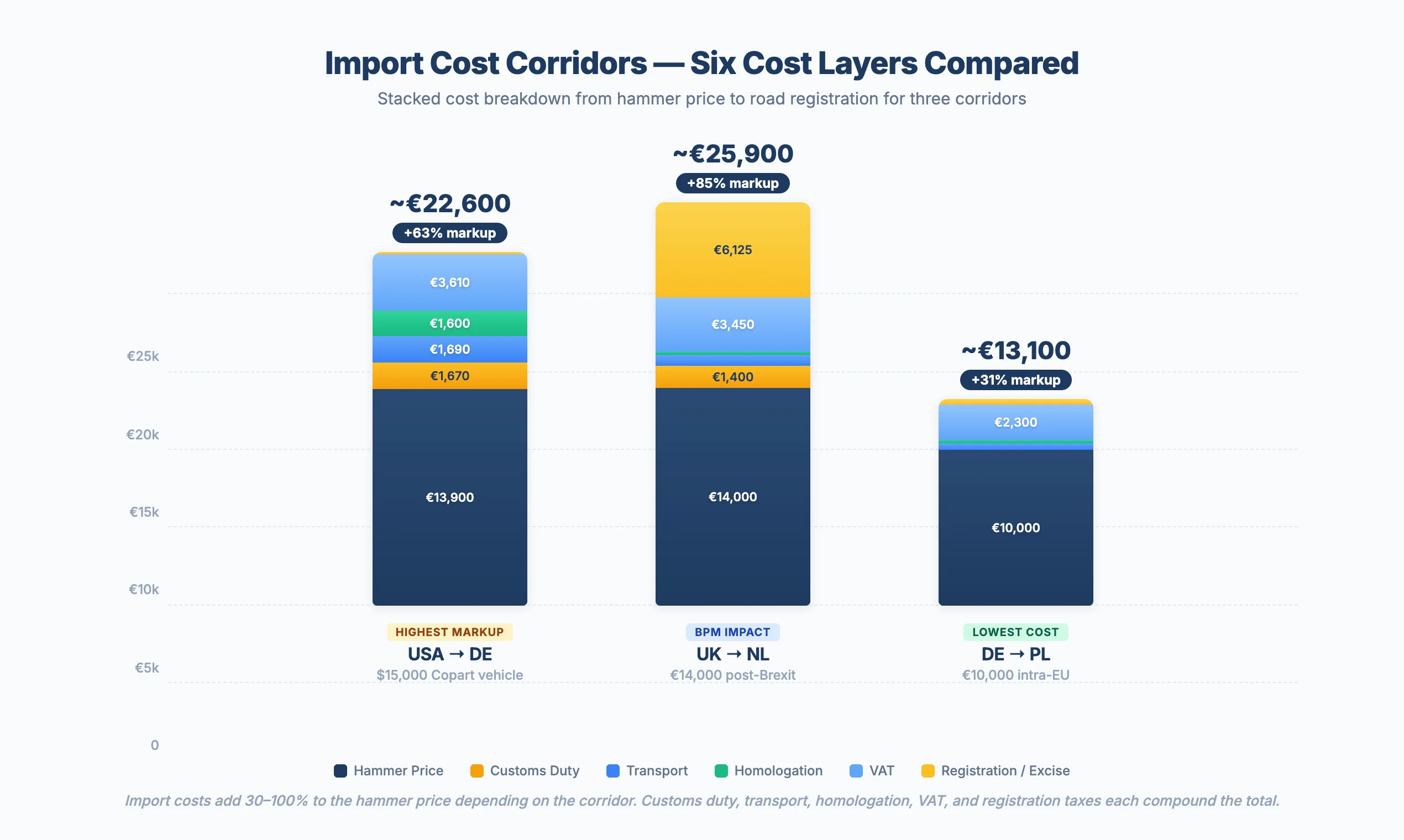
 Import costs add 30–100% to the hammer price depending on the corridor. Customs duty, transport, homologation, VAT, and registration taxes each compound the total.
Why Import Costs Catch Dealers Off Guard
A $15,000 vehicle won on Copart can cost $23,390–$27,860 landed in Germany — 56–86% above hammer price. Dealers who calculate only hammer price plus shipping routinely underestimate their true acquisition cost by 30–80%, turning an apparent arbitrage opportunity into a margin loss.
This guide breaks down the six cost layers between winning bid and road registration, with real numbers for three corridors: USA to Germany, UK to Netherlands, and Germany to Poland. Each corridor illustrates how duty rates, transport methods, homologation requirements, and destination-country taxes compound to determine true landed cost. For the broader regulatory and documentation framework, see the parent Cross-Border Vehicle Buying Guide.
Six Cost Layers Between Hammer Price and Road Registration
Every cross-border vehicle purchase passes through six distinct cost layers before the vehicle reaches road registration. Missing any one layer in your pre-bid calculation distorts the landed cost and erodes margin.
- Hammer price + buyer fee — the auction winning bid plus platform fees (tiered or percentage-based)
- Customs duty — 0% for intra-EU, 10% for EU external tariff, up to 25% for US imports under Section 232
- Transport — truck, RoRo, or container depending on distance and vehicle condition (EUR 300–6,000)
- Homologation and compliance — inspections and modifications to meet destination-country technical standards
- VAT / sales tax — destination-country rate (17–27% in the EU), recoverable for B2B dealers in most corridors
- Registration and excise taxes — non-recoverable destination taxes (BPM, akcyza, VRT, NoVA, registration tax)
Customs Duties: 0% to 25% Depending on Origin and Destination
Customs duty is calculated on the CIF value — Cost, Insurance, and Freight — which includes the purchase price, marine cargo insurance, and transport cost to the destination port. Intra-EU transactions carry zero customs duty under the single market. Third-country imports into the EU face the standard 10% external tariff, while imports into the US now incur 25% under Section 232 (with negotiated rates of 15% for EU- and Japan-origin vehicles).
| Corridor | Duty Rate | Basis | Notes |
|---|---|---|---|
| Intra-EU (e.g., DE to PL) | 0% | EU single market | No customs clearance required |
| USA to EU | 10% | CIF value | Standard EU external tariff |
| UK to EU (post-Brexit) | 0% or 10% | CIF value | 0% with TCA origin proof; 10% MFN without |
| USA to Canada | 6.1% + surtax | Transaction value | Additional 25% surtax on US-origin vehicles |
| Imports into USA | 25% | Vehicle value | Section 232 tariff (15% negotiated for EU/Japan) |
Transport: Truck, RoRo, and Container Compared
Transport cost scales with distance, method, and seasonal demand. Intra-European moves by open truck are the most cost-efficient option. Intercontinental corridors require ocean shipping — either Roll-on/Roll-off (RoRo) for drivable vehicles or container shipping for non-running, high-value, or multi-unit loads.
| Method | Cost Range | Transit Time | Best For |
|---|---|---|---|
| Open truck (intra-EU) | EUR 300–800 | 1–5 days | Standard vehicles within Europe |
| RoRo shipping | $1,000–1,800 | 3–6 weeks | Drivable vehicles, intercontinental |
| Container (20 ft) | $2,000–4,500 | 4–8 weeks | Non-running, high-value, or multiple units |
| Inland transport | $200–500 | 1–3 days | Port to final destination |
Homologation and Compliance Costs
Vehicles imported from outside the destination country’s regulatory zone require technical inspection and possible modifications to meet local standards. The scope and cost depend on the origin-destination pairing: US-to-EU conversions are the most expensive due to differences in lighting, emissions, and speedometer requirements.
Typical homologation costs by destination:
- Germany — TUV/DEKRA inspection EUR 150–300 plus modifications EUR 500–2,500 (headlight beam pattern, speedometer conversion to km/h, emissions compliance)
- UK — Individual Vehicle Approval (IVA) test GBP 199 plus modifications GBP 400–1,000 (fog lamp position, rear reflectors, speedometer)
- Poland — Technical inspection 149 PLN (~EUR 35), minimal modification requirements for EU-origin vehicles
Intra-EU vehicles generally skip homologation entirely. EU type approval means a vehicle registered in Germany meets the same technical standards required in Poland, France, or any other member state. This is a major cost advantage for intra-EU corridors over third-country imports.
Corridor 1: USA to Germany ($15,000 Copart Vehicle)
This corridor illustrates the full cost stack for an intercontinental import. A $15,000 vehicle won on Copart passes through all six cost layers before reaching German road registration.
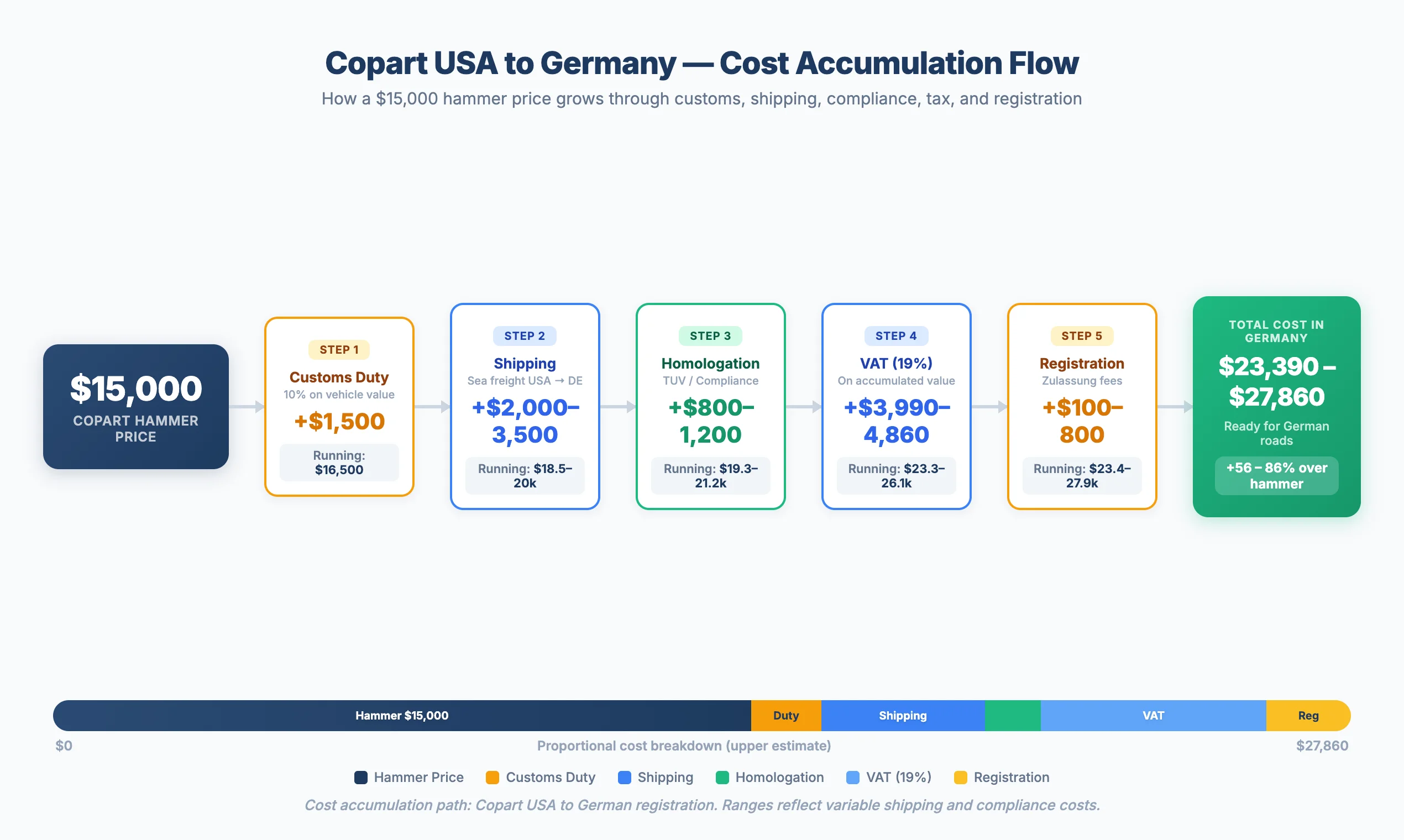 Cost accumulation path: Copart USA to German registration.
| Cost Layer | Low Estimate | High Estimate | Notes |
|---|---|---|---|
| Hammer price | $15,000 | $15,000 | Copart winning bid |
| Buyer fee + gate/environmental | $840 | $1,100 | Copart tiered fees |
| US inland transport to port | $300 | $500 | Lot to East Coast port |
| Ocean shipping (RoRo) | $1,000 | $1,800 | East Coast to Bremerhaven |
| Marine cargo insurance | $45 | $75 | 0.3–0.5% of value |
| EU customs duty (10% of CIF) | $1,700 | $1,900 | On CIF value |
| German VAT (19%) | $3,600 | $4,200 | Recoverable for B2B dealers |
| TUV + modifications | $650 | $2,800 | US-to-EU compliance |
| Customs broker | $200 | $400 | Import clearance |
| Registration + plates | $55 | $85 | Zulassung |
| Total landed | $23,390 | $27,860 | 56–86% above hammer |
Corridor 2: UK to Netherlands (GBP 12,000 Post-Brexit)
The UK-to-Netherlands corridor demonstrates the impact of post-Brexit customs duties combined with the Dutch BPM registration tax — one of the highest non-recoverable vehicle taxes in Europe.
| Cost Layer | Low Estimate | High Estimate | Notes |
|---|---|---|---|
| Hammer price | EUR 14,000 | EUR 14,000 | ~GBP 12,000 at current rates |
| Buyer fee | EUR 350 | EUR 500 | UK auction platform fee |
| Transport (UK to NL, incl. Channel) | EUR 500 | EUR 900 | Ferry + truck |
| EU customs duty (10%) | EUR 1,400 | EUR 1,400 | Post-Brexit MFN rate |
| Dutch VAT (21%) | EUR 3,400 | EUR 3,500 | Recoverable for B2B |
| Dutch BPM (CO2-based) | EUR 4,000 | EUR 8,500 | Non-recoverable registration tax |
| Customs broker | EUR 150 | EUR 300 | Import clearance |
| RDW registration | EUR 40 | EUR 50 | Administrative fee |
| Total landed | EUR 23,840 | EUR 29,150 | 70–108% above hammer |
BPM (Belasting van Personenauto’s en Motorrijwielen) is a CO2-based registration tax applied to every vehicle entering the Dutch market. It scales with emissions: a low-emission petrol vehicle might incur EUR 4,000, while a diesel or higher-emission vehicle can exceed EUR 8,500.
BPM is non-recoverable regardless of B2B or B2C status — it applies equally to dealers and private buyers. This single tax makes the Netherlands one of the most expensive EU destinations for cross-border vehicle imports.
Corridor 3: Germany to Poland (EUR 10,000 Intra-EU)
The intra-EU corridor eliminates two cost layers entirely — customs duty and homologation — making it the most cost-efficient option in this comparison.
| Cost Layer | Low Estimate | High Estimate | Notes |
|---|---|---|---|
| Hammer price | EUR 10,000 | EUR 10,000 | German auction platform |
| Buyer fee | EUR 200 | EUR 350 | Platform-dependent (2–3.5%) |
| Truck transport | EUR 300 | EUR 500 | 500–800 km |
| Customs duty | EUR 0 | EUR 0 | Intra-EU, no customs |
| Polish VAT (23%) | EUR 2,300 | EUR 2,300 | Recoverable for B2B via reverse charge |
| Akcyza excise duty | EUR 155 | EUR 1,860 | 1.55% under 2,000 cc / 18.6% over 2,000 cc |
| Technical inspection | EUR 35 | EUR 35 | 149 PLN |
| Registration | EUR 42 | EUR 58 | 180–250 PLN |
| Total landed | EUR 13,032 | EUR 15,103 | 30–51% above hammer |
How to Estimate Your Landed Cost Before Bidding
Calculate your total landed cost before placing any cross-border bid. Working backward from your target retail price ensures the numbers support a profitable transaction.
Determine the corridor
Identify the origin and destination countries. Check whether customs duty applies (0% intra-EU, 10% EU external tariff, 25% US Section 232) and confirm the applicable rate for the vehicle's manufacturing origin.
Get transport quotes
Request quotes for truck, RoRo, or container depending on distance and vehicle condition. Get at least two quotes — pricing varies by provider, season, and route direction.
Check homologation requirements
Determine whether the vehicle needs inspection or modifications in the destination country. Intra-EU vehicles with EU type approval typically skip this step. Third-country imports require TUV, IVA, or equivalent inspection plus potential modifications.
Calculate duty and tax
Apply customs duty to the CIF value (purchase price + transport + insurance). Calculate VAT on the duty-inclusive value. Check for destination-country registration and excise taxes (BPM, akcyza, VRT, NoVA) — these are non-recoverable.
Set your maximum bid
Subtract all landed costs from your target retail price minus your required margin. The result is your maximum bid. Use the [Landed Cost Calculator](/tools/landed-cost-calculator/) and [Break-Even Max Bid Calculator](/tools/break-even-max-bid-calculator/) to model scenarios before the auction.
Pre-Bid Import Cost Checklist
0 of 8 completedFrequently Asked Questions
What percentage above the hammer price should I budget for import costs?
Budget 30–40% for intra-EU corridors (7–18% excluding recoverable VAT), 50–90% for intercontinental corridors (USA to EU, UK to EU), and 100%+ for corridors terminating in countries with high registration taxes such as the Netherlands (BPM) or Denmark (registration tax up to 150% of vehicle value). Always model the specific corridor rather than applying a generic percentage.
Is VAT recoverable on cross-border vehicle imports?
For VAT-registered B2B dealers, VAT is recoverable through the reverse charge mechanism (intra-EU) or as import VAT on the VAT return (third-country imports). Margin-scheme purchases are the exception — embedded VAT is not recoverable. See the EU VAT Rules for Vehicle Purchases for reverse charge procedures, margin scheme rules, and country-specific rates.
What is the cheapest corridor for cross-border vehicle sourcing?
Intra-EU corridors offer the lowest total cost: zero customs duty, EU type approval eliminates homologation, and shorter distances reduce transport fees. Germany-to-Poland adds 7–18% above hammer price for a B2B dealer (excluding recoverable VAT). The akcyza excise duty rate depends on engine displacement — vehicles under 2,000 cc incur 1.55%, while those over 2,000 cc face 18.6%.
Do I need customs clearance for vehicles bought within the EU?
No. The EU single market means zero customs duty, no customs declaration, and no border inspection for vehicle trade between member states. Post-Brexit, the UK is a third country — UK-to-EU imports now require full customs clearance and incur the 10% MFN duty rate unless the vehicle qualifies for 0% under TCA rules of origin.
What is BPM and why does it make Netherlands imports expensive?
BPM (Belasting van Personenauto’s en Motorrijwielen) is the Dutch CO2-based registration tax applied to every vehicle entering the Netherlands. It can add EUR 4,000–8,500+ depending on the vehicle’s emissions profile, with higher-emission diesels at the upper end. BPM is non-recoverable regardless of B2B status and is the single largest cost variable in any corridor terminating in the Netherlands.