Why Proactive Payment Delay Communication Matters
Late auction payments trigger automated penalties at every major platform. Manheim suspends buying privileges after day four. Copart relists vehicles at a 10% penalty (minimum $600) after eight days. BCA charges statutory interest on overdue balances. These consequences are automatic — no account manager intervenes once the system flags a missed deadline.
No platform guarantees deadline extensions for a payment delay notice sent proactively. However, contacting the payment department before the deadline passes creates a written record, demonstrates good faith, and preserves the business relationship. Dealers who communicate delays with specific resolution dates are more likely to avoid account suspension than those who go silent and let the automated process run.
Before You Send
The notice is more effective when it includes a specific resolution date and proof that payment has been initiated. A vague promise to “pay soon” carries no weight with a platform accounting department. Before composing the email, confirm you have the documentation to back up your proposed timeline and can provide a traceable reference number for any in-progress transfer.
Pre-Notice Readiness Check
0 of 6 completedPayment Delay Notice Email Template
This template is structured around three elements that platform accounting departments need to process a delay notification: identification (account number and affected vehicles), explanation (specific cause with traceable reference numbers), and commitment (proposed payment date and method). The subject line includes the account number so it routes correctly in the platform’s email system.
Three design choices in this template warrant explanation. First, the subject line includes the account number so every reply in the thread is traceable to your account — platform payment departments process hundreds of emails daily, and a subject without an account number risks delays in routing. Second, the delay explanation section offers multiple cause options with specific reference fields, so you select the relevant one and delete the rest. Third, the closing commits to a specific payment date and method, which gives the accounting team a concrete expectation rather than an open-ended promise.
When Payment Delays Happen
Most payment delays fall into predictable categories, each with different typical durations and documentation requirements. Identifying the cause accurately and providing the correct reference numbers determines how quickly the platform can acknowledge your notice and whether an informal extension is possible.
| Delay Cause | Typical Duration | What to Include in Notice |
|---|---|---|
| ACH processing delay | 1–3 business days | ACH trace number, initiation date, expected clearance date |
| Domestic wire transfer | Same day if before bank cutoff | Wire reference number, sending bank, confirmation receipt |
| International wire (SWIFT) | 1–5 business days | SWIFT reference, intermediary banks, expected arrival date |
| Bank fraud / security hold | 1–31 days | Bank reference number, hold reason, expected release date |
| Corporate approval cycle | 1–5 business days | Approval stage, expected sign-off date, authorizing contact |
| Currency conversion | T+2 settlement for most pairs | FX confirmation, settlement date, converted amount |
International wire delays are particularly common for cross-border purchases where SWIFT transfers route through intermediary banks. For European platforms, using the platform’s local bank account can eliminate international transfer delays entirely. See the Cross-Border Buying Guide for more on international payment logistics and currency conversion timelines.
Platform Payment Terms Overview
| Platform | Payment Deadline | Late Fee | Escalation |
|---|---|---|---|
| Manheim | 3 business days | 3% (min $40, max $400) | Buying suspended after day 4 |
| ADESA | Same-day (in-lane) / 2 days (online) | Up to $10/day + 1.5%/month | Account suspension |
| ACV Auctions | 2 business days | Up to total buy fee + 1.5%/month | Automatic ACH debit |
| Copart | 3 business days (incl. sale day) | $50 flat fee | Relist at 10% (min $600) after 8 days |
| IAAI | 3 business days | Not publicly disclosed | Account suspension or revocation |
| BCA | Cleared funds before release | GBP 25 extension fee | Statutory interest; vehicle withheld |
| OPENLANE Europe | 2 business days from invitation | EUR 50 admin fee | Services and deliveries withheld |
| Copart UK | 3 business days (incl. sale day) | GBP 50 flat fee | Relist after 6 days |
Most platforms count the sale day as Day 1 of the payment window and require receipt of cleared funds, not proof of initiation. ADESA is the strictest for in-lane purchases, requiring same-day payment. ACV Auctions auto-debits the buyer’s account via ACH, which means a failed debit due to insufficient funds triggers additional buyer fees. BCA and OPENLANE Europe withhold vehicle release until cleared funds are received, adding storage costs to the delay.
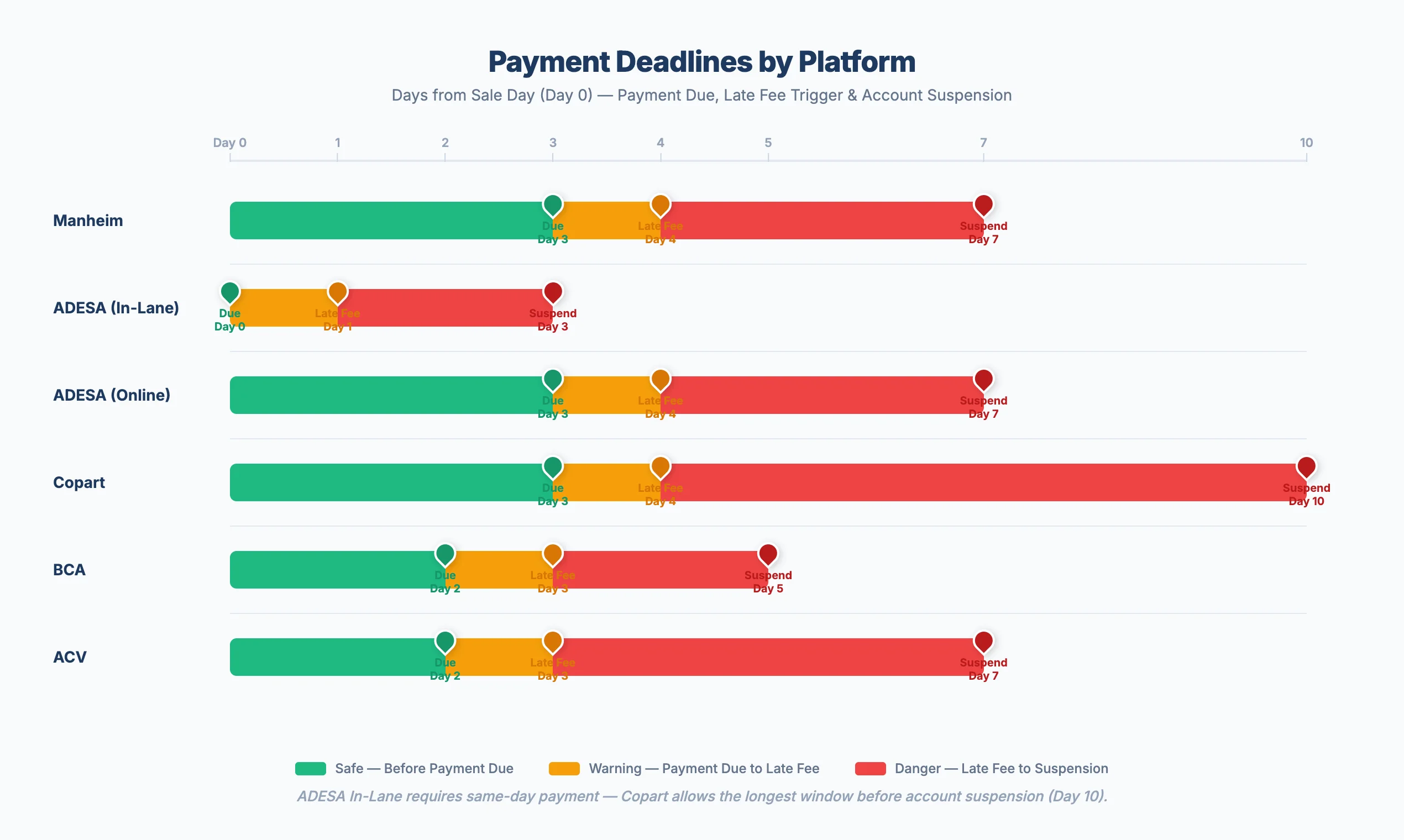 Payment windows vary from same-day (ADESA in-lane) to 3 business days (Manheim, Copart) — and most count sale day as Day 1.
Professional Communication Tips
| Element | Effective Language | Ineffective Language |
|---|---|---|
| Delay explanation | ACH initiated Jan 15, trace #4829371, expected clearance Jan 17 | Payment is on its way |
| Commitment | Full payment of $12,400 via wire by Jan 18 COB | I'll pay as soon as I can |
| Tone | Requesting confirmation of receipt and any required action on my end | Please don't suspend my account |
| Partial payment offer | Able to remit $8,000 today via wire; remaining $4,400 by Jan 20 | Can I pay half now? |
| Documentation | Attached: ACH initiation confirmation from First National Bank | I already sent it, check with my bank |
The goal of every payment delay notice is to provide concrete timelines and traceable reference numbers. Platform accounting departments evaluate delay notifications based on specificity — a notice with an ACH trace number and expected clearance date receives attention, while a vague promise to pay “soon” triggers the standard automated penalty process.
How to Avoid Payment Delays
Set up a dedicated auction float account
Maintain a separate bank account funded specifically for auction purchases. This isolates auction cash flow from operating expenses and prevents overdraft holds from affecting payment deadlines.
Pre-notify your bank before large auction days
Call your bank's fraud department before buying at auction. Alert them to the expected transaction amount and recipient. Bank fraud holds on large ACH or wire transfers can last 1 to 31 days and are the most unpredictable delay.
Initiate payment on sale day
Start the ACH or wire transfer on the day of purchase. This builds in a buffer for processing delays and ensures cleared funds arrive within the platform's window.
Confirm payment method acceptance in advance
Verify which payment methods the platform accepts and their processing times. Some platforms auto-debit via ACH (ACV), while others require buyer-initiated wire or certified funds.
Set calendar reminders for each purchase
Create payment deadline reminders for every vehicle purchased. Include the platform name, lot number, amount due, and deadline. For fleet buyers processing multiple purchases across platforms, a shared payment calendar prevents missed deadlines.
Frequently Asked Questions
Will sending a payment delay notice prevent late fees?
No platform guarantees fee waivers for proactive notification. However, documenting the delay in writing creates a record that may support a fee reversal request after payment clears. Some platform account managers have discretion to waive fees for first-time occurrences when the buyer communicated proactively and paid within a short extension window.
Should I call the platform or send an email?
Both. Call first to speak with the accounting or payment department and get the name of the person handling your account. Then send the email referencing the phone conversation. The email creates the written record; the phone call ensures someone is aware before the automated penalty process triggers.
What if my payment is delayed by a cross-border wire transfer?
International SWIFT transfers take 1–5 business days depending on intermediary banks. Include the SWIFT reference number and intermediary bank details in your notice. For European platforms like BCA and OPENLANE Europe, consider using the platform’s local bank account to avoid international transfer delays. See the Cross-Border Buying Guide for more on international payment logistics.
Can I request a payment extension before the deadline?
You can ask, but extensions are not guaranteed. Contact the platform’s payment department before the deadline expires and provide a specific proposed payment date. The earlier you communicate, the more likely the platform will work with you informally. Once the deadline passes and the automated penalty process begins, reversing fees or suspension requires more effort.
Next Steps
Use this template before the payment deadline expires — ideally as soon as you identify the delay. Attach any available transfer confirmation documents and specify a concrete resolution date. A proactive notice with traceable reference numbers resolves faster and preserves your standing with the platform.
Related resources for auction payment and claims:
- Cross-Border Vehicle Buying Guide — payment logistics for international auction purchases including SWIFT timelines and currency considerations
- Arbitration Claim Email Template — professional email template for undisclosed defect claims
- Missing Items Claim Email Template — template for claiming missing keys, manuals, and accessories